119661
论文已发表
注册即可获取德孚的最新动态
IF 收录期刊
- 3.6 Breast Cancer (Dove Med Press)
- 4.3 Clin Epidemiol
- 2.6 Cancer Manag Res
- 3.2 Infect Drug Resist
- 4.1 Clin Interv Aging
- 6.1 Drug Des Dev Ther
- 4.1 Int J Chronic Obstr
- 8.7 Int J Nanomed
- 2.5 Int J Women's Health
- 3.2 Neuropsych Dis Treat
- 2.4 OncoTargets Ther
- 2.6 Patient Prefer Adher
- 2.6 Ther Clin Risk Manag
- 3.1 J Pain Res
- 3.5 Diabet Metab Synd Ob
- 4.5 Psychol Res Behav Ma
- 3.4 Nat Sci Sleep
- 2.4 Pharmgenomics Pers Med
- 2.6 Risk Manag Healthc Policy
- 4.6 J Inflamm Res
- 2.3 Int J Gen Med
- 3.9 J Hepatocell Carcinoma
- 3.3 J Asthma Allergy
- 2.5 Clin Cosmet Investig Dermatol
- 3.0 J Multidiscip Healthc

外泌体 Circ-ZNF652 通过 miR-29a-3p/GUCD1 轴促进肝细胞癌的细胞增殖、迁移、侵袭和糖酵解
Authors Li Y, Zang H, Zhang X, Huang G
Received 22 April 2020
Accepted for publication 30 July 2020
Published 24 August 2020 Volume 2020:12 Pages 7739—7751
DOI https://doi.org/10.2147/CMAR.S259424
Checked for plagiarism Yes
Review by Single anonymous peer review
Peer reviewer comments 2
Editor who approved publication: Dr Antonella D'Anneo
Background: Circular RNAs (circRNAs) play a crucial role in hepatocellular carcinoma (HCC) progression. However, the role of exosomal circRNAs in HCC is still largely unknown. We aimed to explore the function of exosomal circ-ZNF652 in HCC.
Methods: The morphology and size of exosomes were examined by transmission electron microscopy (TEM) and nanoparticle tracking analysis (NTA). The expression of circ-ZNF652, ZNF652 mRNA, microRNA-29a-3p (miR-29a-3p) and guanylyl cyclase domain containing 1 (GUCD1) mRNA was determined by quantitative real-time polymerase chain reaction (qRT-PCR). The protein levels of CD63, CD81, hexokinase 2 (HK2) and GUCD1 were examined via Western blot assay. The stability of circ-ZNF652 was examined by RNase R digestion assay. Cell proliferation was analyzed by 3-(4, 5-dimethyl-2-thiazolyl)-2, 5-diphenyl-2-H-tetrazolium bromide (MTT) assay. Cell migration and invasion were assessed by transwell assay. The glycolysis level was detected via specific kits. The association between miR-29a-3p and circ-ZNF652 or GUCD1 was analyzed by dual-luciferase reporter assay and RNA immunoprecipitation (RIP) assay. A murine xenograft model was constructed to explore the effect of circ-ZNF652 in vivo.
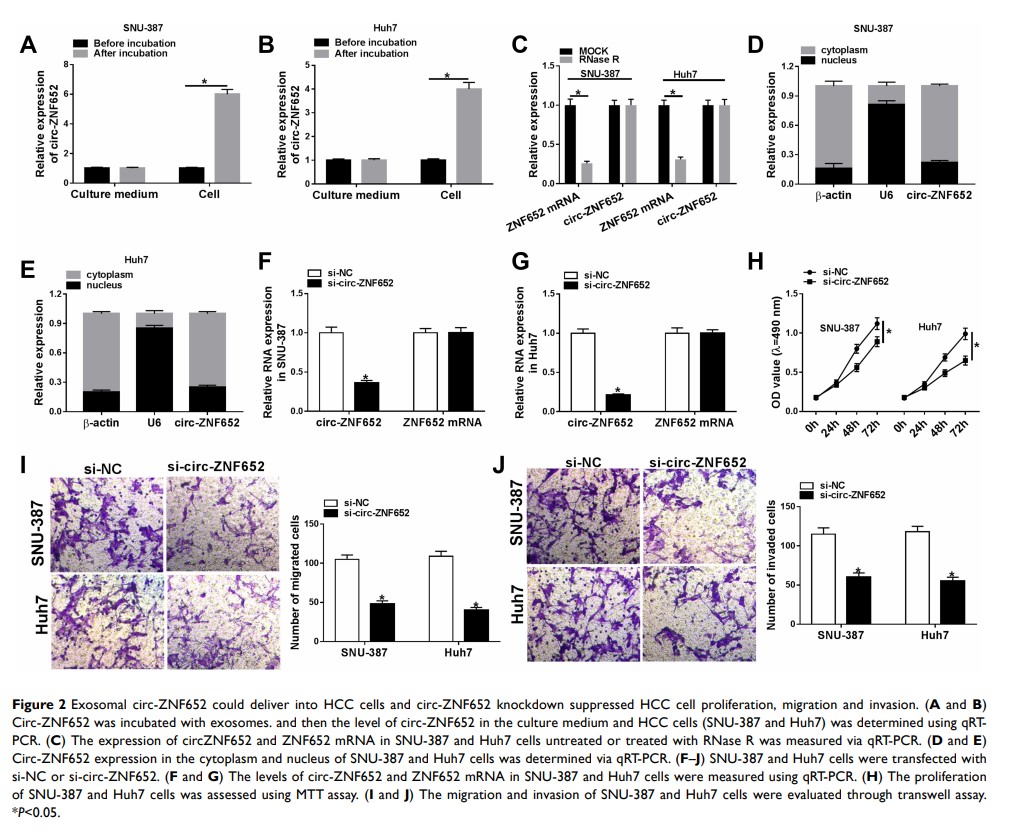
Results: Exosomal circ-ZNF652 was upregulated in HCC patients’ serums and HCC cells. Exosomal circ-ZNF652 could transfer to HCC cells, and circ-ZNF652 silencing suppressed HCC cell proliferation, migration, invasion and glycolysis. Circ-ZNF652 was a sponge of miR-29a-3p, and the inhibitory effect of circ-ZNF652 silencing on HCC cell progression was weakened by miR-29a-3p inhibitor. GUCD1 was a target gene of miR-29a-3p, and GUCD1 overexpression restored the effect of miR-29a-3p on HCC cell development. Moreover, circ-ZNF652 knockdown repressed tumor growth in vivo.
Conclusion: Exosomal circ-ZNF652 contributes to HCC cell proliferation, migration, invasion and glycolysis by miR-29a-3p/GUCD1 axis.
Keywords: HCC, exosome, circ-ZNF652, miR-29a-5p, GUCD1