119661
论文已发表
注册即可获取德孚的最新动态
IF 收录期刊
- 3.6 Breast Cancer (Dove Med Press)
- 4.3 Clin Epidemiol
- 2.6 Cancer Manag Res
- 3.2 Infect Drug Resist
- 4.1 Clin Interv Aging
- 6.1 Drug Des Dev Ther
- 4.1 Int J Chronic Obstr
- 8.7 Int J Nanomed
- 2.5 Int J Women's Health
- 3.2 Neuropsych Dis Treat
- 2.4 OncoTargets Ther
- 2.6 Patient Prefer Adher
- 2.6 Ther Clin Risk Manag
- 3.1 J Pain Res
- 3.5 Diabet Metab Synd Ob
- 4.5 Psychol Res Behav Ma
- 3.4 Nat Sci Sleep
- 2.4 Pharmgenomics Pers Med
- 2.6 Risk Manag Healthc Policy
- 4.6 J Inflamm Res
- 2.3 Int J Gen Med
- 3.9 J Hepatocell Carcinoma
- 3.3 J Asthma Allergy
- 2.5 Clin Cosmet Investig Dermatol
- 3.0 J Multidiscip Healthc

PINK1 过表达通过调节细胞自噬促进细胞迁移和增殖,并预测肺癌病例的预后不良
Authors Lu X, Liu QX, Zhang J, Zhou D, Yang GX, Li MY, Qiu Y, Chen Q, Zheng H, Dai JG
Received 14 May 2020
Accepted for publication 24 July 2020
Published 24 August 2020 Volume 2020:12 Pages 7703—7714
DOI https://doi.org/10.2147/CMAR.S262466
Checked for plagiarism Yes
Review by Single anonymous peer review
Peer reviewer comments 3
Editor who approved publication: Dr Eileen O'Reilly
Background: Lung cancer remains the leading cause of cancer-related death worldwide. The human PINK1 gene (PTEN induced kinase 1, Park6), an important gene for Parkinson’s disease, was found to be associated with tumor development although the molecular mechanisms underlying this relationship remain largely unknown.
Objective: To analyze the clinical value and molecular mechanism of PINK1 in non-small cell lung cancer (NSCLC).
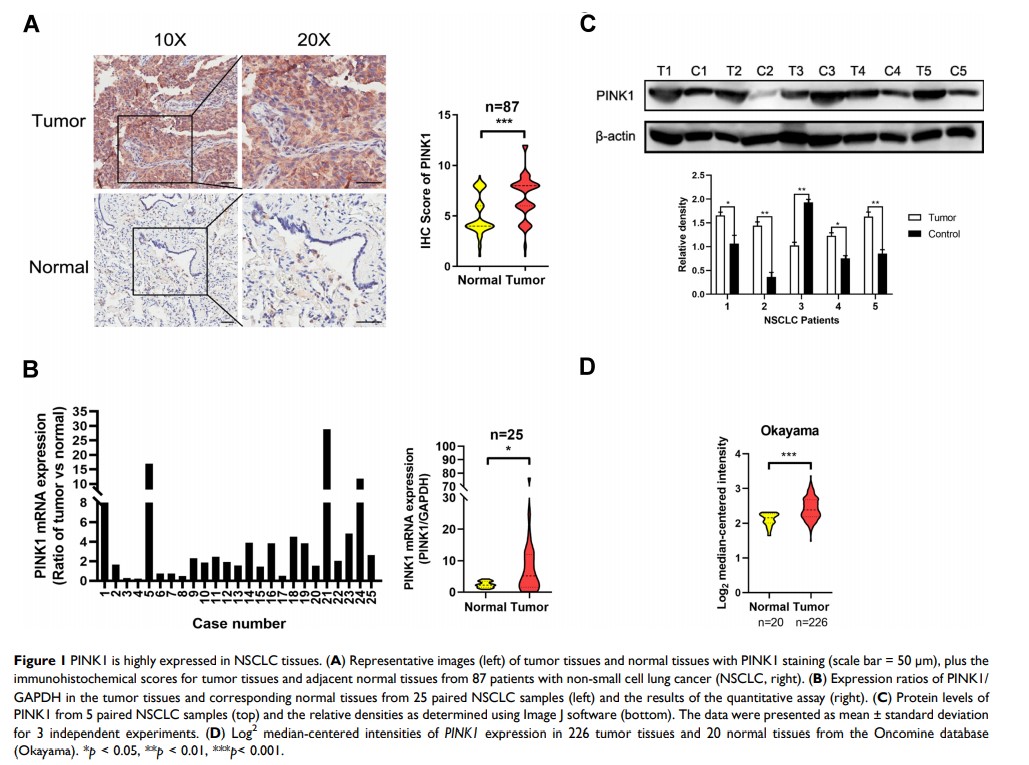
Materials and Methods: Western blot, qRT-PCR and Immunohistochemistry were employed to determine the levels of PINK1 in 87 paired NSCLC tissues, Oncomine and TCGA databases were also used for the evaluation of expression and prognosis of PINK1 . The mitophagy, proliferation, migration, invasion, and apoptosis abilities of A549 and H1975 cells were detected, and the autophagy-related proteins in the cells were also determined.
Results: Immunohistochemical staining revealed higher PINK1 expression in tumor tissues, which was strongly linked to the tumor-node-metastasis classification. Survival analysis of 1085 NSCLC patients also revealed that low PINK1 expression levels were associated with significantly longer overall survival. Univariate and multivariate analyses indicated that PINK1 expression was an independent predictor of overall survival among patients with NSCLC. We also evaluated the influence of PINK1 deficiency in NSCLC cell lines (A549 and H1975), which revealed significant suppression of migration capability and cell viability, as well as a significantly elevated apoptosis ratio. In cells with stable interference of PINK1 expression, dysfunctional mitochondria accumulated while autophagy was inhibited, which indicated that cell activity suppression was mediated by the accumulation of dysfunctional mitochondria. The suppression of migration and autophagy was reversed in cells that overexpressed PINK1 .
Conclusion: Our results suggest that PINK1 may be a potential therapeutic target and prognostic biomarker in NSCLC.
Keywords: PINK1, NSCLC, mitochondria, autophagy, migration, proliferation