119661
论文已发表
注册即可获取德孚的最新动态
IF 收录期刊
- 3.6 Breast Cancer (Dove Med Press)
- 4.3 Clin Epidemiol
- 2.6 Cancer Manag Res
- 3.2 Infect Drug Resist
- 4.1 Clin Interv Aging
- 6.1 Drug Des Dev Ther
- 4.1 Int J Chronic Obstr
- 8.7 Int J Nanomed
- 2.5 Int J Women's Health
- 3.2 Neuropsych Dis Treat
- 2.4 OncoTargets Ther
- 2.6 Patient Prefer Adher
- 2.6 Ther Clin Risk Manag
- 3.1 J Pain Res
- 3.5 Diabet Metab Synd Ob
- 4.5 Psychol Res Behav Ma
- 3.4 Nat Sci Sleep
- 2.4 Pharmgenomics Pers Med
- 2.6 Risk Manag Healthc Policy
- 4.6 J Inflamm Res
- 2.3 Int J Gen Med
- 3.9 J Hepatocell Carcinoma
- 3.3 J Asthma Allergy
- 2.5 Clin Cosmet Investig Dermatol
- 3.0 J Multidiscip Healthc

金纳米簇作为抗艰难梭菌的抗菌替代品
Authors Yang H, Cai R, Zhang Y, Chen Y, Gu B
Received 23 June 2020
Accepted for publication 7 August 2020
Published 25 August 2020 Volume 2020:15 Pages 6401—6408
DOI https://doi.org/10.2147/IJN.S268758
Checked for plagiarism Yes
Review by Single anonymous peer review
Peer reviewer comments 3
Editor who approved publication: Prof. Dr. Thomas Webster
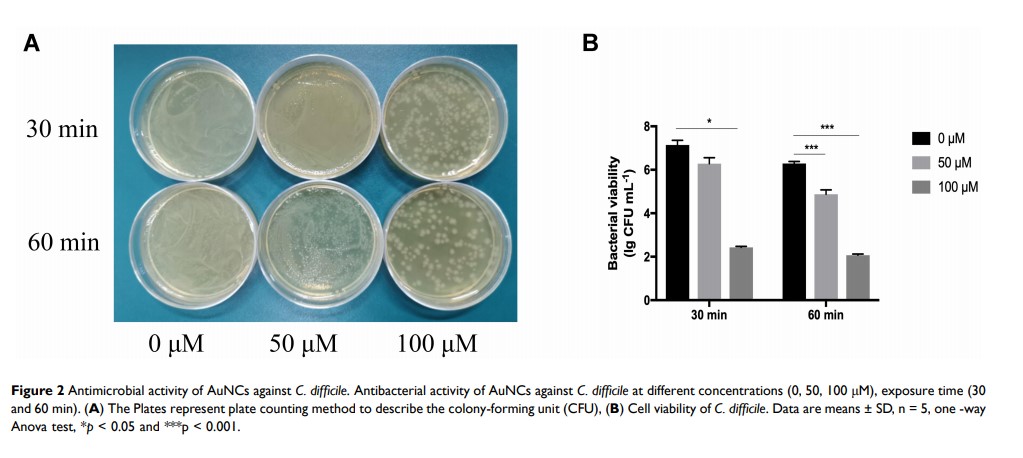
Background: Clostridium difficile infection (CDI) has become one of the most important factors threatening human health, and about 20– 30% antibiotic-related diarrhea cases and almost all pseudomembranous enteritis cases are related to CDI. The high recurrence of Clostridium difficile (C. difficile) and the emergence of drug resistance make clinical treatment of CDI difficult. Therefore, there is an urgent need to develop a non-antibiotic-alternative therapy against CDI. Gold nanoclusters (AuNCs) can better interact with bacteria due to its ultrasmall size. The aim of the present study was to explore whether AuNCs could be used as an antibacterial agent to kill C. difficile .
Methods: AuNCs and C. difficile were co-cultivated in an anaerobic atmosphere to evaluate the bactericidal effect of AuNCs. The bacterial growth rate was estimated by using two concentrations of AuNCs (50 and 100 μM). The damage of AuNCs to C. difficile is detected by SYTOX Green staining methods and SEM image analysis. The mechanism of AuNCs on C. difficile was explored by reactive oxygen species (ROS) detection. The toxic effect of AuNCs on human cells was evaluated by MTT method.
Results: AuNCs (100 μM) killed C. difficile drastically. AuNCs increased the release of ROS by about 5 fold and destroyed the membrane integrity of C. difficile cells without causing significant toxic effect on human cells.
Conclusion: AuNCs showed great potential as an alternative to traditional antibiotics in killing C. difficile and may prove to be an alternative to treat CDI.
Keywords: Clostridium difficile , antibacterial effect, gold nanoclusters, reactive oxygen species