115195
论文已发表
注册即可获取德孚的最新动态
IF 收录期刊
- 3.6 Breast Cancer (Dove Med Press)
- 4.3 Clin Epidemiol
- 2.6 Cancer Manag Res
- 3.2 Infect Drug Resist
- 4.1 Clin Interv Aging
- 6.1 Drug Des Dev Ther
- 4.1 Int J Chronic Obstr
- 8.7 Int J Nanomed
- 2.5 Int J Women's Health
- 3.2 Neuropsych Dis Treat
- 2.4 OncoTargets Ther
- 2.6 Patient Prefer Adher
- 2.6 Ther Clin Risk Manag
- 3.1 J Pain Res
- 3.5 Diabet Metab Synd Ob
- 4.5 Psychol Res Behav Ma
- 3.4 Nat Sci Sleep
- 2.4 Pharmgenomics Pers Med
- 2.6 Risk Manag Healthc Policy
- 4.6 J Inflamm Res
- 2.3 Int J Gen Med
- 3.9 J Hepatocell Carcinoma
- 3.3 J Asthma Allergy
- 2.5 Clin Cosmet Investig Dermatol
- 3.0 J Multidiscip Healthc

制备可光交联的聚碳酸三亚甲基酯/聚己内酯纳米纤维支架,用于肌腱再生
Authors Li X, Chen H, Xie S, Wang N, Wu S, Duan Y, Zhang M, Shui L
Received 22 January 2020
Accepted for publication 15 July 2020
Published 25 August 2020 Volume 2020:15 Pages 6373—6383
DOI https://doi.org/10.2147/IJN.S246966
Checked for plagiarism Yes
Review by Single anonymous peer review
Peer reviewer comments 3
Editor who approved publication: Dr Linlin Sun
Background: The treatment of tendon injuries remains a challenging problem in clinical due to their slow and insufficient natural healing process. Scaffold-based tissue engineering provides a promising strategy to facilitate tendon healing and regeneration. However, many tissue engineering scaffolds have failed due to their poor and unstable mechanical properties. To address this, we fabricated nanofibrous polycaprolactone/methacrylated poly(trimethylene carbonate) (PCL/PTMC-MA) composite scaffolds via electrospinning.
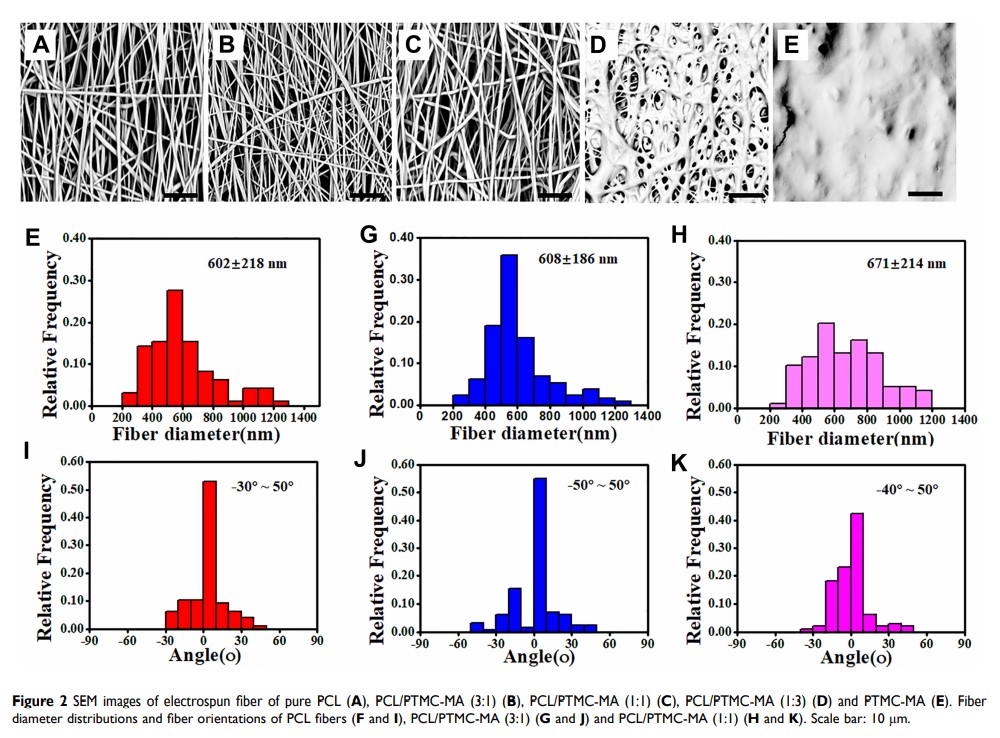
Materials and Methods: PTMC-MA was characterized by nuclear magnetic resonance. Fiber morphology of composite scaffolds was evaluated using scanning electron microscopy. The monotonic tensile test was performed for determining the mechanical properties of composite scaffolds. Cell viability and collagen deposition were assessed via PrestoBlue assay and enzyme-linked immunosorbent assay, respectively.
Results: These PCL/PTMC-MA composite scaffolds had an increase in mechanical properties as PTMC-MA content increase. After photo-crosslinking, they showed further enhanced mechanical properties including creep resistance, which was superior to pure PCL scaffolds. It is worth noting that photo-crosslinked PCL/PTMC-MA (1:3) composite scaffolds had a Young’s modulus of 31.13 ± 1.30 MPa and Max stress at break of 23.80 ± 3.44 MPa that were comparable with the mechanical properties of native tendon (Young’s modulus 20– 1200 MPa, max stress at break 5– 100 MPa). In addition, biological experiments demonstrated that PCL/PTMC-MA composite scaffolds were biocompatible for cell adhesion, proliferation, and differentiation.
Keywords: poly(trimethylene carbonate), composite scaffolds, tissue engineering, photo-crosslinking, creep resistance