115195
论文已发表
注册即可获取德孚的最新动态
IF 收录期刊
- 3.6 Breast Cancer (Dove Med Press)
- 4.3 Clin Epidemiol
- 2.6 Cancer Manag Res
- 3.2 Infect Drug Resist
- 4.1 Clin Interv Aging
- 6.1 Drug Des Dev Ther
- 4.1 Int J Chronic Obstr
- 8.7 Int J Nanomed
- 2.5 Int J Women's Health
- 3.2 Neuropsych Dis Treat
- 2.4 OncoTargets Ther
- 2.6 Patient Prefer Adher
- 2.6 Ther Clin Risk Manag
- 3.1 J Pain Res
- 3.5 Diabet Metab Synd Ob
- 4.5 Psychol Res Behav Ma
- 3.4 Nat Sci Sleep
- 2.4 Pharmgenomics Pers Med
- 2.6 Risk Manag Healthc Policy
- 4.6 J Inflamm Res
- 2.3 Int J Gen Med
- 3.9 J Hepatocell Carcinoma
- 3.3 J Asthma Allergy
- 2.5 Clin Cosmet Investig Dermatol
- 3.0 J Multidiscip Healthc

上海股市 COVID-19 期间孤儿和非孤儿投资者的投资行为
Authors Ahmad MI, Zhuang W, Sattar A
Received 4 May 2020
Accepted for publication 28 July 2020
Published 25 August 2020 Volume 2020:13 Pages 705—711
DOI https://doi.org/10.2147/PRBM.S260541
Checked for plagiarism Yes
Review by Single anonymous peer review
Peer reviewer comments 2
Editor who approved publication: Professor Igor Elman
Purpose: Orphaned children carry many psychological and emotional issues with them throughout their lives, which influence every decision they make, including investment decisions. A lack of self-determination and low confidence may make orphans make more risky decisions than their nonorphan counterparts. In this study, we aimed to see how this risky behavior was reflected in investment choices during the COVID-19 pandemic.
Methods: A well-structured questionnaire was distributed to 230 adult investors (130 orphans and 100 nonorphans) between January 22 and March 13, 2020.
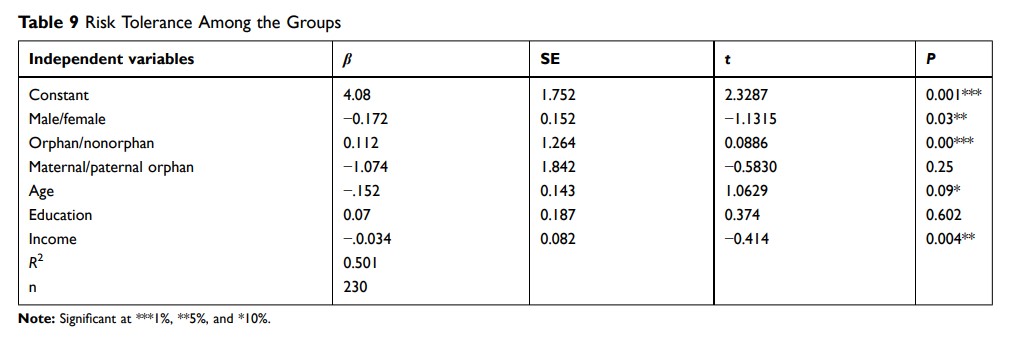
Results: Orphans were found to be risk-takers during the COVID-19 pandemic, as hypothesized from their childhood history. Moreover, female investors showed more sensible (less risky) behavior than male investors when investing in fixed-income securities. Income and age showed significant inverse relationships with risk tolerance, while education showed a positive but insignificant effect.
Conclusion: This study indicates that orphan investors enjoy taking risks and their behavior toward risk remains consistent, even in abnormal conditions, such as a global pandemic. It also suggests that their risk-taking behavior remains stable from orphanhood through to adulthood, contradicting many reports that orphans make reasonable decisions in adulthood.
Keywords: global pandemic, risk-taking behavior, adulthood, investment choices