115195
论文已发表
注册即可获取德孚的最新动态
IF 收录期刊
- 3.6 Breast Cancer (Dove Med Press)
- 4.3 Clin Epidemiol
- 2.6 Cancer Manag Res
- 3.2 Infect Drug Resist
- 4.1 Clin Interv Aging
- 6.1 Drug Des Dev Ther
- 4.1 Int J Chronic Obstr
- 8.7 Int J Nanomed
- 2.5 Int J Women's Health
- 3.2 Neuropsych Dis Treat
- 2.4 OncoTargets Ther
- 2.6 Patient Prefer Adher
- 2.6 Ther Clin Risk Manag
- 3.1 J Pain Res
- 3.5 Diabet Metab Synd Ob
- 4.5 Psychol Res Behav Ma
- 3.4 Nat Sci Sleep
- 2.4 Pharmgenomics Pers Med
- 2.6 Risk Manag Healthc Policy
- 4.6 J Inflamm Res
- 2.3 Int J Gen Med
- 3.9 J Hepatocell Carcinoma
- 3.3 J Asthma Allergy
- 2.5 Clin Cosmet Investig Dermatol
- 3.0 J Multidiscip Healthc

靶向 PIN-1 可通过抑制 PI3K/AKT 信号传导来削弱 GCB DLBCL 细胞的增殖
Authors Yang H, Zhang P, Li J, Gao Y, Zhao L, Li J, Guo M, Zhang J, Li H, Wang F, Yuan Y
Received 28 January 2020
Accepted for publication 26 July 2020
Published 25 August 2020 Volume 2020:13 Pages 8593—8600
DOI https://doi.org/10.2147/OTT.S247429
Checked for plagiarism Yes
Review by Single anonymous peer review
Peer reviewer comments 2
Editor who approved publication: Dr Sanjay Singh
Introduction: Diffuse large B cell lymphoma (DLBCL) is a highly heterogeneous type of non-Hodgkin lymphoma with many molecular subtypes that can be distinguished by gene expression profiling (GEP). However, the pathogenesis of DLBCL is still unclear.
Materials and Methods: The expression levels of the prolyl isomerase PIN-1 and other related proteins were determined in 73 primary DLBCL patient samples and cell lines by Western blotting (WB) and immunohistochemical (IHC) staining. Cell cycle and apoptosis were evaluated by flow cytometry. Lymphoma cell viability was detected by CCK-8 proliferation assay.
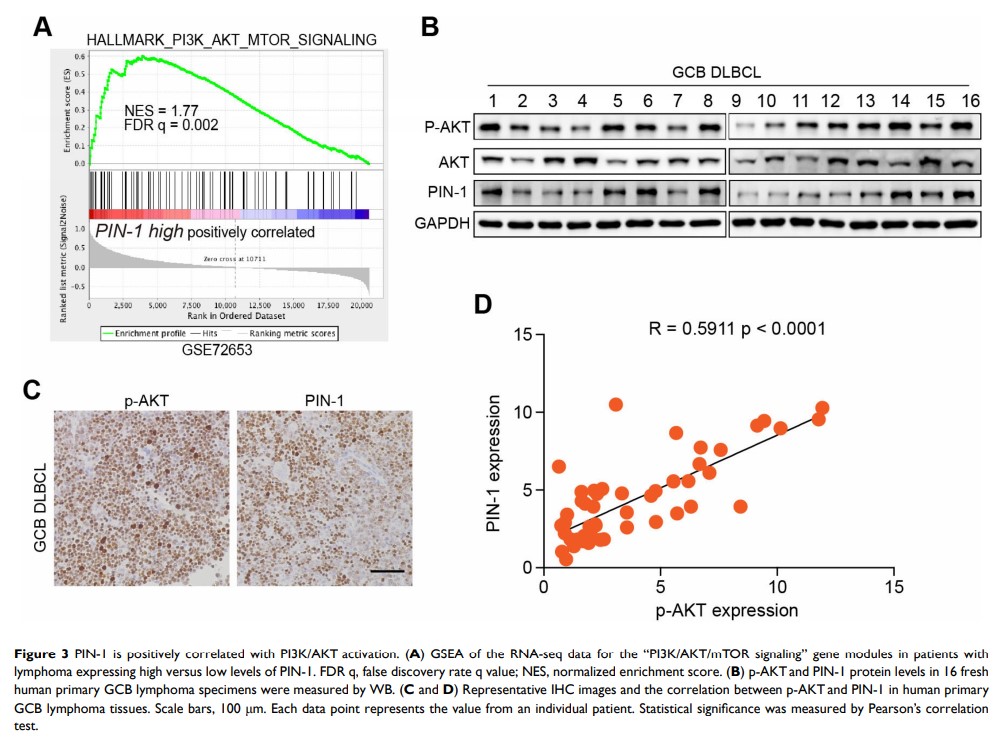
Results: High levels of PIN-1 expression were detected in 55% of germinal center B cell (GCB) DLBCL patient samples, whereas such abnormal expression levels were found in only 11% of non-GCB DLBCL patient samples. PIN-1 expression was positively associated with activation of the oncogenic phosphoinositide 3-kinase (PI3K)/protein kinase B (AKT) pathway in both GCB DLBCL cell lines and primary patient samples. Depletion of PIN-1 was cytotoxic to GCB DLBCL model cell lines because it led to inhibition of the PI3K/AKT signaling pathway, revealing a GCB DLBCL subgroup that is dependent on this pathway. A PI3K inhibitor was selectively toxic to GCB DLBCL lines expressing high levels of PIN-1.
Conclusion: Our study used PIN-1 to identify a new subgroup of GCB DLBCL associated with the PI3K/AKT signaling pathway, and our findings reveal that inhibition of PI3K is a promising therapeutic approach for GCB DLBCL.
Keywords: PIN-1, DLBCL, PI3K/AKT signaling pathway