119661
论文已发表
注册即可获取德孚的最新动态
IF 收录期刊
- 3.6 Breast Cancer (Dove Med Press)
- 4.3 Clin Epidemiol
- 2.6 Cancer Manag Res
- 3.2 Infect Drug Resist
- 4.1 Clin Interv Aging
- 6.1 Drug Des Dev Ther
- 4.1 Int J Chronic Obstr
- 8.7 Int J Nanomed
- 2.5 Int J Women's Health
- 3.2 Neuropsych Dis Treat
- 2.4 OncoTargets Ther
- 2.6 Patient Prefer Adher
- 2.6 Ther Clin Risk Manag
- 3.1 J Pain Res
- 3.5 Diabet Metab Synd Ob
- 4.5 Psychol Res Behav Ma
- 3.4 Nat Sci Sleep
- 2.4 Pharmgenomics Pers Med
- 2.6 Risk Manag Healthc Policy
- 4.6 J Inflamm Res
- 2.3 Int J Gen Med
- 3.9 J Hepatocell Carcinoma
- 3.3 J Asthma Allergy
- 2.5 Clin Cosmet Investig Dermatol
- 3.0 J Multidiscip Healthc

血清 ZAG 和脂联素水平与中国人群的肥胖和代谢异常表型密切相关
Authors Liu M, Zhang K, Wang L, Yang H, Yan K, Pan H, Zhu H, Gong F
Received 9 April 2020
Accepted for publication 3 August 2020
Published 26 August 2020 Volume 2020:13 Pages 3099—3112
DOI https://doi.org/10.2147/DMSO.S257643
Checked for plagiarism Yes
Review by Single anonymous peer review
Peer reviewer comments 2
Editor who approved publication: Dr Konstantinos Tziomalos
Introduction: To explore serum zinc-α 2-glycoprotein (ZAG) and adiponectin in metabolically healthy non-obese (MHNO), metabolically healthy obesity (MHO), metabolically abnormal obesity (MAO) and metabolically abnormal diabetic obese (MADO) subjects and the relationship with metabolically phenotypes of obesity.
Methods: Two hundred twenty-five subjects including 32 with MHNO, 40 with MHO, 104 with MAO and 49 with MADO were enrolled. Baseline clinical data and biochemical variables were collected. Serum ZAG and adiponectin levels were measured by enzyme-linked immunosorbent assay (ELISA) kits. Metabolically healthy (< 3 metabolic abnormalities) or abnormal (≥ 3 metabolic abnormalities) subjects were classified based on the National Cholesterol Education Program–Adult Treatment Panel III (NCEP/ATP III) criteria. Obesity (body mass index ≥ 28 kg/m2) was recommended by China Obesity Task Force.
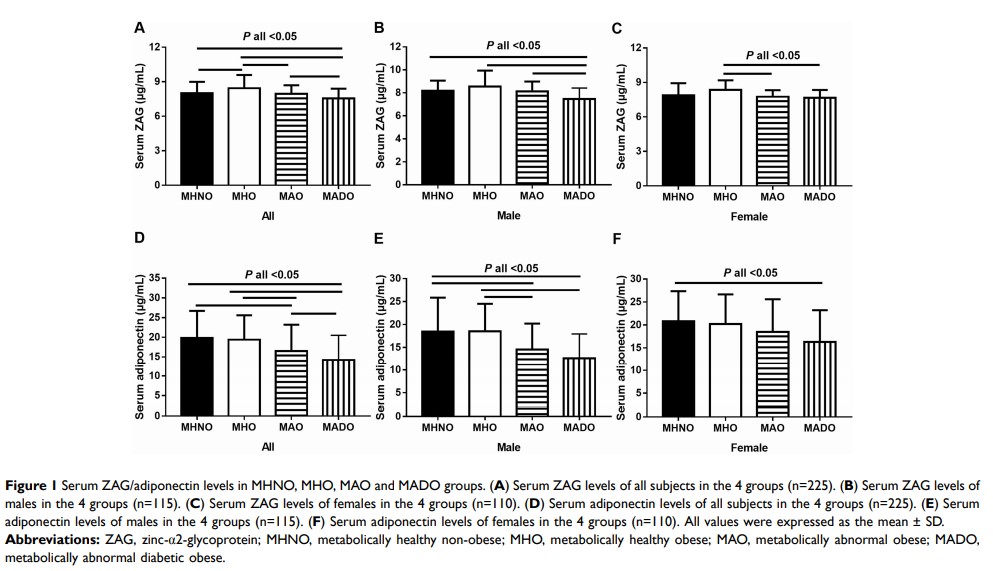
Results: Serum ZAG levels were higher in the MHO group, but were progressively lower in MAO and MADO groups (P all< 0.05). In all subjects, total cholesterol, 2-hour postprandial blood glucose and homeostasis model assessment of adiponectin were independent variables to serum ZAG levels. Compared with subjects in the highest tertile of ZAG, the odds ratio (OR) of metabolically abnormal risks of subjects in the lowest and median tertiles of ZAG were higher both in a univariate and three adjustment models (P all< 0.05). Serum ZAG could discriminate the metabolically abnormal phenotype with receiver operating characteristic (ROC) curve area of 0.622 (95% CI, 0.539– 0.706, P < 0.05). Combination of ZAG and adiponectin had improved diagnosis value accuracy, with ROC curve area of 0.703 (95% CI, 0.629– 0.776, P < 0.05), and 62.7% sensitivity and 73.6% specificity.
Conclusion: Serum ZAG levels were higher in MHO subjects, but lower in MAO and MADO subjects. The decreased serum ZAG levels were closely related to the metabolically abnormal phenotype of obese patients. Serum ZAG, especially the combination with adiponectin might be the potential diagnostic biomarkers for metabolically abnormal obese patients.
Keywords: zinc-α 2-glycoprotein, ZAG, metabolically healthy non-obese, MHNO, metabolically healthy obese, MHO, metabolically abnormal obese, MAO, metabolically abnormal diabetic obese, MADO