119661
论文已发表
注册即可获取德孚的最新动态
IF 收录期刊
- 3.6 Breast Cancer (Dove Med Press)
- 4.3 Clin Epidemiol
- 2.6 Cancer Manag Res
- 3.2 Infect Drug Resist
- 4.1 Clin Interv Aging
- 6.1 Drug Des Dev Ther
- 4.1 Int J Chronic Obstr
- 8.7 Int J Nanomed
- 2.5 Int J Women's Health
- 3.2 Neuropsych Dis Treat
- 2.4 OncoTargets Ther
- 2.6 Patient Prefer Adher
- 2.6 Ther Clin Risk Manag
- 3.1 J Pain Res
- 3.5 Diabet Metab Synd Ob
- 4.5 Psychol Res Behav Ma
- 3.4 Nat Sci Sleep
- 2.4 Pharmgenomics Pers Med
- 2.6 Risk Manag Healthc Policy
- 4.6 J Inflamm Res
- 2.3 Int J Gen Med
- 3.9 J Hepatocell Carcinoma
- 3.3 J Asthma Allergy
- 2.5 Clin Cosmet Investig Dermatol
- 3.0 J Multidiscip Healthc

静脉注射利多卡因用于接受无痛结肠镜检查的肥胖患者:一项前瞻性、随机、双盲、对照研究
Authors Li X, Lv X, Jiang Z, Nie X, Wang X, Li T, Zhang L, Liu S
Received 4 June 2020
Accepted for publication 5 August 2020
Published 27 August 2020 Volume 2020:14 Pages 3509—3518
DOI https://doi.org/10.2147/DDDT.S266062
Checked for plagiarism Yes
Review by Single anonymous peer review
Peer reviewer comments 3
Editor who approved publication: Dr Tuo Deng
Objective: Propofol for procedural sedation and analgesia (PSA) for colonoscopy can result in a high prevalence of severe respiratory depression. Studies have shown that intravenous (IV) infusion of lidocaine can reduce propofol requirements significantly and increase the ventilatory response to carbon dioxide in humans. We tested the hypothesis that IV lidocaine could improve propofol-induced respiratory depression in obese patients during colonoscopy.
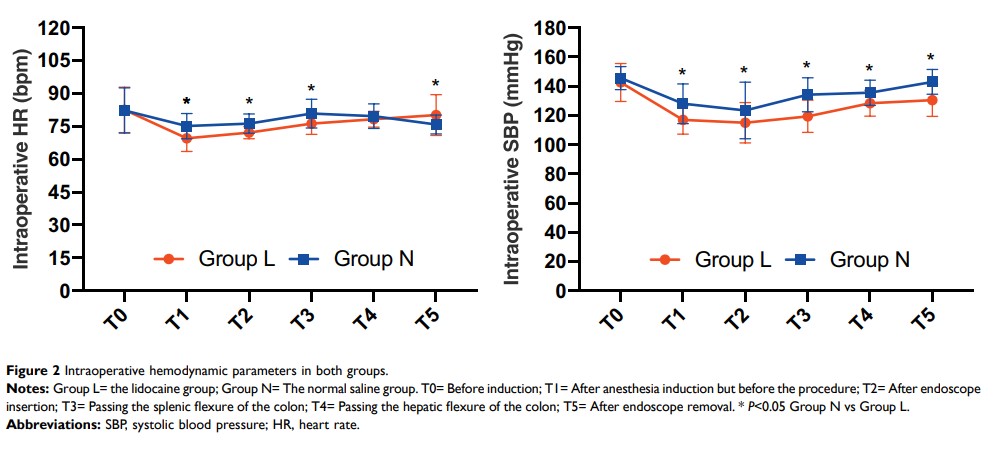
Methods: Ninety obese patients scheduled for painless colonoscopy were randomized to receive lidocaine (1.5 mg/kg, then 2 mg/kg/h, IV) or the same volume of 0.9% saline. Intraoperative sedation was provided by propofol. The primary outcome was the number of oxygen-desaturation episodes. Secondary outcomes were: the number of apnea episodes; total propofol consumption; time to the first hypoxia episode; time to consciousness loss; intraoperative hemodynamic parameters; awakening time; adverse events; duration of post-anesthesia care unit (PACU) stay; satisfaction of endoscopists and patients.
Results: Demographic characteristics between the two groups were comparable. The number of oxygen-desaturation episodes in group L (1.49± 1.12) decreased by 0.622 (P =0.018) compared with that in group N (2.11± 1.32), and the number of apnea episodes in group L decreased by 0.533 (P < 0.001). Kaplan–Meier curves showed that the median time to the first hypoxia episode was longer in group L (86.78 s) than that in group N (63.83 s) (Log rank P =0.0008). The total propofol consumption, awakening time, and duration of PACU stay were reduced in group L. There was no significant difference in the prevalence of adverse events (P > 0.05 for all). Satisfaction scores for endoscopists and patients in group L were higher than that in group N (P < 0.001).
Conclusion: Intravenous infusion of lidocaine could significantly reduce the number of oxygen-desaturation and apnea episodes in obese patients during painless colonoscopy. This method is worthy of clinical promotion.
Clinical Trials Registration: ChiCTR2000028937.
Keywords: lidocaine, propofol, obese patients, colonoscopy