119661
论文已发表
注册即可获取德孚的最新动态
IF 收录期刊
- 3.6 Breast Cancer (Dove Med Press)
- 4.3 Clin Epidemiol
- 2.6 Cancer Manag Res
- 3.2 Infect Drug Resist
- 4.1 Clin Interv Aging
- 6.1 Drug Des Dev Ther
- 4.1 Int J Chronic Obstr
- 8.7 Int J Nanomed
- 2.5 Int J Women's Health
- 3.2 Neuropsych Dis Treat
- 2.4 OncoTargets Ther
- 2.6 Patient Prefer Adher
- 2.6 Ther Clin Risk Manag
- 3.1 J Pain Res
- 3.5 Diabet Metab Synd Ob
- 4.5 Psychol Res Behav Ma
- 3.4 Nat Sci Sleep
- 2.4 Pharmgenomics Pers Med
- 2.6 Risk Manag Healthc Policy
- 4.6 J Inflamm Res
- 2.3 Int J Gen Med
- 3.9 J Hepatocell Carcinoma
- 3.3 J Asthma Allergy
- 2.5 Clin Cosmet Investig Dermatol
- 3.0 J Multidiscip Healthc

具有遗传家族史的食管鳞状细胞癌的遗传异质性
Authors He W, Leng X, Yang Y, Peng L, Shao Y, Li X, Han Y
Received 4 June 2020
Accepted for publication 8 August 2020
Published 3 September 2020 Volume 2020:13 Pages 8795—8802
DOI https://doi.org/10.2147/OTT.S262512
Checked for plagiarism Yes
Review by Single anonymous peer review
Peer reviewer comments 3
Editor who approved publication: Prof. Dr. Nicola Silvestris
Background: Esophageal squamous cell carcinoma (ESCC) is a common malignant tumor with significant geographical variation and familial aggregation. However, the potentially different mechanisms underlying tumorigenesis in patients with ESCC with and without a family history of the disease remain unclear. In this study, the genes mutated in familial and nonfamilial ESCC were analyzed. Further, we aimed to explore the genes related to ESCC and attempt to identify potential patients in families with a history of ESCC.
Methods: Next-generation sequencing technology was used to examine germline mutations and mutation profiles in 36 matched tumor-normal ESCC specimens. Additionally, tumor mutational burden (TMB) values were measured in two cohorts.
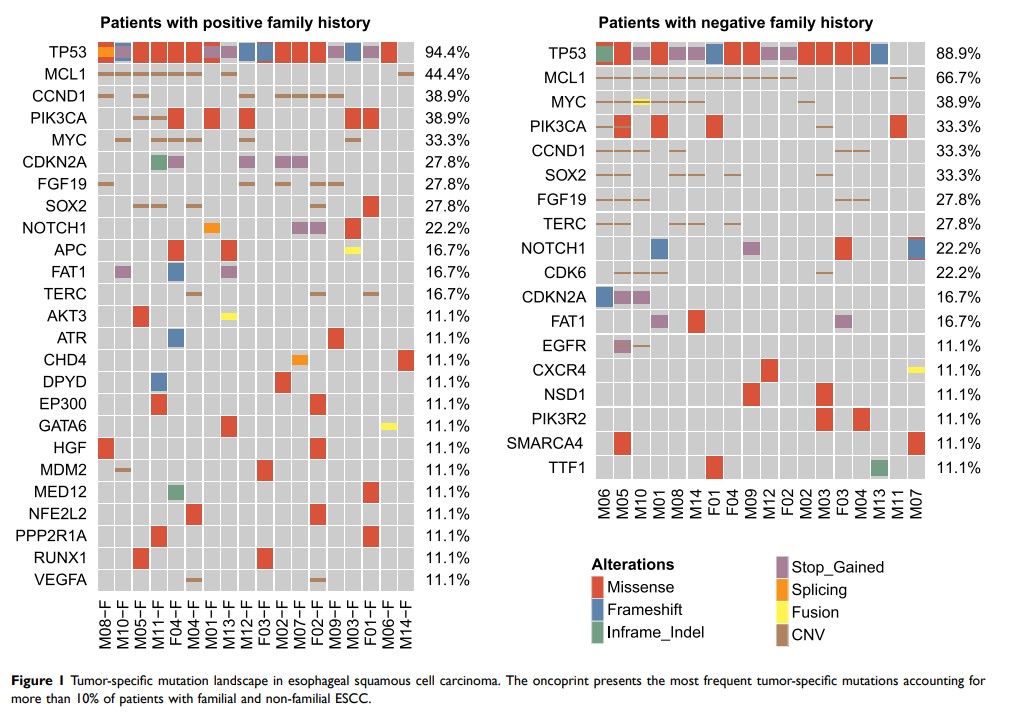
Results: We identified four novel germline mutations in patients with familial ESCC, in BAX (c.121dupG: p.E41G), CDKN2A (c.374dupA: p.D125E), TP53 (c.856G>A: p.E286K), and CHEK1 (c.923+1G>A). Mutation profiles revealed that patients with and without a family history of ESCC had similar high-frequency gene mutation profiles, among which TP53 was the most commonly mutated gene. Additionally, tumor-specific mutated genes in patients with a positive family history of ESCC were APC, AKT3, DPYD, EP300, NFE2L2, PPP2R1A, RUNX1 , and VEGFA , while those in patients without a family history of ESCC were CXCR4, PIK3R2, SMARCA4 , and TTF1 . Moreover, patients with positive family history had significantly higher TMB values (7.8 ± 4.1 vs 5.0 ± 2.4, for patients with and without a family history, respectively; P = 0.038).
Conclusion: Our results identified mutation profiles in patients with familial and nonfamilial ESCC, and identified germline mutations in patients with positive history. TMB values may be informative for immunotherapy approaches in familial ESCC.
Keywords: esophageal squamous cell carcinoma, genetic heterogeneity, family heredity