119661
论文已发表
注册即可获取德孚的最新动态
IF 收录期刊
- 3.6 Breast Cancer (Dove Med Press)
- 4.3 Clin Epidemiol
- 2.6 Cancer Manag Res
- 3.2 Infect Drug Resist
- 4.1 Clin Interv Aging
- 6.1 Drug Des Dev Ther
- 4.1 Int J Chronic Obstr
- 8.7 Int J Nanomed
- 2.5 Int J Women's Health
- 3.2 Neuropsych Dis Treat
- 2.4 OncoTargets Ther
- 2.6 Patient Prefer Adher
- 2.6 Ther Clin Risk Manag
- 3.1 J Pain Res
- 3.5 Diabet Metab Synd Ob
- 4.5 Psychol Res Behav Ma
- 3.4 Nat Sci Sleep
- 2.4 Pharmgenomics Pers Med
- 2.6 Risk Manag Healthc Policy
- 4.6 J Inflamm Res
- 2.3 Int J Gen Med
- 3.9 J Hepatocell Carcinoma
- 3.3 J Asthma Allergy
- 2.5 Clin Cosmet Investig Dermatol
- 3.0 J Multidiscip Healthc

乔松素可改善由血管性痴呆引起的认知障碍:Reelin-dab1 信号通路的贡献
Authors Kang ZC, Wang HG, Yang YL, Zhao XY, Zhou QM, Yang YL, Yang JY, Du GH
Received 10 February 2020
Accepted for publication 12 June 2020
Published 4 September 2020 Volume 2020:14 Pages 3577—3587
DOI https://doi.org/10.2147/DDDT.S249176
Checked for plagiarism Yes
Review by Single anonymous peer review
Peer reviewer comments 2
Editor who approved publication: Professor Manfred Ogris
Background: As a substrate of apoER2, Reelin has been verified to exert neuroprotection by preventing memory impairment. Pinocembrin is the most abundant natural flavonoid found in propolis, and it has been used to exert neuroprotection, blood–brain barrier protection, anti-oxidation, and inflammation diminishing, both in vitro and in vivo. However, the roles and molecular mechanisms of pinocembrin in neurobehavioral outcomes and neuronal repair after vascular dementia are still under investigation.
Purpose: To explore the role of pinocembrin in the involvement of the Reelin-dab1 signaling pathway in improving memory impairment, both in cell culture and animals experiments.
Material and Methods: Behavioral tests were conducted on day 48 to confirm the protection of pinocembrin against cognitive impairment. Cell and molecular biology experiments demonstrated that the Reelin-dab1 pathway mediates the underlying mechanism of cognitive improvement by pinocembrin.
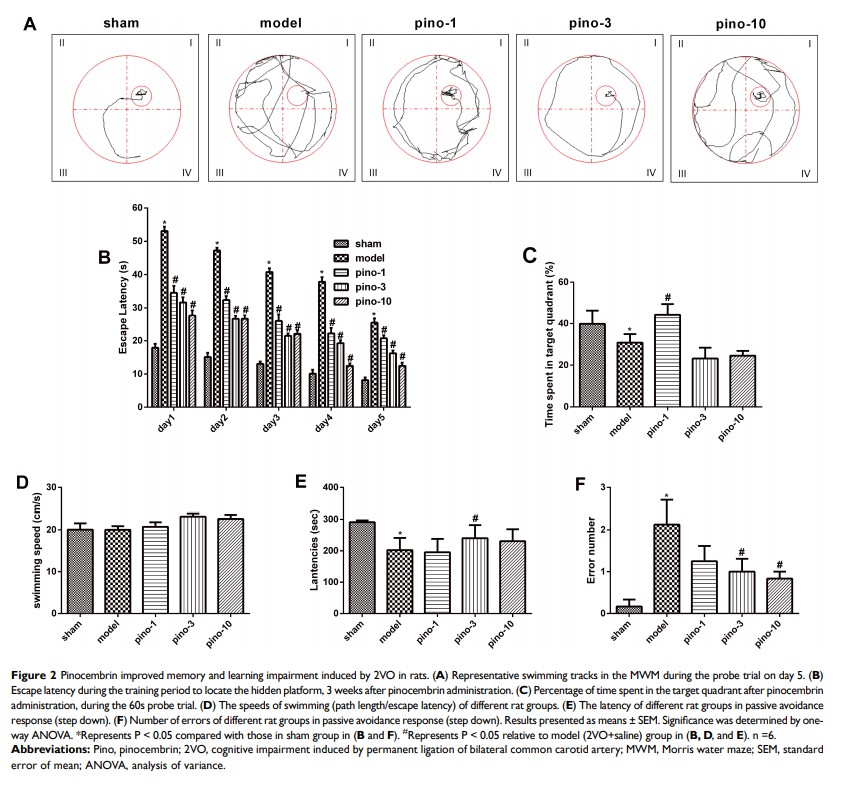
Results: It was showed that pinocembrin alleviated learning and memory deficits induced by vascular dementia, by inducing the expression of Reelin, apoER2, and p-dab1 in the hippocampus. The expression of Reelin and p-dab1 was both inhibited following Reelin RNA interference in SH-SY5Y prior to oxygen glucose deprivation (OGD) injury, suggesting that Reelin played a core role in pinocembrin’s effect on OGD in vitro.
Conclusion: Pinocembrin improves the cognition via the Reelin-dab1 signaling pathway.
Keywords: pinocembrin, Reelin, vascular dementia, hippocampus, cognitive impairment, signaling pathway