119942
论文已发表
注册即可获取德孚的最新动态
IF 收录期刊
- 3.6 Breast Cancer (Dove Med Press)
- 4.3 Clin Epidemiol
- 2.6 Cancer Manag Res
- 3.2 Infect Drug Resist
- 4.1 Clin Interv Aging
- 6.1 Drug Des Dev Ther
- 4.1 Int J Chronic Obstr
- 8.7 Int J Nanomed
- 2.5 Int J Women's Health
- 3.2 Neuropsych Dis Treat
- 2.4 OncoTargets Ther
- 2.6 Patient Prefer Adher
- 2.6 Ther Clin Risk Manag
- 3.1 J Pain Res
- 3.5 Diabet Metab Synd Ob
- 4.5 Psychol Res Behav Ma
- 3.4 Nat Sci Sleep
- 2.4 Pharmgenomics Pers Med
- 2.6 Risk Manag Healthc Policy
- 4.6 J Inflamm Res
- 2.3 Int J Gen Med
- 3.9 J Hepatocell Carcinoma
- 3.3 J Asthma Allergy
- 2.5 Clin Cosmet Investig Dermatol
- 3.0 J Multidiscip Healthc

钛表面电化学沉积纳米羟基磷灰石涂层具有增强的早期成骨活性和骨整合作用
Authors Lu M, Chen H, Yuan B, Zhou Y, Min L, Xiao Z, Zhu X, Tu C, Zhang X
Received 25 June 2020
Accepted for publication 26 August 2020
Published 8 September 2020 Volume 2020:15 Pages 6605—6618
DOI https://doi.org/10.2147/IJN.S268372
Checked for plagiarism Yes
Review by Single anonymous peer review
Peer reviewer comments 3
Editor who approved publication: Dr Thomas Webster
Purpose: The aim of research is to fabricate nanostructured hydroxyapatite (HA) coatings on the titanium via electrochemical deposition (ED). Additionally, the biological properties of the ED-produced HA (EDHA) coatings with a plate-like nanostructure were evaluated in vitro and in vivo by undertaking comparisons with those prepared by acid/alkali (AA) treatment and by plasma spray-produced HA (PSHA) nanotopography-free coatings.
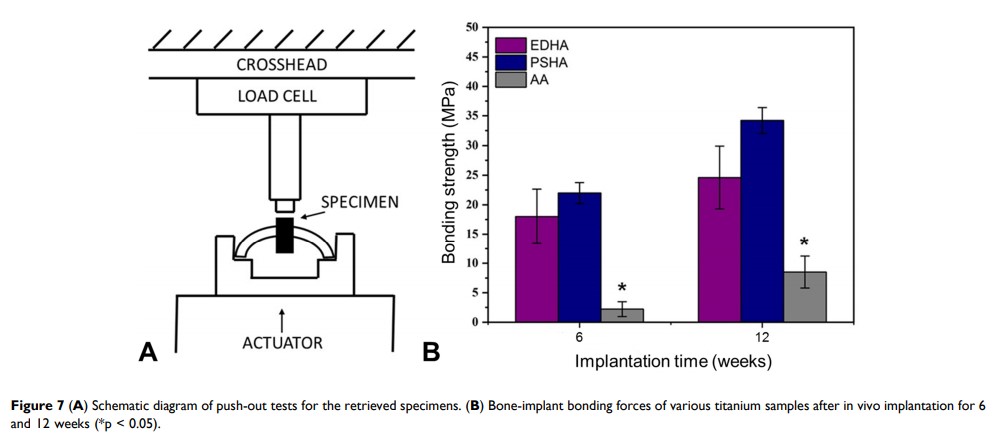
Materials and Methods: Nanoplate-like HA coatings were prepared through ED, and nanotopography-free PSHA coatings were fabricated. The surface morphology, phase composition, roughness, and wettability of these samples were investigated. Furthermore, the growth, proliferation, and osteogenic differentiation of MC3T3-E1 cells cultured on each sample were evaluated via in vitro experiments. Histological assessment and push-out tests for the bone–implant interface were performed to explore the effect of the EDHA coatings on the interfacial osseointegration in vivo.
Results: XRD analysis showed that the strongest intensity for the EDHA coatings was at the (002) plane rather than at the regular (211) plane. Relatively higher surface roughness and greater wettability were observed for the EDHA coatings. Cellular experiments revealed that the plate-like nanostructured EDHA coatings not only possessed an ability, similar to that of PSHA coatings, to promote the adhesion and proliferation of MC3T3-E1 cells but also demonstrated significantly enhanced early or intermediate markers of osteogenic differentiation. Significant osseointegration enhancement in the early stage of implantation period and great bonding strength were observed at the interface of bone and EDHA samples. In comparison, relatively weak osseointegration and bonding strength of the bone–implant interface were observed for the AA treatment.
Conclusion: The biological performance of the plate-like nanostructured EDHA coating, which was comparable with that of the PSHA, improves early-stage osteogenic differentiation and osseointegration abilities and has great potential for enhancing the initial stability and long-term survival of uncemented or 3D porous titanium implants.
Keywords: electrochemical deposition, hydroxyapatite coatings, nanoscale, osteogenic activity, osseointegration