119942
论文已发表
注册即可获取德孚的最新动态
IF 收录期刊
- 3.6 Breast Cancer (Dove Med Press)
- 4.3 Clin Epidemiol
- 2.6 Cancer Manag Res
- 3.2 Infect Drug Resist
- 4.1 Clin Interv Aging
- 6.1 Drug Des Dev Ther
- 4.1 Int J Chronic Obstr
- 8.7 Int J Nanomed
- 2.5 Int J Women's Health
- 3.2 Neuropsych Dis Treat
- 2.4 OncoTargets Ther
- 2.6 Patient Prefer Adher
- 2.6 Ther Clin Risk Manag
- 3.1 J Pain Res
- 3.5 Diabet Metab Synd Ob
- 4.5 Psychol Res Behav Ma
- 3.4 Nat Sci Sleep
- 2.4 Pharmgenomics Pers Med
- 2.6 Risk Manag Healthc Policy
- 4.6 J Inflamm Res
- 2.3 Int J Gen Med
- 3.9 J Hepatocell Carcinoma
- 3.3 J Asthma Allergy
- 2.5 Clin Cosmet Investig Dermatol
- 3.0 J Multidiscip Healthc

实性结节的出现可预测肺腺癌患者的肿瘤通过空气空间传播:倾向评分匹配研究
Authors Zeng Q, Wang B, Li J, Zhao J, Mao Y, Gao Y, Xue Q, Gao S, Sun N, He J
Received 8 June 2020
Accepted for publication 13 August 2020
Published 8 September 2020 Volume 2020:12 Pages 8197—8207
DOI https://doi.org/10.2147/CMAR.S266750
Checked for plagiarism Yes
Review by Single anonymous peer review
Peer reviewer comments 3
Editor who approved publication: Dr Ahmet Emre Eskazan
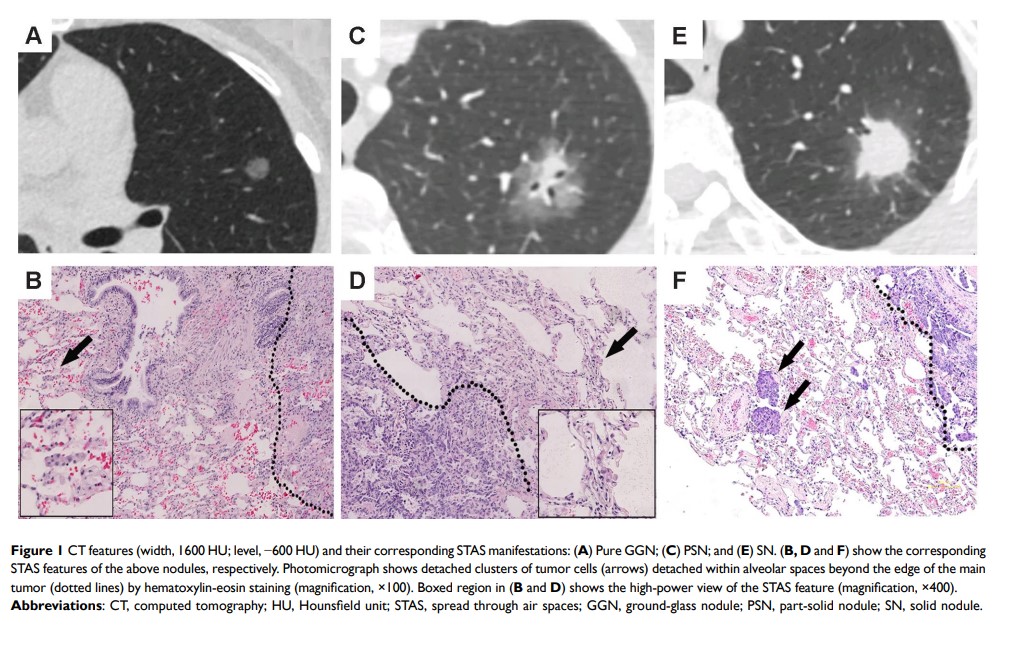
Objective: Spread through air spaces (STAS) has been reported to be an invasive histological pattern with poor prognosis in lung cancer; however, little is known about its intrinsic risk factors. This work analyzed the correlation between pathological and radiological features and STAS in resected lung adenocarcinomas.
Patients and Methods: We retrospectively reviewed 1821 consecutive surgically treated patients with histologically diagnosed lung adenocarcinoma (174 positive for STAS and 1647 negative for STAS) from December 2017 to November 2018 at our institution. Propensity score matching identified 170 well-balanced pairs of patients. The correlations between pathological and radiological features and the presence of STAS were analyzed.
Results: Before propensity matching, the incidence rate of STAS was 9.6% in all patients. In matched cohorts, multivariate analysis showed that the presence of STAS was significantly correlated with pure solid nodules (SNs) (p = 0.001) and solid/micropapillary patterns (SMPs) (p = 0.002). The odds ratio for STAS in SN-positive and SMP-positive adenocarcinoma against that in SN-negative and SMP-negative adenocarcinoma was 10.922 (95% confidence interval, 5.826– 20.475; p < 0.001). Tumor differentiation, visceral pleural invasion (VPI), lymphovascular invasion (LVI), invasive adenocarcinoma, and non-lepidic subtype were significantly associated with STAS in the univariate analysis (p < 0.05); however, the differences failed to reach a significant level in the multivariate analysis.
Conclusion: We found that STAS was significantly correlated with several invasive clinicopathological patterns. The presence of SNs and SMPs were revealed as independent predictors for STAS, which could offer clinicians clues to identify STAS-positive adenocarcinoma.
Keywords: lung adenocarcinoma, spread through air spaces, solid pulmonary nodule