119942
论文已发表
注册即可获取德孚的最新动态
IF 收录期刊
- 3.6 Breast Cancer (Dove Med Press)
- 4.3 Clin Epidemiol
- 2.6 Cancer Manag Res
- 3.2 Infect Drug Resist
- 4.1 Clin Interv Aging
- 6.1 Drug Des Dev Ther
- 4.1 Int J Chronic Obstr
- 8.7 Int J Nanomed
- 2.5 Int J Women's Health
- 3.2 Neuropsych Dis Treat
- 2.4 OncoTargets Ther
- 2.6 Patient Prefer Adher
- 2.6 Ther Clin Risk Manag
- 3.1 J Pain Res
- 3.5 Diabet Metab Synd Ob
- 4.5 Psychol Res Behav Ma
- 3.4 Nat Sci Sleep
- 2.4 Pharmgenomics Pers Med
- 2.6 Risk Manag Healthc Policy
- 4.6 J Inflamm Res
- 2.3 Int J Gen Med
- 3.9 J Hepatocell Carcinoma
- 3.3 J Asthma Allergy
- 2.5 Clin Cosmet Investig Dermatol
- 3.0 J Multidiscip Healthc

核转录因子-κB 的高表达与顺铂耐药和卵巢癌的预后有关
Authors Kan Y, Liu J, Li F
Received 8 June 2020
Accepted for publication 5 August 2020
Published 9 September 2020 Volume 2020:12 Pages 8241—8252
DOI https://doi.org/10.2147/CMAR.S265531
Checked for plagiarism Yes
Review by Single anonymous peer review
Peer reviewer comments 2
Editor who approved publication: Dr Chien-Feng Li
Background: Abnormal activation of the nuclear transcription factor-κB (NF-κB) signaling pathway plays a crucial role in the chemoresistance of tumor cells. This study aimed to explore the significance of NF-κB in the chemoresistance of ovarian cancer.
Materials: We performed immunohistochemical staining for evaluating the expression of NF-κB in cancer tissues. The MTT assay was performed for analyzing cell proliferation, Western blotting was performed to quantify NF-κB p65, and flow cytometry was used to determine the apoptosis rate.
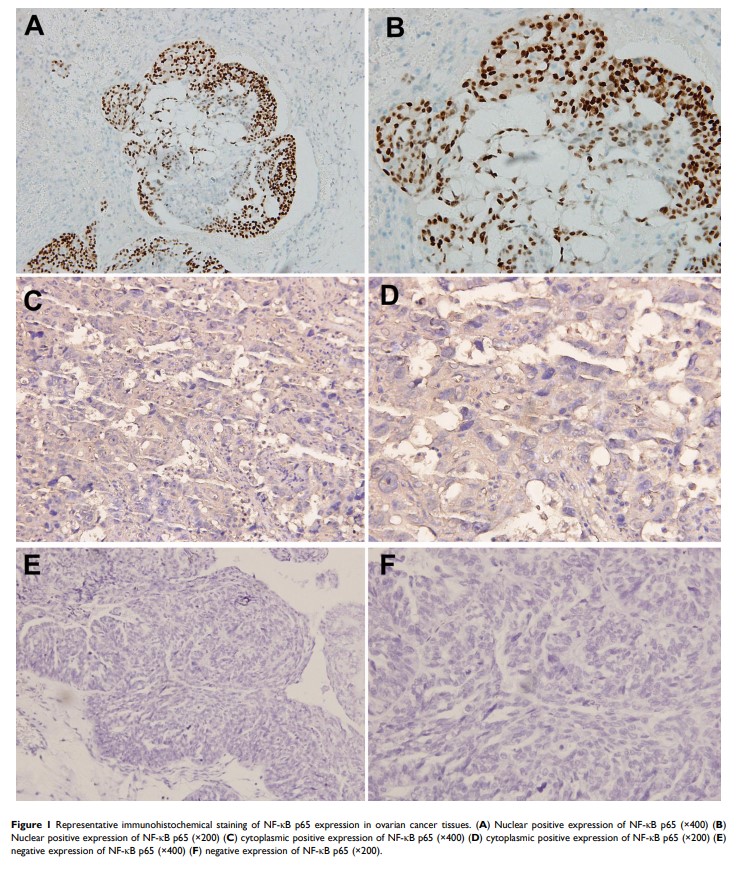
Results: Nuclear NF-κB p65 over-expression was closely associated with ovarian cancer with advanced FIGO stage, residual disease ≥ 1 cm, low histologic grade, platinum resistance and refractory, chemotherapy resistance (P < 0.05). FIGO stage I–II and residual disease < 1 cm were associated with complete response (CR) to chemotherapy, while FIGO stage I–II, residual disease < 1cm and absence of lymph node (LN) metastasis were associated with platinum sensitivity. In multivariate logistic regression, residual disease ≥ 1 cm was a risk factor for response to chemotherapy, while the over-expression of nuclear NF-κB p65 was a risk factor for sensitivity to chemotherapy. In the ROC curves, nuclear NF-κB p65 expression had the discriminative ability for sensitivity to chemotherapy (AUC = 0.637, P = 0.021). Furthermore, nuclear NF-κB p65 expression was an independent prognostic factor. Western blotting showed that NF-κB p65 level in cisplatin-resistant cells (C13* and A2780cp) was significantly higher than that in cisplatin-sensitive cells (OV2008 and A2780s) (P < 0.05), and this increased expression could be suppressed by NF-κB inhibitor-PDTC treatment. The proliferation inhibitory rates of cisplatin in C13* and A2780cp cells increased after PDTC treatment in a concentration-dependent manner. PDTC treatment could also enhance cisplatin-induced apoptosis.
Conclusion: NF-κB was associated with the clinicopathological features, chemoresistance, and prognosis of ovarian cancer. The NF-κB inhibitor PDTC can enhance cisplatin sensitivity of platinum-resistant C13* and A2780cp ovarian cancer cells.
Keywords: ovarian cancer, NF-κB, cisplatin resistance, chemoresistance, PDTC