119942
论文已发表
注册即可获取德孚的最新动态
IF 收录期刊
- 3.6 Breast Cancer (Dove Med Press)
- 4.3 Clin Epidemiol
- 2.6 Cancer Manag Res
- 3.2 Infect Drug Resist
- 4.1 Clin Interv Aging
- 6.1 Drug Des Dev Ther
- 4.1 Int J Chronic Obstr
- 8.7 Int J Nanomed
- 2.5 Int J Women's Health
- 3.2 Neuropsych Dis Treat
- 2.4 OncoTargets Ther
- 2.6 Patient Prefer Adher
- 2.6 Ther Clin Risk Manag
- 3.1 J Pain Res
- 3.5 Diabet Metab Synd Ob
- 4.5 Psychol Res Behav Ma
- 3.4 Nat Sci Sleep
- 2.4 Pharmgenomics Pers Med
- 2.6 Risk Manag Healthc Policy
- 4.6 J Inflamm Res
- 2.3 Int J Gen Med
- 3.9 J Hepatocell Carcinoma
- 3.3 J Asthma Allergy
- 2.5 Clin Cosmet Investig Dermatol
- 3.0 J Multidiscip Healthc

在肥胖成年人口中,抑郁和觉知压力(非焦虑)与发炎加剧相关
Authors Zou B, Miao C, Chen J
Received 11 July 2020
Accepted for publication 13 August 2020
Published 9 September 2020 Volume 2020:13 Pages 1489—1497
DOI https://doi.org/10.2147/RMHP.S270359
Checked for plagiarism Yes
Review by Single anonymous peer review
Peer reviewer comments 3
Editor who approved publication: Professor Marco Carotenuto
Background: Anxiety, depression and perceived stress are risk factors for adverse health problems. Inflammation participates in the development of chronic diseases such as psychiatric disorders. This study explored the relationships between inflammatory biomarkers and depression, anxiety and perceived stress in an obese adult population.
Methods: The relationships between psychological scores and inflammatory markers were analyzed.
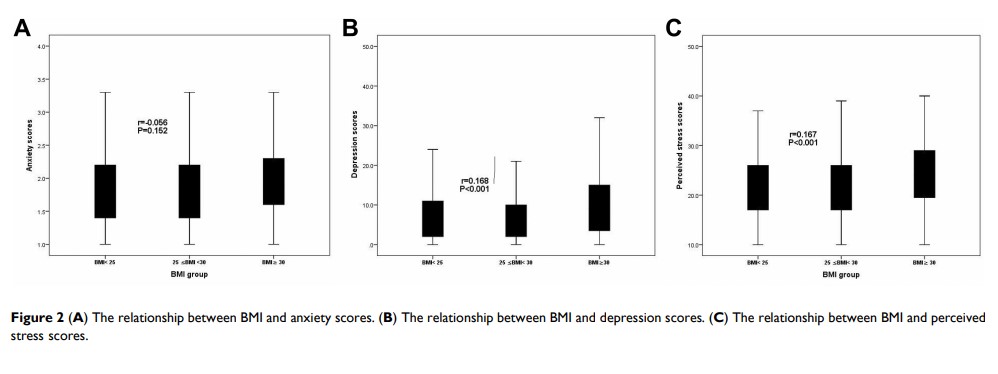
Results: A higher BMI was not correlated with a higher anxiety score (P=0.152); however, BMI was positively associated with a higher depression score (P< 0.001) and a higher perceived stress score (P< 0.001). Multivariate linear regression analysis revealed that in participants with BMI≥ 30 and 25≤BMI< 30, depression and perceived stress were significantly and independently associated with ICAM-1, E-selectin and CRP, but these associations were not observed in participants with BMI< 25. The anxiety score was not associated with any inflammatory marker in any group of subjects, as determined by multivariate analysis.
Conclusion: Depression and perceived stress were strongly associated with increased serum levels of pro-inflammatory markers, including ICAM-1, E-selectin and CRP, among a general obese population from the United States. These results further suggest that depression and perceived stress might also be chronic systemic inflammatory diseases.
Keywords: inflammatory markers, anxiety, depression, perceived stress, obesity