115195
论文已发表
注册即可获取德孚的最新动态
IF 收录期刊
- 3.6 Breast Cancer (Dove Med Press)
- 4.3 Clin Epidemiol
- 2.6 Cancer Manag Res
- 3.2 Infect Drug Resist
- 4.1 Clin Interv Aging
- 6.1 Drug Des Dev Ther
- 4.1 Int J Chronic Obstr
- 8.7 Int J Nanomed
- 2.5 Int J Women's Health
- 3.2 Neuropsych Dis Treat
- 2.4 OncoTargets Ther
- 2.6 Patient Prefer Adher
- 2.6 Ther Clin Risk Manag
- 3.1 J Pain Res
- 3.5 Diabet Metab Synd Ob
- 4.5 Psychol Res Behav Ma
- 3.4 Nat Sci Sleep
- 2.4 Pharmgenomics Pers Med
- 2.6 Risk Manag Healthc Policy
- 4.6 J Inflamm Res
- 2.3 Int J Gen Med
- 3.9 J Hepatocell Carcinoma
- 3.3 J Asthma Allergy
- 2.5 Clin Cosmet Investig Dermatol
- 3.0 J Multidiscip Healthc

circKRT7-miR-29a-3p-COL1A1 轴促进卵巢癌细胞进展
Authors An Q, Liu T, Wang M, Yang Y, Zhang Z, Lin Z, Yang B
Received 20 April 2020
Accepted for publication 28 July 2020
Published 9 September 2020 Volume 2020:13 Pages 8963—8976
DOI https://doi.org/10.2147/OTT.S259033
Checked for plagiarism Yes
Review by Single anonymous peer review
Peer reviewer comments 2
Editor who approved publication: Prof. Dr. Takuya Aoki
Background: Circular RNA (circRNA) has emerged as an important regulator in the progression of human diseases. However, the role of circRNAs in ovarian cancer remains largely unknown.
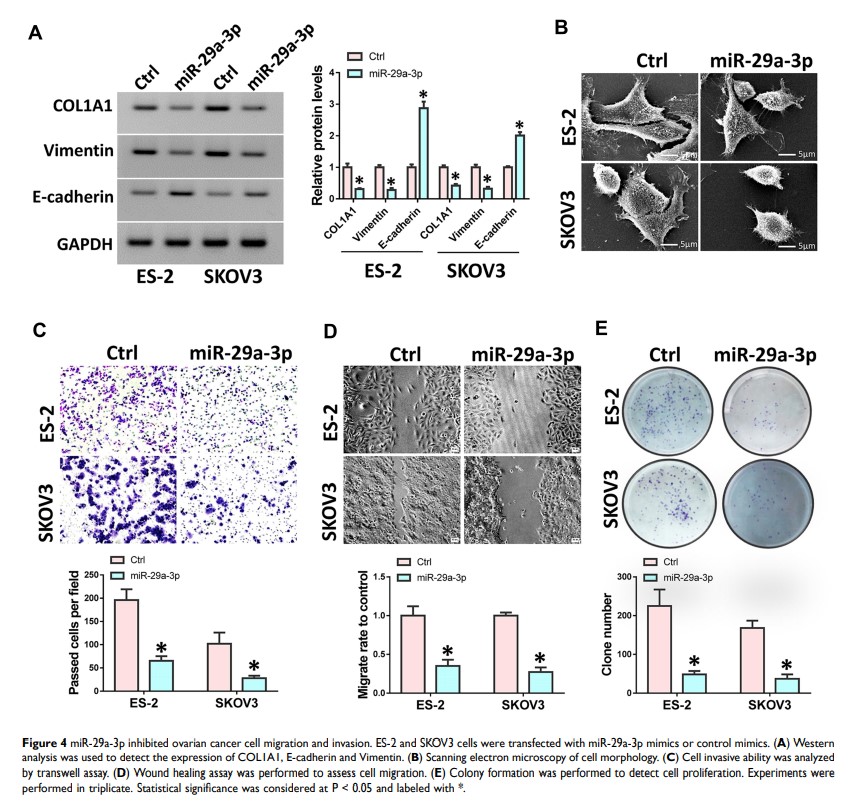
Materials and Methods: DNA sequencing and PCR were used to identify the existence and expression of circKRT7. The targeting relationship between circKRT7/miR-29a-3p and miR-29a-3p/COL1A1 was verified by fluorescence reporter assay. In vitro, colony formation, transwell and wound healing assay were used to detect the effects of circKRT7 and miR-29a-3p on the proliferation, migration and invasion ability of ovarian cancer cells. In vivo, xenograft tumor model was performed to validate the role of circKRT7 and miR-29a-3p in tumor growth.
Results: We found that circKRT7 can promote the proliferation and metastasis of ovarian cancer cells by absorbing miR-29a-3p, which leads to the up-regulation of COL1A1 . In vitro, knock-down of circKRT7 can inhibit the migration and invasion of ovarian cancer cells. This effect of circKRT7 is achieved by adsorbing miR-29a-3p and subsequently COL1A1 release. In vivo experiments, the reduction of circKRT7 expression can also slow tumor growth, and this inhibition was partly counteracted after miR-29a-3p repression.
Conclusion: Overall, circKRT7 promotes EMT-related cell progression by absorbing miR-29a-3p in ovarian cancer. This suggests the crucial role of circular RNA in the malignant evolution in cancer.
Keywords: ovarian cancer, KRT7, circular RNA, EMT