119942
论文已发表
注册即可获取德孚的最新动态
IF 收录期刊
- 3.6 Breast Cancer (Dove Med Press)
- 4.3 Clin Epidemiol
- 2.6 Cancer Manag Res
- 3.2 Infect Drug Resist
- 4.1 Clin Interv Aging
- 6.1 Drug Des Dev Ther
- 4.1 Int J Chronic Obstr
- 8.7 Int J Nanomed
- 2.5 Int J Women's Health
- 3.2 Neuropsych Dis Treat
- 2.4 OncoTargets Ther
- 2.6 Patient Prefer Adher
- 2.6 Ther Clin Risk Manag
- 3.1 J Pain Res
- 3.5 Diabet Metab Synd Ob
- 4.5 Psychol Res Behav Ma
- 3.4 Nat Sci Sleep
- 2.4 Pharmgenomics Pers Med
- 2.6 Risk Manag Healthc Policy
- 4.6 J Inflamm Res
- 2.3 Int J Gen Med
- 3.9 J Hepatocell Carcinoma
- 3.3 J Asthma Allergy
- 2.5 Clin Cosmet Investig Dermatol
- 3.0 J Multidiscip Healthc

长非编码 RNA DARS-AS1 通过调节 MicroRNA-628-5p/MTDH 轴促进前列腺癌的进展
Authors Fan H, Hou J, Liu S, Xiao Z, Cui J
Received 6 July 2020
Accepted for publication 19 August 2020
Published 10 September 2020 Volume 2020:12 Pages 8363—8377
DOI https://doi.org/10.2147/CMAR.S271021
Checked for plagiarism Yes
Review by Single anonymous peer review
Peer reviewer comments 2
Editor who approved publication: Dr Antonella D'Anneo
Purpose: DARS antisense RNA 1 (DARS-AS1) is a long non-coding RNA that has been validated as a critical regulator in several human cancer types. Our study aimed to determine the expression profile of DARS-AS1 in prostate cancer (PCa) tissues and cell lines. Functional experiments were conducted to explore the detailed roles of DARS-AS1 in regulating PCa carcinogenesis. Furthermore, the detailed mechanisms by which DARS-AS1 regulates the oncogenicity of PCa cells were uncovered.
Methods: Reverse transcription quantitative polymerase chain reaction was performed to analyze DARS-AS1 expression in PCa tissues and cell lines. Cell Counting Kit-8 assays, flow cytometry analyses, Transwell assays, and tumor xenograft experiments were conducted to determine the regulatory effects of DARS-AS1 knockdown on the malignant phenotype of PCa cells. Bioinformatics analysis was performed to identify putative microRNAs (miRNAs) targeting DARS-AS1, and the direct interaction between DARS-AS1 and miR-628-5p was verified using RNA immunoprecipitation and luciferase reporter assays.
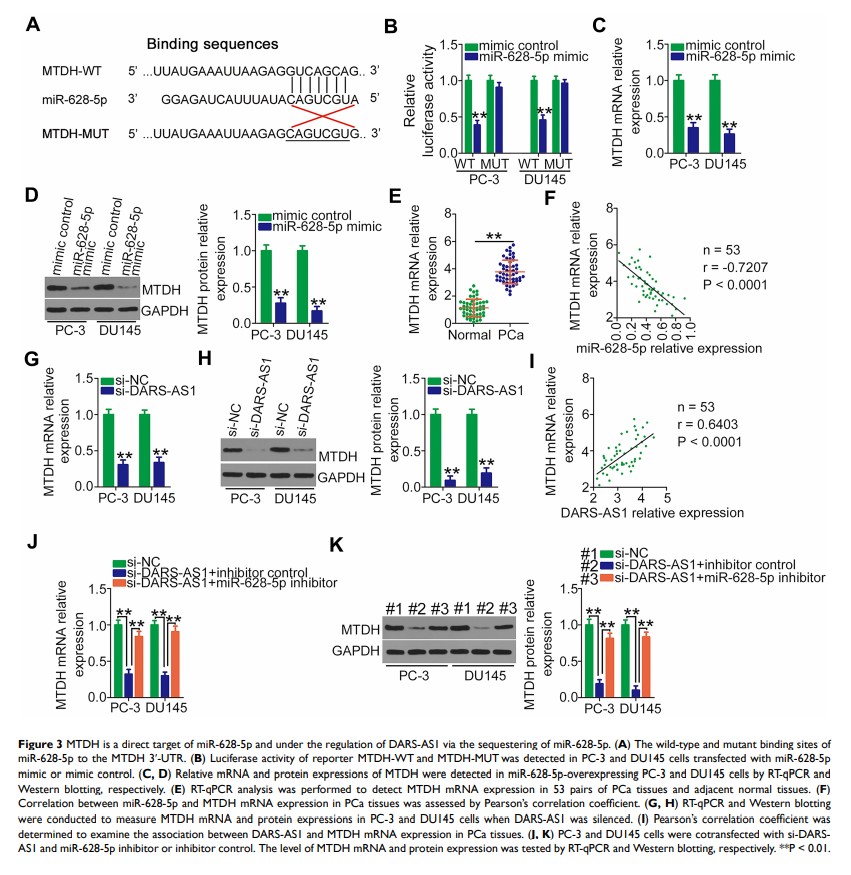
Results: DARS-AS1 was highly expressed in PCa tissues and cell lines. In vitro functional experiments demonstrated that DARS-AS1 depletion suppressed PCa cell proliferation, promoted cell apoptosis, and restricted cell migration and invasion. In vivo studies revealed that the downregulation of DARS-AS1 inhibited PCa tumor growth in nude mice. Mechanistic investigation verified that DARS-AS1 functioned as an endogenous miR-628-5p sponge in PCa cells and consequently promoted the expression of metadherin (MTDH). Furthermore, the involvement of miR-628-5p/MTDH axis in DARS-AS1-mediated regulatory actions in PCa cells was verified using rescue experiments.
Conclusion: DARS-AS1 functioned as a competing endogenous RNA in PCa by adsorbing miR-628-5p and thereby increasing the expression of MTDH, resulting in enhanced PCa progression. The identification of a novel DARS-AS1/miR-628-5p/MTDH regulatory network in PCa cells may offer a new theoretical basis for the development of promising therapeutic targets.
Keywords: DARS antisense RNA 1, non-coding RNA, ceRNA theory, target therapy