115195
论文已发表
注册即可获取德孚的最新动态
IF 收录期刊
- 3.6 Breast Cancer (Dove Med Press)
- 4.3 Clin Epidemiol
- 2.6 Cancer Manag Res
- 3.2 Infect Drug Resist
- 4.1 Clin Interv Aging
- 6.1 Drug Des Dev Ther
- 4.1 Int J Chronic Obstr
- 8.7 Int J Nanomed
- 2.5 Int J Women's Health
- 3.2 Neuropsych Dis Treat
- 2.4 OncoTargets Ther
- 2.6 Patient Prefer Adher
- 2.6 Ther Clin Risk Manag
- 3.1 J Pain Res
- 3.5 Diabet Metab Synd Ob
- 4.5 Psychol Res Behav Ma
- 3.4 Nat Sci Sleep
- 2.4 Pharmgenomics Pers Med
- 2.6 Risk Manag Healthc Policy
- 4.6 J Inflamm Res
- 2.3 Int J Gen Med
- 3.9 J Hepatocell Carcinoma
- 3.3 J Asthma Allergy
- 2.5 Clin Cosmet Investig Dermatol
- 3.0 J Multidiscip Healthc

MicroRNA-3666 通过抑制 PFKFB3 介导的 Warburg 效应来遏制头颈部鳞状细胞癌中的细胞生长
Authors Chen L, Cao Y, Wu B, Cao Y
Received 1 March 2020
Accepted for publication 9 July 2020
Published 10 September 2020 Volume 2020:13 Pages 9029—9041
DOI https://doi.org/10.2147/OTT.S251992
Checked for plagiarism Yes
Review by Single anonymous peer review
Peer reviewer comments 3
Editor who approved publication: Dr Federico Perche
Purpose: MicroRNA-3666 (miR-3666) is aberrantly expressed and plays critical roles in numerous human tumors. However, the expression pattern, biological role, and mechanisms of action of miR-3666 in head and neck squamous cell carcinoma (HNSCC) remain unknown. Therefore, we attempted to determine the expression status and function of miR-3666 in HNSCC and to explore the underlying mechanisms in detail.
Methods: In this study, quantitative real-time polymerase chain reaction was carried out to measure the expression of miR-3666 HNSCC tissues. A series of experiments, including a Cell Counting Kit-8 assay, colony formation assay, BrdU incorporation and apoptosis analysis, were applied to test whether miR-3666 affects the growth of HNSCC cells. Glucose uptake and lactate production measurements and extracellular acidification and oxygen consumption rate assays were conducted to determine the effect of miR-3666 on glycolysis.
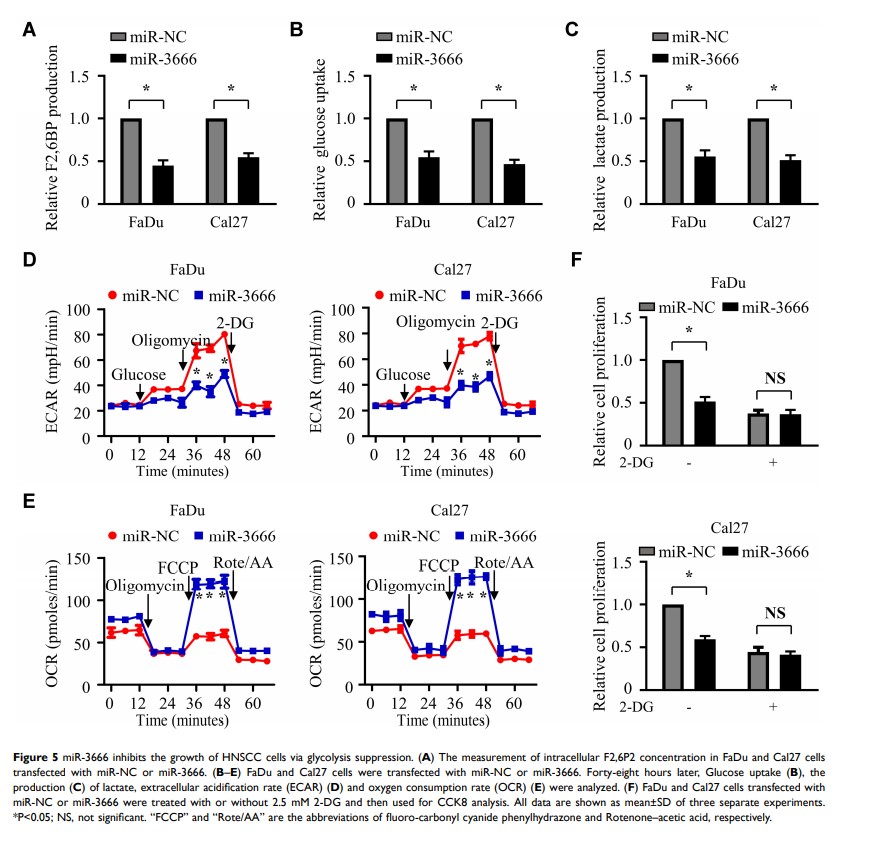
Results: We found that miR-3666 showed a decreased expression in HNSCC tissues. Further functional studies demonstrated that miR-3666 inhibited the growth of HNSCC cells by suppressing cell proliferation and promoting apoptosis. Bioinformatics analysis and luciferase reporter assays identified phosphofructokinase-2/fructose-2,6-bisphosphatase 3 (PFKFB3), a key enzyme regulating glycolysis, as a direct target of miR-3666. Through inhibition of PFKFB3, miR-3666 decreased glycolysis in HNSCC cells by reducing the production of F2,6BP. Importantly, glycolysis suppression caused by miR-3666 was found to be required for its inhibitory effect on HNSCC cell growth.
Conclusion: Our data suggest that miR-3666 functions as a tumor suppressor by decreasing the rate of glycolysis through inhibition of PFKFB3 activity, and this miRNA may present a potential candidate for HNSCC therapy.
Keywords: microRNA-3666, head and neck squamous cell carcinoma, PFKFB3, Warburg effect