115195
论文已发表
注册即可获取德孚的最新动态
IF 收录期刊
- 3.6 Breast Cancer (Dove Med Press)
- 4.3 Clin Epidemiol
- 2.6 Cancer Manag Res
- 3.2 Infect Drug Resist
- 4.1 Clin Interv Aging
- 6.1 Drug Des Dev Ther
- 4.1 Int J Chronic Obstr
- 8.7 Int J Nanomed
- 2.5 Int J Women's Health
- 3.2 Neuropsych Dis Treat
- 2.4 OncoTargets Ther
- 2.6 Patient Prefer Adher
- 2.6 Ther Clin Risk Manag
- 3.1 J Pain Res
- 3.5 Diabet Metab Synd Ob
- 4.5 Psychol Res Behav Ma
- 3.4 Nat Sci Sleep
- 2.4 Pharmgenomics Pers Med
- 2.6 Risk Manag Healthc Policy
- 4.6 J Inflamm Res
- 2.3 Int J Gen Med
- 3.9 J Hepatocell Carcinoma
- 3.3 J Asthma Allergy
- 2.5 Clin Cosmet Investig Dermatol
- 3.0 J Multidiscip Healthc

对接受辅助生殖的子宫内膜薄的患者,GnRH-a 超长方案和 GnRH-a 短方案的比较:一项回顾性队列研究
Authors Song J, Duan C, Cai W, Wu W, Lv H, Xu J
Received 3 July 2020
Accepted for publication 21 August 2020
Published 11 September 2020 Volume 2020:14 Pages 3673—3682
DOI https://doi.org/10.2147/DDDT.S270519
Checked for plagiarism Yes
Review by Single anonymous peer review
Peer reviewer comments 2
Editor who approved publication: Dr Qiongyu Guo
Purpose: Gonadotrophin releasing hormone agonist (GnRH-a) is widely used for pituitary down-regulation and recruiting more follicles in assisted reproduction. However, no information is available on its value for patients with thin endometrial thickness.
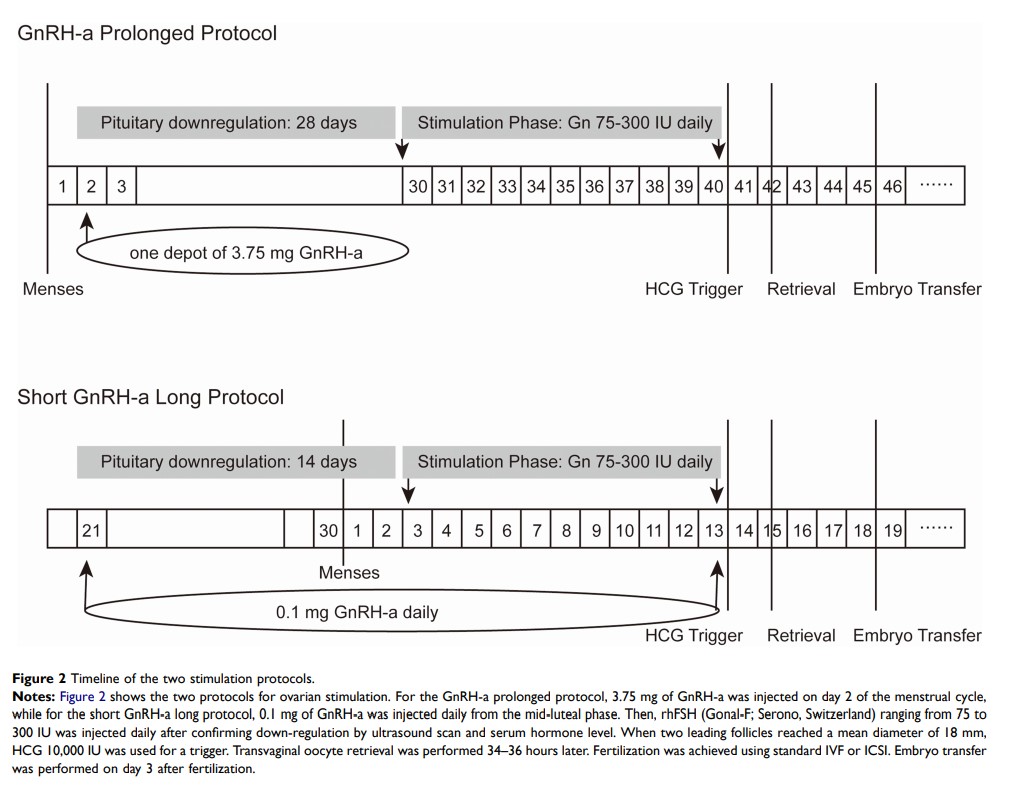
Patients and Methods: This was a retrospective cohort study of 302 patients with endometrium < 8 mm undergoing fresh embryo transfer at a fertility center of a university hospital from January 2016 and December 2018. In 148 cycles of the GnRH-a prolonged protocol, one depot of 3.75 mg GnRH-a was injected on day 2 of the menstrual cycle, while in 154 cycles of the short GnRH-a long protocol, 0.1 mg of GnRH-a was injected daily from the mid-luteal phase. The live birth rate and clinical pregnancy rate were compared between the two groups. Other outcome measures included the implantation rate, miscarriage rate, and characteristics of stimulation procedures.
Results: Live birth rates and clinical pregnancy rates were significantly higher in the GnRH-a prolonged protocol group than in the other group (36.5% vs 20.8%, P =0.002; 43.9% vs 28.2%, P =0.006, respectively). The live birth rate was significantly increased in the prolonged protocol group (crude OR: 2.190, 95% CI: 1.311, 3.660; adjusted OR: 2.458, 95% CI: 1.430, 4.224) compared with that in the reference group. The implantation rate of the former group was also significantly higher than that of the latter group (35.4% vs 15.9%, P =0.000). There was no significant difference in miscarriage rates between the two protocols. In terms of stimulation procedures, the GnRH-a prolonged protocol group required significantly higher Gn time (10.9 vs 9.5 days, P =0.000) and Gn consumption (2625.0 vs 2047.5 IU, P =0.000) than the short GnRH-a long protocol group.
Conclusion: The GnRH-a prolonged protocol in fresh embryo transfer cycles yielded better clinical outcomes of patients with thin endometrium than the short GnRH-a long protocol.
Keywords: ovarian stimulation, GnRH-a prolonged protocol, thin endometrium, IVF, COH