115195
论文已发表
注册即可获取德孚的最新动态
IF 收录期刊
- 3.6 Breast Cancer (Dove Med Press)
- 4.3 Clin Epidemiol
- 2.6 Cancer Manag Res
- 3.2 Infect Drug Resist
- 4.1 Clin Interv Aging
- 6.1 Drug Des Dev Ther
- 4.1 Int J Chronic Obstr
- 8.7 Int J Nanomed
- 2.5 Int J Women's Health
- 3.2 Neuropsych Dis Treat
- 2.4 OncoTargets Ther
- 2.6 Patient Prefer Adher
- 2.6 Ther Clin Risk Manag
- 3.1 J Pain Res
- 3.5 Diabet Metab Synd Ob
- 4.5 Psychol Res Behav Ma
- 3.4 Nat Sci Sleep
- 2.4 Pharmgenomics Pers Med
- 2.6 Risk Manag Healthc Policy
- 4.6 J Inflamm Res
- 2.3 Int J Gen Med
- 3.9 J Hepatocell Carcinoma
- 3.3 J Asthma Allergy
- 2.5 Clin Cosmet Investig Dermatol
- 3.0 J Multidiscip Healthc

基质金属蛋白酶 11 是膀胱癌诊断和预后的潜在生物标志物
Authors Chen C, Liu X, Jiang J, Li S, Wang G, Ju L, Wang F, Liu T, Li S
Received 23 December 2019
Accepted for publication 16 August 2020
Published 11 September 2020 Volume 2020:13 Pages 9059—9069
DOI https://doi.org/10.2147/OTT.S243452
Checked for plagiarism Yes
Review by Single anonymous peer review
Peer reviewer comments 5
Editor who approved publication: Dr Leo Jen-Liang Su
Purpose: Bladder cancer is one of the leading causes of cancer death all over the world, and half of patients are diagnosed at advanced stages with poor therapeutic response. Thus, developing new biomarkers for bladder cancer diagnosis and prognosis is urgently needed.
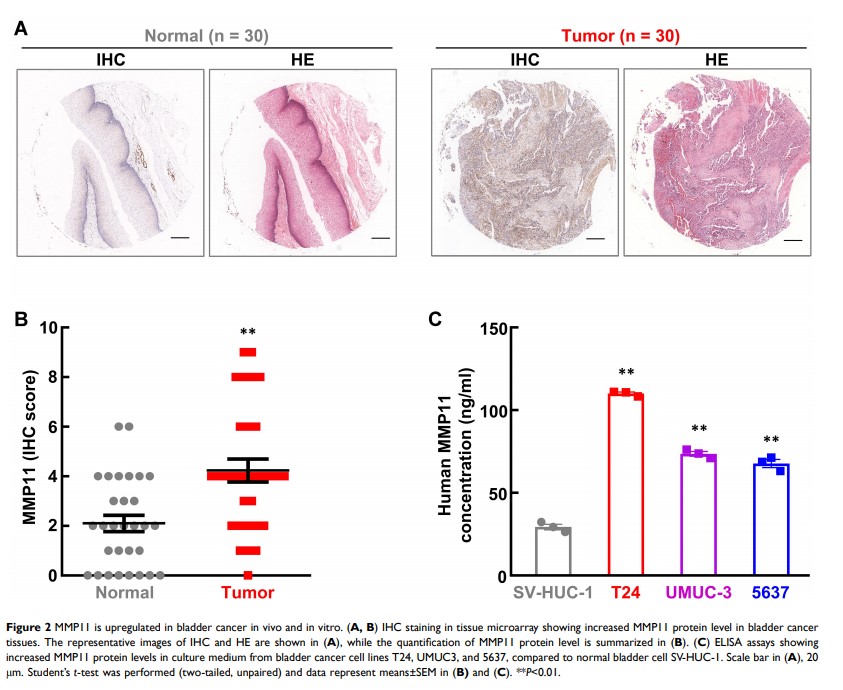
Materials and Methods: Bioinformatic and gene ontology (GO) analysis were employed to screen highly upregulated and secretory tumor markers in the TCGA BLCA cohort. IHC in tissue microarray and ELISA in cancer cell culture medium were used to validate the expression of putative biomarkers in bladder cancer. Bisulfite sequencing was used to detect DNA methylation status in the promoter of putative genes.
Results: In this study, MMP11 is first identified as one of the most differentially expressed genes (DEGs) in bladder cancer by meta-analysis in a TCGA bladder cancer cohort. The strong upregulation of MMP11 is confirmed at protein levels in both bladder cancer patients and cell lines. Mechanistic studies reveal that MMP11 promoter hypomethylation, but not genomic amplification or mutation, accounts for its enhanced expression in bladder cancer both in vitro and in vivo. Moreover, clinicopathological analysis indicates that MMP11 upregulation is associated with the tumor progression and poor survival in bladder cancer patients.
Discussion: These findings suggest that MMP11, as a secretory protein, is a promising biomarker for diagnosis and prognosis in bladder cancer.
Keywords: bladder cancer, TCGA, MMP11, DEG, hypomethylation, diagnosis, prognosis