115195
论文已发表
注册即可获取德孚的最新动态
IF 收录期刊
- 3.6 Breast Cancer (Dove Med Press)
- 4.3 Clin Epidemiol
- 2.6 Cancer Manag Res
- 3.2 Infect Drug Resist
- 4.1 Clin Interv Aging
- 6.1 Drug Des Dev Ther
- 4.1 Int J Chronic Obstr
- 8.7 Int J Nanomed
- 2.5 Int J Women's Health
- 3.2 Neuropsych Dis Treat
- 2.4 OncoTargets Ther
- 2.6 Patient Prefer Adher
- 2.6 Ther Clin Risk Manag
- 3.1 J Pain Res
- 3.5 Diabet Metab Synd Ob
- 4.5 Psychol Res Behav Ma
- 3.4 Nat Sci Sleep
- 2.4 Pharmgenomics Pers Med
- 2.6 Risk Manag Healthc Policy
- 4.6 J Inflamm Res
- 2.3 Int J Gen Med
- 3.9 J Hepatocell Carcinoma
- 3.3 J Asthma Allergy
- 2.5 Clin Cosmet Investig Dermatol
- 3.0 J Multidiscip Healthc

不同年龄段肺癌患者的临床特征和预后
Authors Chen X, Han X, Zhou H, Liang Y, Huang Z, Li S, Lin Y, Huang X, Wu J, Su W, Lai Z, Yang Z
Received 28 November 2019
Accepted for publication 13 August 2020
Published 14 September 2020 Volume 2020:12 Pages 8445—8450
DOI https://doi.org/10.2147/CMAR.S240318
Checked for plagiarism Yes
Review by Single anonymous peer review
Peer reviewer comments 3
Editor who approved publication: Dr Beicheng Sun
Objective: Cancer is closely related to age, and the incidence of cancer increases with age. However, there are few studies on the relationship between age and clinical characteristics of lung cancer.
Patients and Methods: We collected all the consecutive lung cancer cases from 2012 to 2017 in our hospital and divided them into 6 groups according to their ages: ≤ 40 y/o, 41∼ 50 y/o, 51∼ 60 y/o, 61∼ 70 y/o, 71∼ 80 y/o and > 80 y/o. The clinical characteristics and prognosis of these patients were evaluated.
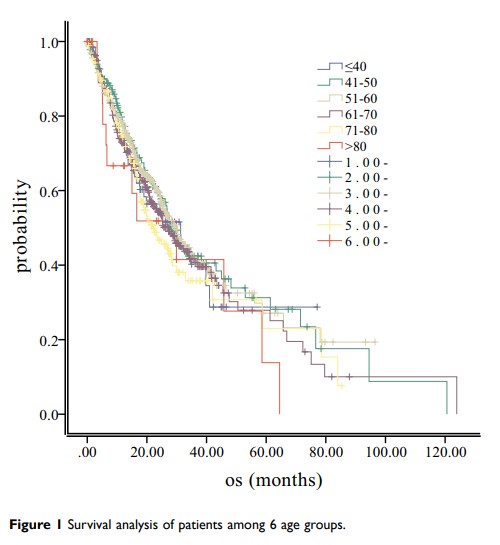
Results: There were 1143 cases diagnosed in our hospital from 2012 to 2017. There were more non-smokers (p< 0.01), stage IV (p< 0.01) and anaplastic lymphoma kinase (ALK) fusion (p< 0.01) patients but less stage I patients in ≤ 40 y/o group compared with other age groups. It seemed that older patients were more likely had co-exist driver gene mutations (p=0.04). There was no significant difference in overall survival (OS) among these 6 age groups. However, the age may be an independent prognostic factor compared with the patients in ≤ 40 y/o group, the patients in > 80 y/o group were associated with a higher mortality risk, while the patients in other groups had the similar mortality risk.
Conclusion: There are some differences in clinical characteristics and prognosis among different age groups. The reasons behind the phenomenon are largely unclear. The age should be taken into account when we develop clinical trials.
Keywords: age, lung cancer, clinical characteristics, clinical trials