115195
论文已发表
注册即可获取德孚的最新动态
IF 收录期刊
- 3.6 Breast Cancer (Dove Med Press)
- 4.3 Clin Epidemiol
- 2.6 Cancer Manag Res
- 3.2 Infect Drug Resist
- 4.1 Clin Interv Aging
- 6.1 Drug Des Dev Ther
- 4.1 Int J Chronic Obstr
- 8.7 Int J Nanomed
- 2.5 Int J Women's Health
- 3.2 Neuropsych Dis Treat
- 2.4 OncoTargets Ther
- 2.6 Patient Prefer Adher
- 2.6 Ther Clin Risk Manag
- 3.1 J Pain Res
- 3.5 Diabet Metab Synd Ob
- 4.5 Psychol Res Behav Ma
- 3.4 Nat Sci Sleep
- 2.4 Pharmgenomics Pers Med
- 2.6 Risk Manag Healthc Policy
- 4.6 J Inflamm Res
- 2.3 Int J Gen Med
- 3.9 J Hepatocell Carcinoma
- 3.3 J Asthma Allergy
- 2.5 Clin Cosmet Investig Dermatol
- 3.0 J Multidiscip Healthc

人际交往中的负偏差效应:为什么人们低估了他们给别人留下的积极印象
Authors Li J, Zhong Z, Mo L
Received 15 April 2020
Accepted for publication 13 August 2020
Published 14 September 2020 Volume 2020:13 Pages 733—745
DOI https://doi.org/10.2147/PRBM.S258057
Checked for plagiarism Yes
Review by Single anonymous peer review
Peer reviewer comments 3
Editor who approved publication: Professor Igor Elman
Background: Recently, a study revealed that people liked others significantly more than they estimated that others liked them. Thus, the study found that people tended to underestimate how much others liked them, a phenomenon the authors called the Liking Gap. However, the logic and testing of the study existed unclear nature. In order to show whether people underestimate the positivity of impression they left on others, we directly compare the estimate of the impression we left on others with others’ actual impression of us, which make the logic clear. Besides, we explored the new findings with regard to the mechanism of the effect.
Methods: Based on this idea, in study 1, we explored whether there is indeed a negative deviation effect in the estimate of the impression people left on others in short interpersonal communication. In study 2, we investigated the potential psychological mechanisms of that effect.
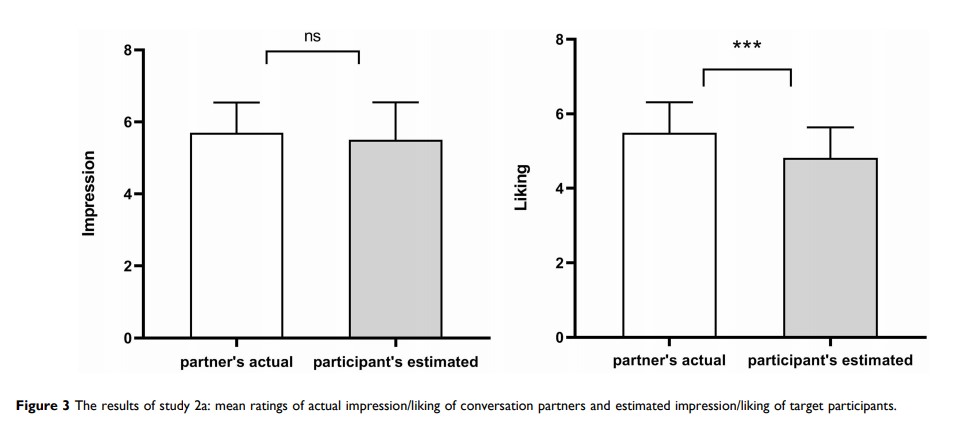
Results: In Study 1, the results revealed that people estimated that others liked them significantly less than others actually liked them. That is, a negative deviation effect did occur, and even if people were clear about their liking for others, the effect still existed. In Study 2, we provided evidence that a negative deviation effect existed not just because people are too focused on their own-negative thoughts in conversational performance but rather because people had a psychological defense towards others in their first communication.
Conclusion: People significantly underestimate how much they are liked and its reason is that their psychological defense towards others in their initial communication. The results of the study are beneficial for people in social interaction and provide them with new ways of thinking in interpersonal communication and mutual contact.
Keywords: impression, negative deviation, negative thoughts, psychological defense