115195
论文已发表
注册即可获取德孚的最新动态
IF 收录期刊
- 3.6 Breast Cancer (Dove Med Press)
- 4.3 Clin Epidemiol
- 2.6 Cancer Manag Res
- 3.2 Infect Drug Resist
- 4.1 Clin Interv Aging
- 6.1 Drug Des Dev Ther
- 4.1 Int J Chronic Obstr
- 8.7 Int J Nanomed
- 2.5 Int J Women's Health
- 3.2 Neuropsych Dis Treat
- 2.4 OncoTargets Ther
- 2.6 Patient Prefer Adher
- 2.6 Ther Clin Risk Manag
- 3.1 J Pain Res
- 3.5 Diabet Metab Synd Ob
- 4.5 Psychol Res Behav Ma
- 3.4 Nat Sci Sleep
- 2.4 Pharmgenomics Pers Med
- 2.6 Risk Manag Healthc Policy
- 4.6 J Inflamm Res
- 2.3 Int J Gen Med
- 3.9 J Hepatocell Carcinoma
- 3.3 J Asthma Allergy
- 2.5 Clin Cosmet Investig Dermatol
- 3.0 J Multidiscip Healthc

在以人为本的痴呆症护理中了解护理人员与护理对象之间的相互作用:一个简短回顾
Authors Wu Q, Qian S, Deng C, Yu P
Received 25 March 2020
Accepted for publication 5 August 2020
Published 14 September 2020 Volume 2020:15 Pages 1637—1647
DOI https://doi.org/10.2147/CIA.S255454
Checked for plagiarism Yes
Review by Single anonymous peer review
Peer reviewer comments 3
Editor who approved publication: Dr Richard Walker
Background: Good interactions are essential in caring for people with dementia. There is a lack of knowledge about interaction approaches used by caregivers in person-centered dementia care. This study aimed to understand interactions in person-centered dementia care.
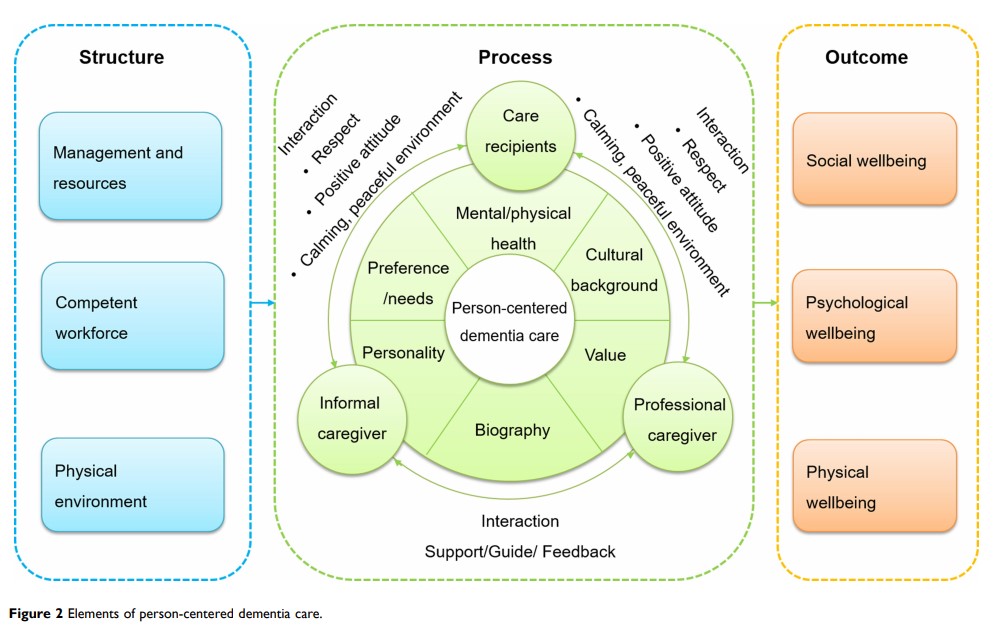
Methods: A search for relevant publications was undertaken in 2020 on two electronic databases, MEDLINE with full text and CINAHL Plus with full text. This was supplemented by manual searching of the reference lists of relevant articles. Inclusion and exclusion criteria were applied to determine the relevance of the articles. Data extraction included publication year, country, study setting, aim, design, definition of person-centered dementia care, elements of person-centered dementia care and interaction approaches used by caregivers. A Donabedian quality framework was used to group the elements of person-centered dementia care into three categories: structure, process and outcome.
Results: A total of 25 articles were included in the review, all from developed countries. A conceptual framework was developed for the delivery of person-centered dementia care. It includes the organizational structure, ie, management and resources, a competent workforce and physical environment; the dementia care process, ie, respectful interaction underpinned by good knowledge about the care recipients in a calm, peaceful environment; and care outcome, ie, the social, psychological, and physical well-being of the care recipients. Interaction approaches used by caregivers in providing person-centered dementia care were classified according to the six purposes of interaction: to know and understand the care recipient, to keep the person happy and satisfied, to make the person feel safe and secure, to calm the person, to support self-identity, and to guide the person in conducting daily activities.
Conclusion: The delivery of person-centered dementia care needs to consider organizational structure, the dementia care process, and care outcome which together foster a positive environment for meaningful interactions between caregivers and care recipients. The identified interaction approaches could be used by dementia care trainers to develop training materials.
Keywords: dementia, framework, interaction, person-centered care