115195
论文已发表
注册即可获取德孚的最新动态
IF 收录期刊
- 3.6 Breast Cancer (Dove Med Press)
- 4.3 Clin Epidemiol
- 2.6 Cancer Manag Res
- 3.2 Infect Drug Resist
- 4.1 Clin Interv Aging
- 6.1 Drug Des Dev Ther
- 4.1 Int J Chronic Obstr
- 8.7 Int J Nanomed
- 2.5 Int J Women's Health
- 3.2 Neuropsych Dis Treat
- 2.4 OncoTargets Ther
- 2.6 Patient Prefer Adher
- 2.6 Ther Clin Risk Manag
- 3.1 J Pain Res
- 3.5 Diabet Metab Synd Ob
- 4.5 Psychol Res Behav Ma
- 3.4 Nat Sci Sleep
- 2.4 Pharmgenomics Pers Med
- 2.6 Risk Manag Healthc Policy
- 4.6 J Inflamm Res
- 2.3 Int J Gen Med
- 3.9 J Hepatocell Carcinoma
- 3.3 J Asthma Allergy
- 2.5 Clin Cosmet Investig Dermatol
- 3.0 J Multidiscip Healthc

在预测肾癌无复发生存时间中,凝血酶原时间活性、凝血酶原时间、白蛋白/球蛋白比、血小板、性别和纤维蛋白原的预后作用
Authors Bian Z, Meng J, Niu Q, Jin X, Wang J, Feng X, Che H, Zhou J, Zhang L, Zhang M, Liang C
Received 2 June 2020
Accepted for publication 25 August 2020
Published 15 September 2020 Volume 2020:12 Pages 8481—8490
DOI https://doi.org/10.2147/CMAR.S264856
Checked for plagiarism Yes
Review by Single anonymous peer review
Peer reviewer comments 2
Editor who approved publication: Dr Yong Teng
Background: To help with the clinical practice of renal cancer patients, prognostic models are urgently warranted. We hunted and identified prognostic variables associated with recurrence-free survival (RFS) for renal cancer patients.
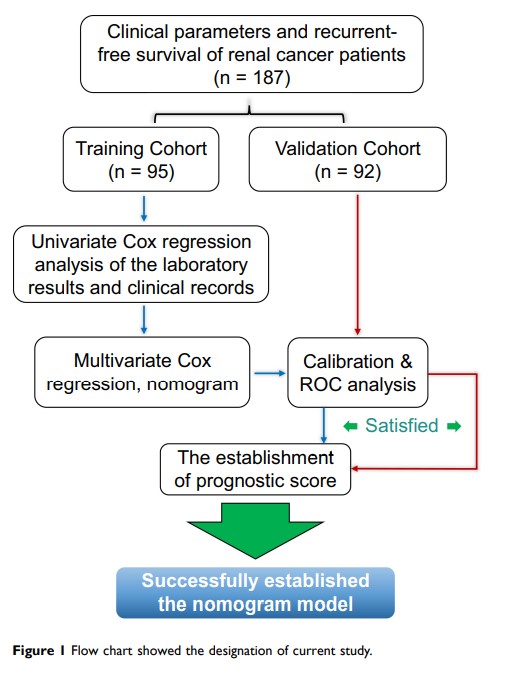
Patients and Methods: In this retrospective study, 187 renal cancer patients who had received curative radical/partial nephrectomy between November 2011 and January 2017 were enrolled in the current study. These patients were randomly split into the training (n = 95) and validation sets (n = 92) by the ratio of 1:1. Univariate and multivariable Cox regression analyses were used to establish the nomogram, which was then evaluated by receiver operating characteristic (ROC) and Kaplan-Meier (K-M) analyses.
Results: Patient characteristics and outcomes were well balanced between the training and validation sets; the median RFS values were 54.1 months and 58.9 months for the training and validation cohorts, respectively. The final nomogram included six independent prognostic variables (prothrombin time (%), prothrombin time (second), albumin/globulin ratio, platelets, sex and fibrinogen). The mean values of RFS for the low- and high-risk groups defined by a prognostic formula were 56.22 ± 18.50 months and 49.54 ± 23.57 months, respectively, in the training cohort and were 59.00 ± 19.50 months and 53.32 ± 19.95 months, respectively, in the validation cohort. The significance and stability of the model were tested by the time-dependent K-M model and ROC curves, respectively.
Conclusion: Our validated prognostic model incorporates variables routinely collected from renal cancer patients, identifying subsets of patients with different survival outcomes, which provides useful information for patient care and clinical trial design.
Keywords: renal cancer, recurrence, nomogram