115195
论文已发表
注册即可获取德孚的最新动态
IF 收录期刊
- 3.6 Breast Cancer (Dove Med Press)
- 4.3 Clin Epidemiol
- 2.6 Cancer Manag Res
- 3.2 Infect Drug Resist
- 4.1 Clin Interv Aging
- 6.1 Drug Des Dev Ther
- 4.1 Int J Chronic Obstr
- 8.7 Int J Nanomed
- 2.5 Int J Women's Health
- 3.2 Neuropsych Dis Treat
- 2.4 OncoTargets Ther
- 2.6 Patient Prefer Adher
- 2.6 Ther Clin Risk Manag
- 3.1 J Pain Res
- 3.5 Diabet Metab Synd Ob
- 4.5 Psychol Res Behav Ma
- 3.4 Nat Sci Sleep
- 2.4 Pharmgenomics Pers Med
- 2.6 Risk Manag Healthc Policy
- 4.6 J Inflamm Res
- 2.3 Int J Gen Med
- 3.9 J Hepatocell Carcinoma
- 3.3 J Asthma Allergy
- 2.5 Clin Cosmet Investig Dermatol
- 3.0 J Multidiscip Healthc

半乳糖凝集素-3 的药理学抑制作用可在体内和体外改善糖尿病相关的认知障碍、氧化应激和神经炎症
Authors Yin Q, Chen J, Ma S, Dong C, Zhang Y, Hou X, Li S, Liu B
Received 31 July 2020
Accepted for publication 1 September 2020
Published 15 September 2020 Volume 2020:13 Pages 533—542
DOI https://doi.org/10.2147/JIR.S273858
Checked for plagiarism Yes
Review by Single anonymous peer review
Peer reviewer comments 2
Editor who approved publication: Professor Ning Quan
Background: In diabetes, cognitive impairment is linked with oxidative stress and neuroinflammation. As the only chimeric member of the galectin family, galectin-3 (Gal3) induces neuroinflammation and cognitive impairment in models of Alzheimer’s disease (AD); however, its role in diabetes-associated cognitive impairment is not established.
Methodology: Here, we investigated the effects of Gal3 inhibition on cognitive impairment and the possible underlying molecular events in diabetes. We investigated the effects of the Gal3 inhibitor modified citrus pectin (MCP; 100 mg/kg/day oral for 6 weeks) in vivo in high-fat diet (HFD)/streptozotocin (STZ)-induced diabetic rats. Additionally, the effects of MCP on high glucose (HG)-stimulated BV-2 microglial cells were investigated in vitro.
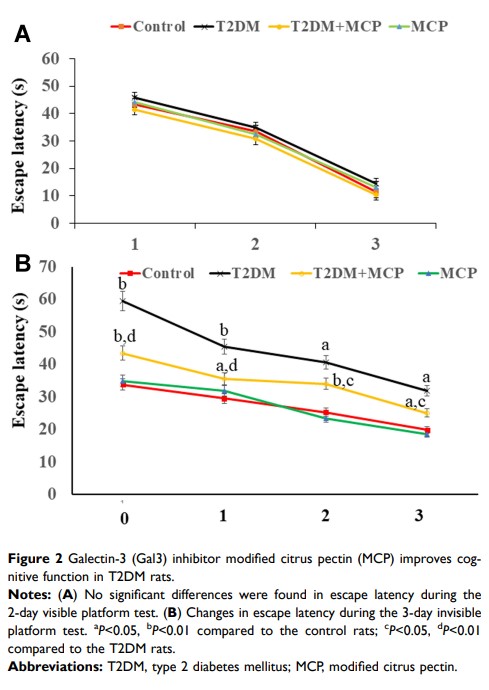
Results: We found that MCP attenuated memory impairment in diabetic rats in the Morris water maze test and reduced insulin resistance, oxidative stress, and neuroinflammation. In HG-stimulated BV-2 microglial cells, MCP increased cell viability and decreased oxidative stress and the production of proinflammatory cytokines.
Conclusion: The results of this study indicate that the inhibition of Gal3 by MCP ameliorates diabetes-associated cognitive impairment, oxidative stress, and neuroinflammation, suggesting that Gal3 could be a potential new target for therapeutic intervention to prevent cognitive impairment in diabetes.
Keywords: galectin-3, oxidative stress, neuroinflammation, cognitive impairment, diabetes