115195
论文已发表
注册即可获取德孚的最新动态
IF 收录期刊
- 3.6 Breast Cancer (Dove Med Press)
- 4.3 Clin Epidemiol
- 2.6 Cancer Manag Res
- 3.2 Infect Drug Resist
- 4.1 Clin Interv Aging
- 6.1 Drug Des Dev Ther
- 4.1 Int J Chronic Obstr
- 8.7 Int J Nanomed
- 2.5 Int J Women's Health
- 3.2 Neuropsych Dis Treat
- 2.4 OncoTargets Ther
- 2.6 Patient Prefer Adher
- 2.6 Ther Clin Risk Manag
- 3.1 J Pain Res
- 3.5 Diabet Metab Synd Ob
- 4.5 Psychol Res Behav Ma
- 3.4 Nat Sci Sleep
- 2.4 Pharmgenomics Pers Med
- 2.6 Risk Manag Healthc Policy
- 4.6 J Inflamm Res
- 2.3 Int J Gen Med
- 3.9 J Hepatocell Carcinoma
- 3.3 J Asthma Allergy
- 2.5 Clin Cosmet Investig Dermatol
- 3.0 J Multidiscip Healthc

颈围与以大型社区居民的心绞痛发生率有关
Authors Yan B, Du H, Zhao J, Wu D, Wang J, Yang G, Wang M
Received 26 June 2020
Accepted for publication 21 August 2020
Published 15 September 2020 Volume 2020:13 Pages 3213—3220
DOI https://doi.org/10.2147/DMSO.S269546
Checked for plagiarism Yes
Review by Single anonymous peer review
Peer reviewer comments 2
Editor who approved publication: Prof. Dr. Juei-Tang Cheng
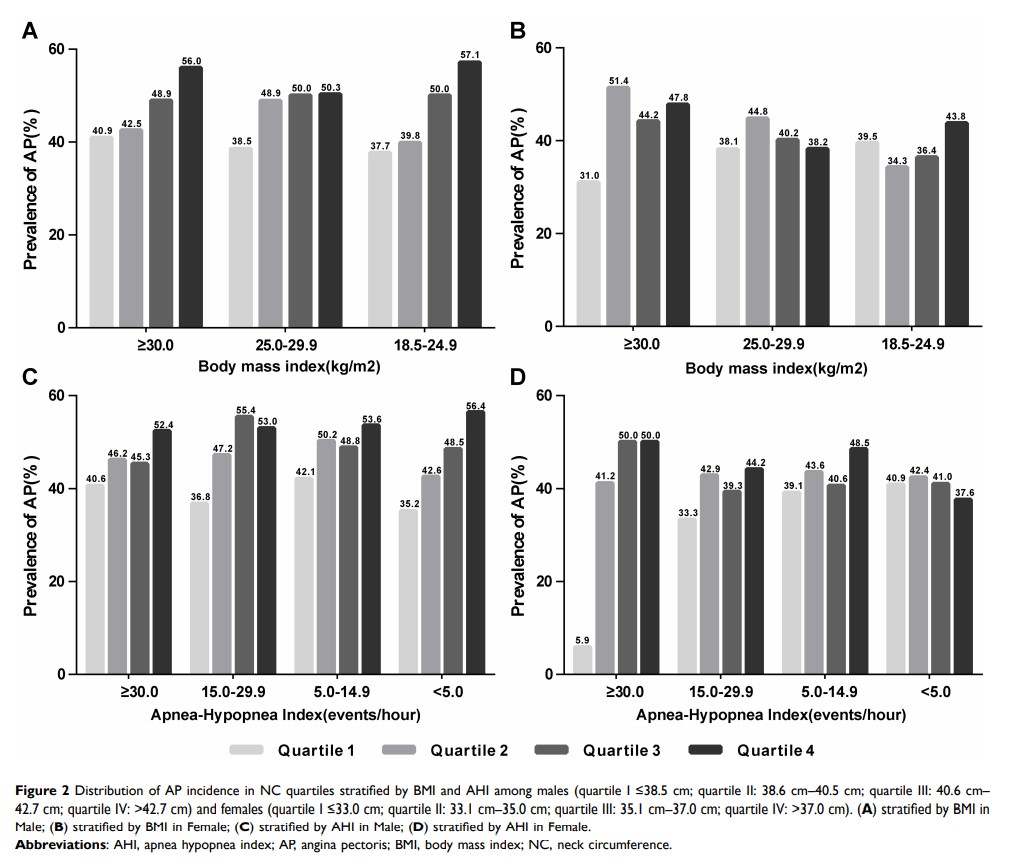
Background: Previous studies have found that neck circumference (NC) is associated with cardiovascular disease risk factors. This study investigated the relationship between NC and the incidence of angina pectoris (AP).
Methods: Altogether 4821 participants (2212 males and 2609 females) from the Sleep Heart Health Study (SHHS) with a mean age of 63.4± 11.0 years were selected in this study. Anthropometric measurements, including NC, waist circumference (WC), hip circumference (HC), and body mass index (BMI), were collected at baseline. AP was defined as the first occurrence between baseline and 2011. Linear and logistic regression analysis was used to explore the association between NC and incidences of AP.
Results: There was a significant difference in NC between AP and controls in both male (41.1± 3.1 cm vs 40.3± 3.2 cm; p< 0.001) and female (35.2± 3.1 cm vs 34.9± 2.9 cm; p=0.006). Multivariable linear regression analysis showed that NC (every cm increase) was independently associated with the incidence of AP in both male (odds ratio [OR] 1.067; 95% confidence interval [CI] 1.035– 1.100; p< 0.001) and female (OR 1.067; 95% CI 1.035– 1.101; p< 0.001).
Conclusion: NC was significantly associated with the incidence of AP in both male and female. The role of NC in the incidence of AP is worthy of further investigation.
Keywords: angina pectoris, neck circumference, SHHS, obesity, community-based population