115195
论文已发表
注册即可获取德孚的最新动态
IF 收录期刊
- 3.6 Breast Cancer (Dove Med Press)
- 4.3 Clin Epidemiol
- 2.6 Cancer Manag Res
- 3.2 Infect Drug Resist
- 4.1 Clin Interv Aging
- 6.1 Drug Des Dev Ther
- 4.1 Int J Chronic Obstr
- 8.7 Int J Nanomed
- 2.5 Int J Women's Health
- 3.2 Neuropsych Dis Treat
- 2.4 OncoTargets Ther
- 2.6 Patient Prefer Adher
- 2.6 Ther Clin Risk Manag
- 3.1 J Pain Res
- 3.5 Diabet Metab Synd Ob
- 4.5 Psychol Res Behav Ma
- 3.4 Nat Sci Sleep
- 2.4 Pharmgenomics Pers Med
- 2.6 Risk Manag Healthc Policy
- 4.6 J Inflamm Res
- 2.3 Int J Gen Med
- 3.9 J Hepatocell Carcinoma
- 3.3 J Asthma Allergy
- 2.5 Clin Cosmet Investig Dermatol
- 3.0 J Multidiscip Healthc

MicroRNA-182 通过靶向肝癌细胞中的程序性细胞死亡 4 促进细胞迁移
Authors Hu J, Wang Z, Wang J, Jian Y, Dai J, Wang X, Xiong W
Received 15 April 2020
Accepted for publication 17 August 2020
Published 16 September 2020 Volume 2020:13 Pages 9159—9167
DOI https://doi.org/10.2147/OTT.S258251
Checked for plagiarism Yes
Review by Single anonymous peer review
Peer reviewer comments 3
Editor who approved publication: Dr Leo Jen-Liang Su
Purpose: Hepatocellular carcinoma (HCC) is the most common primary liver tumor and the third greatest cause of cancer-related death worldwide. Programmed cell death 4 (PDCD4) was reported as a potential tumor-suppressor in hepatocarcinogenesis. However, relatively little is known about mechanisms that regulate PDCD4 expression in HCC. The aim of the present study is to investigate the expression of PDCD4 and miR-182 in human HCC cell lines and clinical HCC specimens and determine whether PDCD4 is a direct target of miR-182 in HCC cell lines.
Materials: The expression of miR-182 and PDCD4 in human HCC cell lines and HCC tissues were examined using qRT-PCR and Western blot method. Transwell and wound healing assays were carried out to explore the influence of miR-182 on hepatoma cells migration. A luciferase reporter assay was conducted to confirm target association.
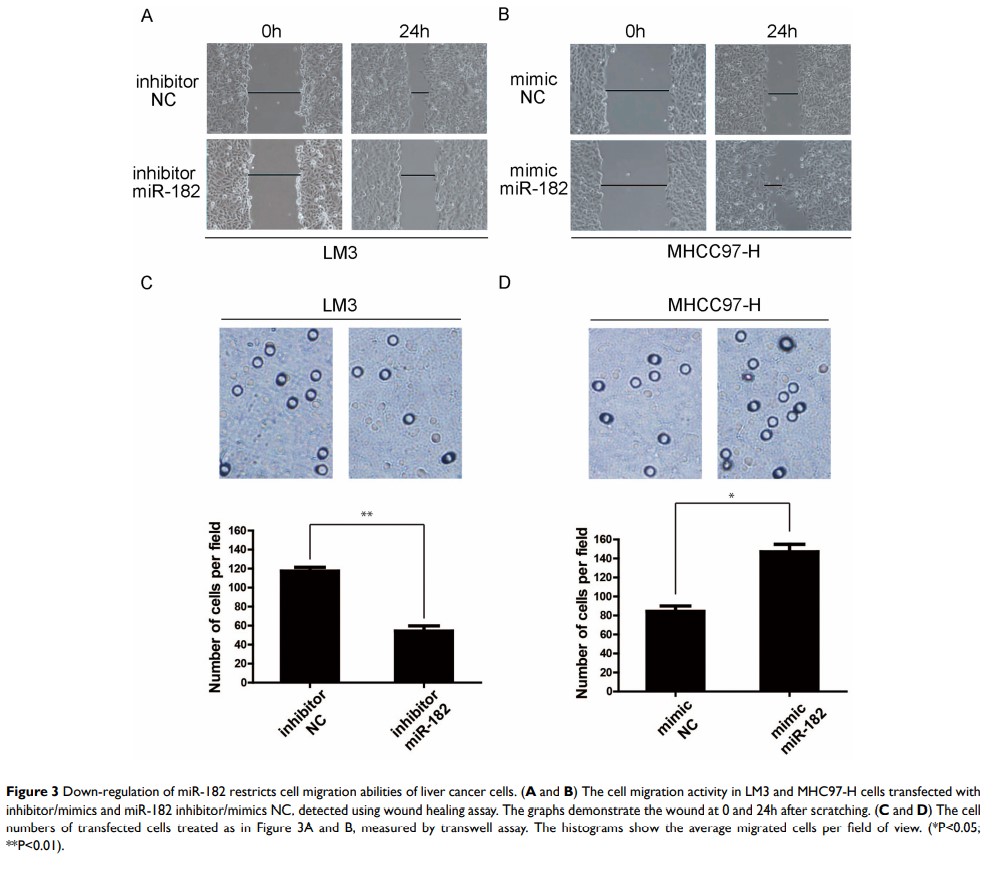
Results: In our research, we found that PDCD4 was downregulated, whereas miR-182 was upregulated in liver cancer cell lines and HCC tissues. Transwell and wound healing assays illustrated that miR-182 contributed to migration activities of liver cancer cell lines. Loss or increase of miR-182 can lead to a negative expression of PDCD4 protein level. The luciferase reporter assay showed that PDCD4 is a direct target of miR-182.
Conclusion: All these findings suggest that miR-182 may act as an oncogenic role in liver cancer cells by directly and negatively regulating expression of PDCD4.
Keywords: miR-182, migration, PDCD4, hepatocellular carcinoma