115195
论文已发表
注册即可获取德孚的最新动态
IF 收录期刊
- 3.6 Breast Cancer (Dove Med Press)
- 4.3 Clin Epidemiol
- 2.6 Cancer Manag Res
- 3.2 Infect Drug Resist
- 4.1 Clin Interv Aging
- 6.1 Drug Des Dev Ther
- 4.1 Int J Chronic Obstr
- 8.7 Int J Nanomed
- 2.5 Int J Women's Health
- 3.2 Neuropsych Dis Treat
- 2.4 OncoTargets Ther
- 2.6 Patient Prefer Adher
- 2.6 Ther Clin Risk Manag
- 3.1 J Pain Res
- 3.5 Diabet Metab Synd Ob
- 4.5 Psychol Res Behav Ma
- 3.4 Nat Sci Sleep
- 2.4 Pharmgenomics Pers Med
- 2.6 Risk Manag Healthc Policy
- 4.6 J Inflamm Res
- 2.3 Int J Gen Med
- 3.9 J Hepatocell Carcinoma
- 3.3 J Asthma Allergy
- 2.5 Clin Cosmet Investig Dermatol
- 3.0 J Multidiscip Healthc

MicroRNA-623 通过靶向 TRIM44 抑制上皮-间充质转化以减轻胶质瘤的增殖
Authors Cui D, Wang K, Liu Y, Gao J, Cui J
Received 19 February 2020
Accepted for publication 11 August 2020
Published 21 September 2020 Volume 2020:13 Pages 9291—9303
DOI https://doi.org/10.2147/OTT.S250497
Checked for plagiarism Yes
Review by Single anonymous peer review
Peer reviewer comments 2
Editor who approved publication: Dr Federico Perche
Objective: Glioma has the highest incidence among the different tumor types within the nervous system, accounting for about 40% of them. Malignant glioma has a high invasion and metastasis rate, which leads to the poor prognosis of patients. By targeting specific genes, microRNAs serve as key regulators in the epithelial–mesenchymal transformation (EMT) process, which could provide new insights into the treatment of glioblastomas (GBM). The detailed molecular role that miR-623 plays in GBM still remains unclear.
Materials and Methods: The level of miR-623 in GBM cells was evaluated by RT-PCR. The function of miR-623 overexpression on GBM cell proliferation, migration, and invasion was assessed by MTS, Transwell analysis, and colony formation assay. In addition, a mouse subcutaneous xenograft model was used to study in vivo effects. The binding between miR-623 and TRIM44 was verified by a dual-luciferase reporter assay and the regulatory function of miR-623 on EMT markers was evaluated using Western blot.
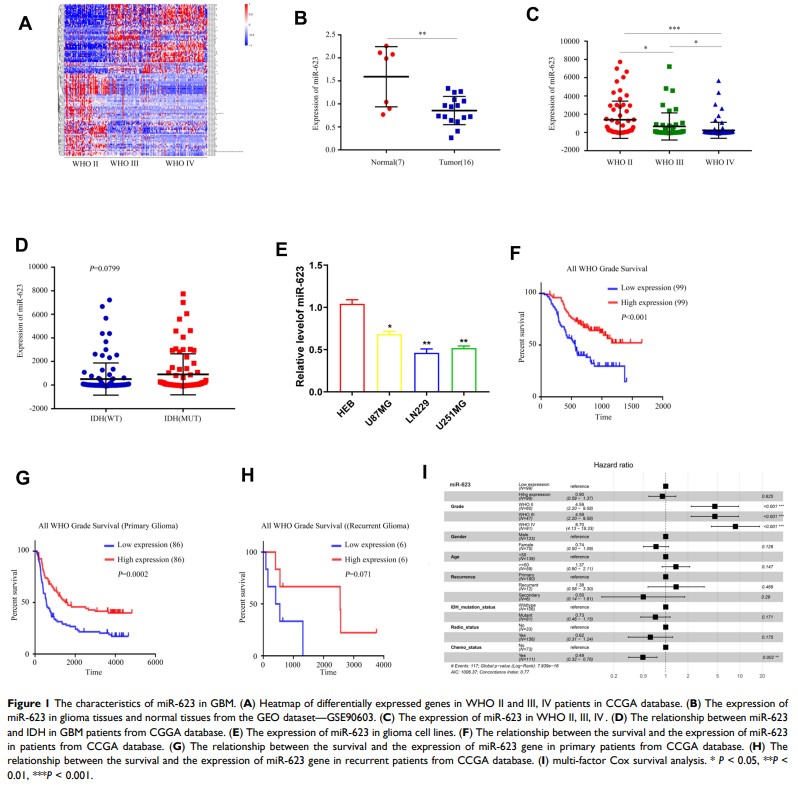
Results: The expression of miR-623 was repressed in the GBM cancer cell lines. MiR-623 overexpression or TRIM44 knockdown attenuated the proliferation, migration, and invasion of GBM cell lines. TRIM44 could facilitate the reverse suppression of EMT and miR-623 in GBM progression. MiR-623 was found to inhibit TRIM44 expression by directly binding to its 3ʹUTR. In addition, systemic delivery of miR-623 mimic reduced tumor growth and inhibited TRIM44 protein expression in tumor-bearing nude mice. Furthermore, our findings indicated that miR-623 overexpression or TRIM44 down-regulation impeded the proliferation and migratory ability of LN229 and U251MG glioma cells, and miR-623 attenuates TRIM44 -induced EMT by directly targeting the 3ʹUTR of TRIM44 , which could serve as preliminary research to identify potential therapeutic targets for future treatment of GBM.
Conclusion: Overall, microRNA-623 inhibits epithelial–mesenchymal transition to attenuate glioma proliferation by targeting TRIM44 .
Keywords: GBM, hsa-miR-623, TRIM44 , proliferation, EMT