115195
论文已发表
注册即可获取德孚的最新动态
IF 收录期刊
- 3.6 Breast Cancer (Dove Med Press)
- 4.3 Clin Epidemiol
- 2.6 Cancer Manag Res
- 3.2 Infect Drug Resist
- 4.1 Clin Interv Aging
- 6.1 Drug Des Dev Ther
- 4.1 Int J Chronic Obstr
- 8.7 Int J Nanomed
- 2.5 Int J Women's Health
- 3.2 Neuropsych Dis Treat
- 2.4 OncoTargets Ther
- 2.6 Patient Prefer Adher
- 2.6 Ther Clin Risk Manag
- 3.1 J Pain Res
- 3.5 Diabet Metab Synd Ob
- 4.5 Psychol Res Behav Ma
- 3.4 Nat Sci Sleep
- 2.4 Pharmgenomics Pers Med
- 2.6 Risk Manag Healthc Policy
- 4.6 J Inflamm Res
- 2.3 Int J Gen Med
- 3.9 J Hepatocell Carcinoma
- 3.3 J Asthma Allergy
- 2.5 Clin Cosmet Investig Dermatol
- 3.0 J Multidiscip Healthc

一种新型 3D 生物打印的多孔纳米凹凸棒石支架用于骨再生,具有良好性能
Authors Wang Z, Hui A, Zhao H, Ye X, Zhang C, Wang A, Zhang C
Received 18 March 2020
Accepted for publication 5 August 2020
Published 22 September 2020 Volume 2020:15 Pages 6945—6960
DOI https://doi.org/10.2147/IJN.S254094
Checked for plagiarism Yes
Review by Single anonymous peer review
Peer reviewer comments 2
Editor who approved publication: Dr Linlin Sun
Background: Natural clay nanomaterials are an emerging class of biomaterial with great potential for tissue engineering and regenerative medicine applications, most notably for osteogenesis.
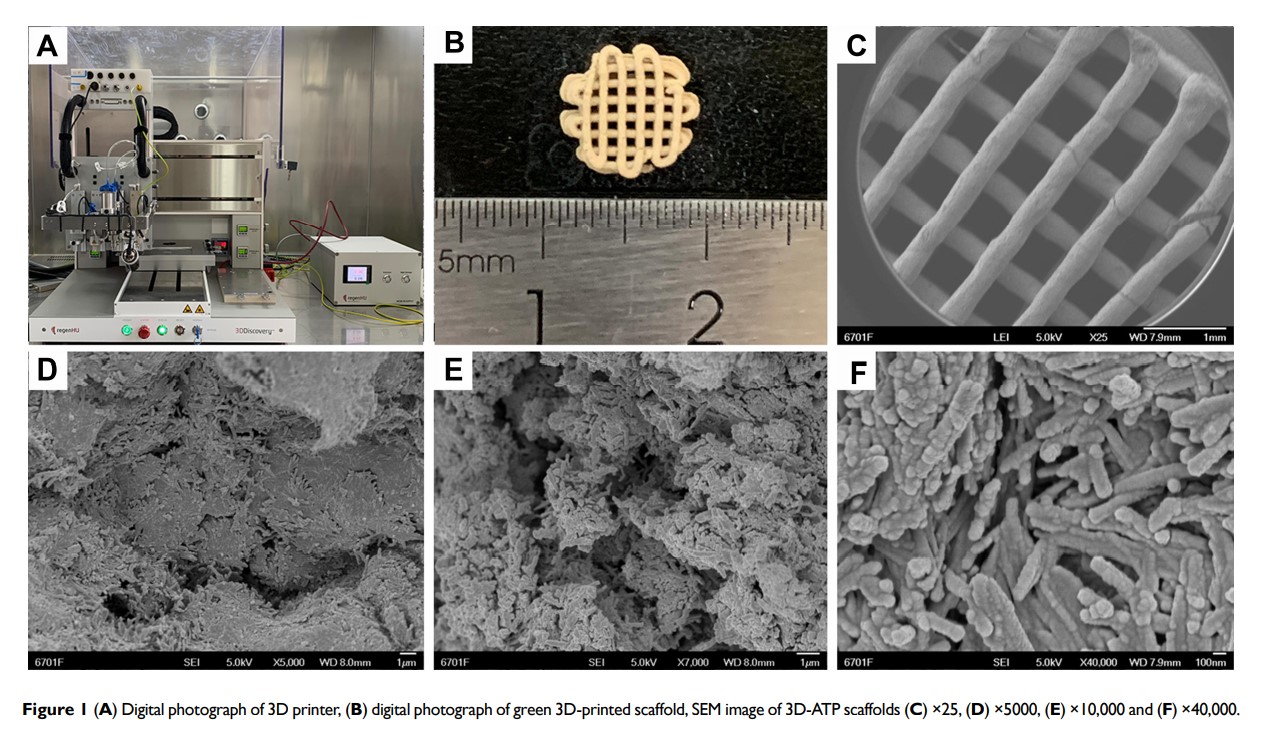
Materials and Methods: Herein, for the first time, novel tissue engineering scaffolds were prepared by 3D bioprinter using nontoxic and bioactive natural attapulgite (ATP) nanorods as starting materials, with polyvinyl alcohol as binder, and then sintered to obtain final scaffolds. The microscopic morphology and structure of ATP particles and scaffolds were observed by transmission electron microscope and scanning electron microscope. In vitro biocompatibility and osteogenesis with osteogenic precursor cell (hBMSCs) were assayed using MTT method, Live/Dead cell staining, alizarin red staining and RT-PCR. In vivo bone regeneration was evaluated with micro-CT and histology analysis in rat cranium defect model.
Results: We successfully printed a novel porous nano-ATP scaffold designed with inner channels with a dimension of 500 μm and wall structures with a thickness of 330 μm. The porosity of current 3D-printed scaffolds ranges from 75% to 82% and the longitudinal compressive strength was up to 4.32± 0.52 MPa. We found firstly that nano-ATP scaffolds with excellent biocompatibility for hBMSCscould upregulate the expression of osteogenesis-related genes bmp2 and runx2 and calcium deposits in vitro. Interestingly, micro-CT and histology analysis revealed abundant newly formed bone was observed along the defect margin, even above and within the 3D bioprinted porous ATP scaffolds in a rat cranial defect model. Furthermore, histology analysis demonstrated that bone was formed directly following a process similar to membranous ossification without any intermediate cartilage formation and that many newly formed blood vessels are within the pores of 3D-printed scaffolds at four and eight weeks.
Conclusion: These results suggest that the 3D-printed porous nano-ATP scaffolds are promising candidates for bone tissue engineering by osteogenesis and angiogenesis.
Keywords: attapulgite, 3D-printing, porous scaffold, bone regeneration, nanomaterial, bone tissue engineering