115195
论文已发表
注册即可获取德孚的最新动态
IF 收录期刊
- 3.6 Breast Cancer (Dove Med Press)
- 4.3 Clin Epidemiol
- 2.6 Cancer Manag Res
- 3.2 Infect Drug Resist
- 4.1 Clin Interv Aging
- 6.1 Drug Des Dev Ther
- 4.1 Int J Chronic Obstr
- 8.7 Int J Nanomed
- 2.5 Int J Women's Health
- 3.2 Neuropsych Dis Treat
- 2.4 OncoTargets Ther
- 2.6 Patient Prefer Adher
- 2.6 Ther Clin Risk Manag
- 3.1 J Pain Res
- 3.5 Diabet Metab Synd Ob
- 4.5 Psychol Res Behav Ma
- 3.4 Nat Sci Sleep
- 2.4 Pharmgenomics Pers Med
- 2.6 Risk Manag Healthc Policy
- 4.6 J Inflamm Res
- 2.3 Int J Gen Med
- 3.9 J Hepatocell Carcinoma
- 3.3 J Asthma Allergy
- 2.5 Clin Cosmet Investig Dermatol
- 3.0 J Multidiscip Healthc

瘦素基因的变体降低了中国人胃癌的风险:一项病例对照研究的证据
Authors Ma R, He Q
Received 23 April 2020
Accepted for publication 11 August 2020
Published 22 September 2020 Volume 2020:13 Pages 397—404
DOI https://doi.org/10.2147/PGPM.S258672
Checked for plagiarism Yes
Review by Single anonymous peer review
Peer reviewer comments 3
Editor who approved publication: Dr Martin Bluth
Background: A host of studies have explored the potential connection between leptin (LEP ) G19A polymorphism and the risk of cancers, but the relationship between gastric cancer (GC) susceptibility and LEP G19A polymorphism was not revealed before. The aim of this study was to investigate this relationship in Chinese Han population.
Methods: Thus, this case–control study with 380 GC cases and 465 controls was designed to unearth the link between LEP G19A polymorphism and GC susceptibility. Genotyping was accomplished by a custom-made 48-Plex SNP scanTM kit. Relative LEP gene expression was detected by real-time reverse transcription-polymerase chain reaction.
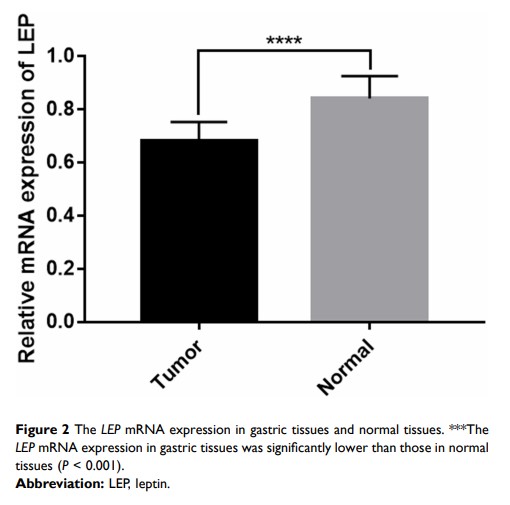
Results: LEP G19A polymorphism was shown to relate with a decreased risk of GC. Subgroup analyses uncovered significant connections in the males, nondrinkers, and those at age < 60 years. G19A polymorphism was also linked with tumor size and location and pathological type of GC. Last, LEP gene expression in gastric tissues was considerably less than in control tissues.
Conclusion: This study shows that G19A polymorphism of LEP gene is linked with a lower risk of GC in the tested Chinese Han individuals.
Keywords: LEP , gastric cancer, G19A polymorphism, case-control study