115195
论文已发表
注册即可获取德孚的最新动态
IF 收录期刊
- 3.6 Breast Cancer (Dove Med Press)
- 4.3 Clin Epidemiol
- 2.6 Cancer Manag Res
- 3.2 Infect Drug Resist
- 4.1 Clin Interv Aging
- 6.1 Drug Des Dev Ther
- 4.1 Int J Chronic Obstr
- 8.7 Int J Nanomed
- 2.5 Int J Women's Health
- 3.2 Neuropsych Dis Treat
- 2.4 OncoTargets Ther
- 2.6 Patient Prefer Adher
- 2.6 Ther Clin Risk Manag
- 3.1 J Pain Res
- 3.5 Diabet Metab Synd Ob
- 4.5 Psychol Res Behav Ma
- 3.4 Nat Sci Sleep
- 2.4 Pharmgenomics Pers Med
- 2.6 Risk Manag Healthc Policy
- 4.6 J Inflamm Res
- 2.3 Int J Gen Med
- 3.9 J Hepatocell Carcinoma
- 3.3 J Asthma Allergy
- 2.5 Clin Cosmet Investig Dermatol
- 3.0 J Multidiscip Healthc

向肾上腺素补充脂质乳剂可改善老年大鼠窒息引起的心脏骤停的复苏结果
Authors Huang L, Ren Q, Yu S, Shao Y, Chen Y, Huang X
Received 21 June 2020
Accepted for publication 12 August 2020
Published 22 September 2020 Volume 2020:15 Pages 1701—1716
DOI https://doi.org/10.2147/CIA.S268768
Checked for plagiarism Yes
Review by Single anonymous peer review
Peer reviewer comments 3
Editor who approved publication: Prof. Dr. Zhi-Ying Wu
Objective: The goal of the study was to investigate the efficacy of lipid supplement to epinephrine-based therapy in resuscitation of asphyxia-induced cardiac arrest in aged rats.
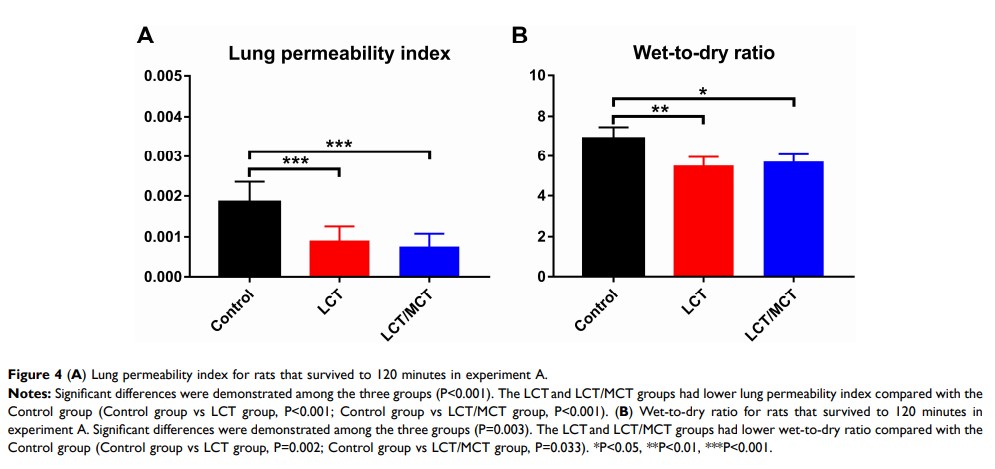
Methods: The study included two parts: in experiment A, rats underwent asphyxial cardiac arrest and cardiopulmonary resuscitation, randomized to receive epinephrine and normal saline (control group, n=22), epinephrine and intralipid 20% (long-chain triglycerides (LCT) group, n=22) or epinephrine and lipovenoes 20% (LCT/medium-chain triglcerides (MCT) group, n=22). Return of spontaneous circulation, recurrence of asystole after resuscitation, hemodynamic metrics, arterial blood gas values, neurological assessment score and indexes of pulmonary transudation were recorded. In experiment B, rats using the same model and resuscitation protocol were randomly divided into 21 groups: Control 0, Control 20, Control 40, Control 60, Control 80, Control 100, Control 120, LCT 0, LCT 20, LCT 40, LCT 60, LCT 80, LCT 100, LCT 120, LCT/MCT 0, LCT/MCT 20, LCT/MCT 40, LCT/MCT 60, LCT/MCT 80, LCT/MCT 100 and LCT 120 (n=10, the subscripts represent respective endpoint of observation in minutes). Myocardial bioenergetics were determined.
Results: In experiment A, the LCT and LCT/MCT groups had a shorter time to return of spontaneous circulation (ROSC) (P=0.001and P< 0.001, respectively) and higher survival rate (P=0.033 and P=0.014, respectively) compared with the Control group. The LCT/MCT group had higher MAP (P< 0.001 and P=0.001, respectively), HR (P< 0.001 and P=0.004, respectively) and RPP (P< 0.001 and P< 0.001, respectively) compared with the Control and LCT groups, respectively. In experiment B, the LCT/MCT group had a higher energy charge compared with the control group at 20 (P< 0.001) and 40 (P< 0.001) minutes. The LCT group had higher energy charge compared with the Control group at 40 (P< 0.001) and 60 (P< 0.001) minutes.
Conclusion: The supplement of lipid emulsion to epinephrine improves resuscitation outcomes of asphyxia-induced cardiac arrest than epinephrine alone in our in vivo model of aged rat. LCT/MCT emulsion may be superior to LCT emulsion in epinephrine-based resuscitation.
Keywords: asphyxia, cardiac arrest, epinephrine, lipid emulsion, cardiopulmonary resuscitation