115195
论文已发表
注册即可获取德孚的最新动态
IF 收录期刊
- 3.6 Breast Cancer (Dove Med Press)
- 4.3 Clin Epidemiol
- 2.6 Cancer Manag Res
- 3.2 Infect Drug Resist
- 4.1 Clin Interv Aging
- 6.1 Drug Des Dev Ther
- 4.1 Int J Chronic Obstr
- 8.7 Int J Nanomed
- 2.5 Int J Women's Health
- 3.2 Neuropsych Dis Treat
- 2.4 OncoTargets Ther
- 2.6 Patient Prefer Adher
- 2.6 Ther Clin Risk Manag
- 3.1 J Pain Res
- 3.5 Diabet Metab Synd Ob
- 4.5 Psychol Res Behav Ma
- 3.4 Nat Sci Sleep
- 2.4 Pharmgenomics Pers Med
- 2.6 Risk Manag Healthc Policy
- 4.6 J Inflamm Res
- 2.3 Int J Gen Med
- 3.9 J Hepatocell Carcinoma
- 3.3 J Asthma Allergy
- 2.5 Clin Cosmet Investig Dermatol
- 3.0 J Multidiscip Healthc

依沙佐米治疗多发性骨髓瘤的有效性和安全性的真实数据:在中国的单中心研究
Authors Ding K, Yu H, Shao YY, Li LY, Wang CM, Song J, Li LJ, Fu R
Received 14 May 2020
Accepted for publication 1 August 2020
Published 23 September 2020 Volume 2020:12 Pages 8935—8941
DOI https://doi.org/10.2147/CMAR.S261887
Checked for plagiarism Yes
Review by Single anonymous peer review
Peer reviewer comments 2
Editor who approved publication: Dr Sanjeev Srivastava
Objective: To assess the short-term efficacy and safety of ixazomib in Chinese multiple myeloma (MM) patients in the real world.
Methods: Fifty-nine MM patients who received at least one cycle of ixazomib-based therapy between 1 June 2018 and 30 September 2019 were retrospectively analyzed in Tianjin Medical University General Hospital. Thirteen newly diagnosed MM (NDMM), 13 refractory/relapsed MM (RRMM) and 33 continuous therapy (27 bortezomib peripheral neuritis (PN) intolerant and six maintenance therapy) MM patients were included. The indicated overall response rate (ORR), time to overall response (TOR), and adverse events (AEs) were investigated.
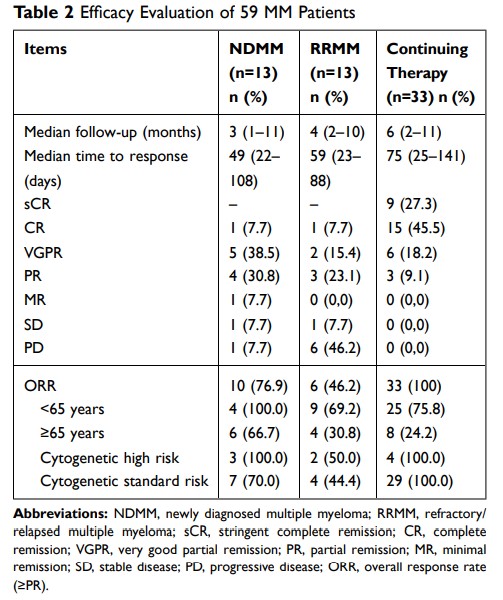
Results: The ORR in NDMM was 76.9%, with one complete response (CR), five very good partial response (VGPR), four partial response (PR), median PFS, and TOR were 122 (66– 272) days and 49 (22– 108) days. The ORR in RRMM was 46.2%, with one CR, two VGPR, three PR, median PFS, and TOR were 79 (28– 169) days and 59 (23– 88) days. The ORR in continuous therapy MM patients was 100%, with nine stringent CR, 15 CR, six VGPR and three PR, median TOR was 75 (25– 141) days. There were no significant differences regarding ORR between patients with cytogenetic high risk and standard risk in three subgroups (all P> 0.05). The most frequent hematological AEs were anemia (13.6%) and thrombocytopenia (10.2%). The most common nonhematological AEs were PN (25.0%) and diarrhea (13.6%).
Conclusion: The real-world data demonstrated that ixazomib-based therapy was generally effective and safe in the short term for MM patients.
Keywords: multiple myeloma, ixazomib, real world, overall response rate, adverse events