115195
论文已发表
注册即可获取德孚的最新动态
IF 收录期刊
- 3.6 Breast Cancer (Dove Med Press)
- 4.3 Clin Epidemiol
- 2.6 Cancer Manag Res
- 3.2 Infect Drug Resist
- 4.1 Clin Interv Aging
- 6.1 Drug Des Dev Ther
- 4.1 Int J Chronic Obstr
- 8.7 Int J Nanomed
- 2.5 Int J Women's Health
- 3.2 Neuropsych Dis Treat
- 2.4 OncoTargets Ther
- 2.6 Patient Prefer Adher
- 2.6 Ther Clin Risk Manag
- 3.1 J Pain Res
- 3.5 Diabet Metab Synd Ob
- 4.5 Psychol Res Behav Ma
- 3.4 Nat Sci Sleep
- 2.4 Pharmgenomics Pers Med
- 2.6 Risk Manag Healthc Policy
- 4.6 J Inflamm Res
- 2.3 Int J Gen Med
- 3.9 J Hepatocell Carcinoma
- 3.3 J Asthma Allergy
- 2.5 Clin Cosmet Investig Dermatol
- 3.0 J Multidiscip Healthc

对于有危险因素的肺癌手术患者,全面的肺康复治疗是改善术后结果的有效方法:一项基于倾向评分匹配法的回顾性队列研究
Authors Zhou K, Lai Y, Wang Y, Sun X, Mo C, Wang J, Wu Y, Li J, Chang S, Che G
Received 12 June 2020
Accepted for publication 19 August 2020
Published 23 September 2020 Volume 2020:12 Pages 8903—8912
DOI https://doi.org/10.2147/CMAR.S267322
Checked for plagiarism Yes
Review by Single anonymous peer review
Peer reviewer comments 2
Editor who approved publication: Dr Antonella D'Anneo
Background: To investigate the effectiveness and cost minimization of comprehensive pulmonary rehabilitation (CPR) in lung cancer patients who underwent surgery.
Patients and Methods: A retrospective observational study based on medical records was conducted, with 2410 lung cancer patients who underwent an operation with/without CPR during the peri-operative period. Variables including clinical characteristics, length of stay (LOS), postoperative pulmonary complications (PPCs), and hospitalization expenses were compared between the intervention group (IG) and control group (CG). The CPR regimen consists of inspiratory muscle training (IMT), aerobic endurance training, and pharmacotherapy.
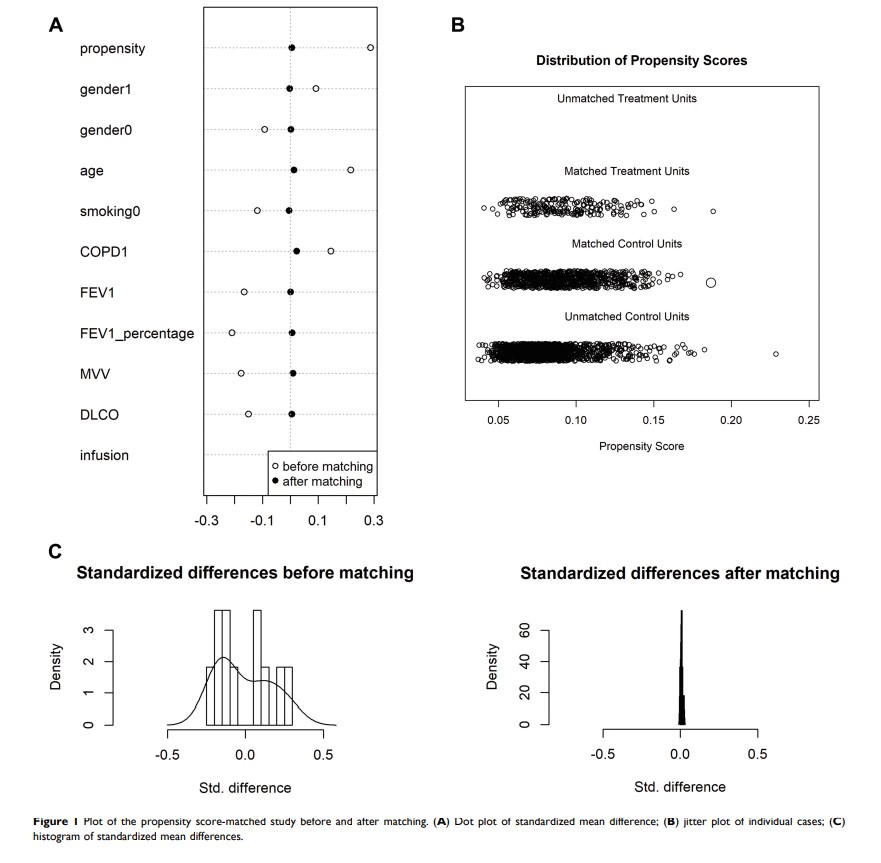
Results: Propensity score matching analysis was performed between two groups, and the ratio of matched patients was 1:4. Finally, 205 cases of IG and 820 cases of CG in the matched cohort of our study were identified. The length of postoperative hospital stay [median: 5 interquartile (4– 7) vs 7 (4– 8) days, P < 0.001] and drug expenses [7146 (5411– 8987) vs 8253 (6048– 11,483) ¥, P < 0.001] in the IG were lower compared with the CG. Additionally, the overall incidence of PPCs in the IG was reduced compared with the CG (26.8% vs 36.7%, P = 0.008), including pneumonia (10.7% vs 16.8%, P = 0.035) and atelectasis (8.8% vs 14.0%, P = 0.046). Multivariable analysis showed that CPR intervention (OR = 0.655, 95% CI: 0.430– 0.865, P = 0.006), age ≥ 70 yr (OR = 1.919, 95% CI: 1.342– 2.744, P < 0.001), smoking (OR = 2.048, 95% CI: 1.552– 2.704, P < 0.001) and COPD (OR = 1.158, 95% CI: 1.160– 2.152, P = 0.004) were related to PPCs.
Conclusion: The retrospective cohort study revealed a lower PPC rate and the shorter postoperative length of stay in the patients receiving CPR, demonstrating the clinical value of CRP as an effective strategy for surgical lung cancer patients with risk factors.
Keywords: pulmonary rehabilitation, thoracic surgery, lobectomy, lung cancer