115195
论文已发表
注册即可获取德孚的最新动态
IF 收录期刊
- 3.6 Breast Cancer (Dove Med Press)
- 4.3 Clin Epidemiol
- 2.6 Cancer Manag Res
- 3.2 Infect Drug Resist
- 4.1 Clin Interv Aging
- 6.1 Drug Des Dev Ther
- 4.1 Int J Chronic Obstr
- 8.7 Int J Nanomed
- 2.5 Int J Women's Health
- 3.2 Neuropsych Dis Treat
- 2.4 OncoTargets Ther
- 2.6 Patient Prefer Adher
- 2.6 Ther Clin Risk Manag
- 3.1 J Pain Res
- 3.5 Diabet Metab Synd Ob
- 4.5 Psychol Res Behav Ma
- 3.4 Nat Sci Sleep
- 2.4 Pharmgenomics Pers Med
- 2.6 Risk Manag Healthc Policy
- 4.6 J Inflamm Res
- 2.3 Int J Gen Med
- 3.9 J Hepatocell Carcinoma
- 3.3 J Asthma Allergy
- 2.5 Clin Cosmet Investig Dermatol
- 3.0 J Multidiscip Healthc

MicroRNA-6071 通过与 ULBP2 结合抑制 PI3K/AKT/mTOR 信号通路,从而遏制胶质母细胞瘤的进展
Authors Zhou Y, An H, Wu G
Received 16 June 2020
Accepted for publication 11 September 2020
Published 23 September 2020 Volume 2020:13 Pages 9429—9441
DOI https://doi.org/10.2147/OTT.S265791
Checked for plagiarism Yes
Review by Single anonymous peer review
Peer reviewer comments 2
Editor who approved publication: Dr XuYu Yang
Objective: The purpose of this study was to explore the effect of microRNA-6071 (miR-6071) on glioblastoma (GBM) and its potential mechanisms.
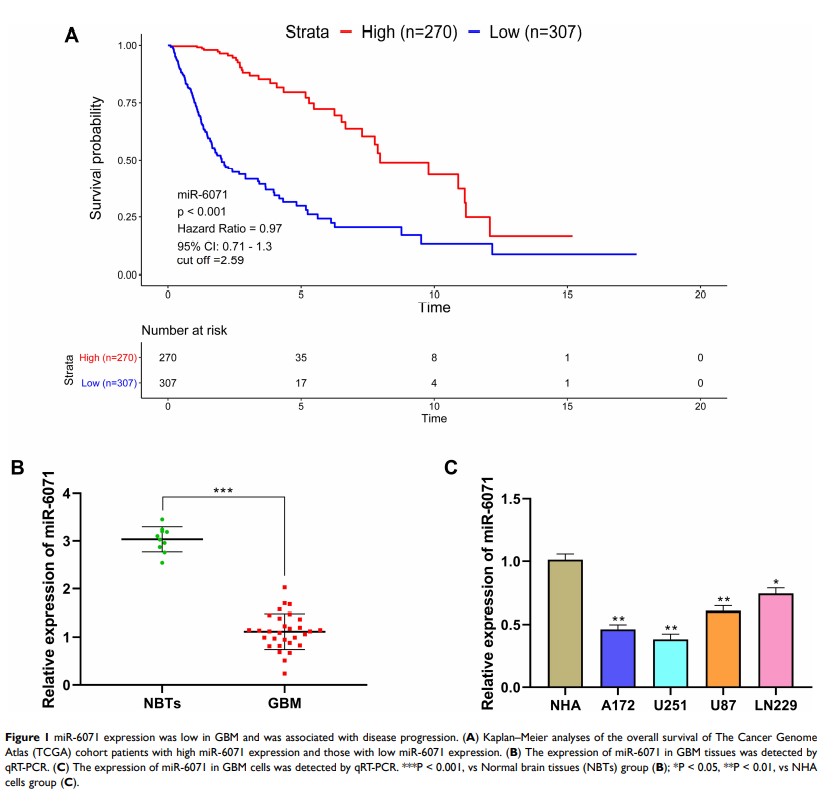
Methods: In this study, the expressions of miR-6071 and UL16 binding protein 2 (ULBP2) were measured by qRT-RCR in GBM tissues and cells. The prognostic values of miR-6071 and ULBP2 were evaluated by Kaplan–Meier methods using the data obtained from The Cancer Genome Atlas (TCGA) database. The cell clones, proliferation, apoptosis, migration and invasion in GBM cells were detected by colony formation assay, EdU assay, flow cytometry, wound-healing assay and transwell assay. The targeting relationship between miR-6071 and ULBP2 was predicted by Targetscan 7.2 and further verified by dual-luciferase reporter gene assay. Moreover, the expressions of Bax, caspase-3, Bcl-2, matrix metalloproteinases 2 (MMP-2), MMP-9, phosphatidylinositol 3′-kinase (PI3K), p-PI3K, protein kinase B (AKT), p-AKT, mammalian target of rapamycin (mTOR) and p-mTOR were measured by Western blot.
Results: miR-6071 was lowly expressed and ULBP2 was highly expressed in GBM tissues and cells. miR-6071 significantly repressed the proliferation, migration and invasion, and promoted apoptosis in GBM cells. Moreover, miR-6071 also inhibited the activation of PI3K/AKT/mTOR pathway in GBM cells. Additionally, miR-6071 has been shown to negatively regulate ULBP2 expression. We also confirmed that ULBP2 could reverse the effects of miR-6071 on GBM cells through regulating PI3K/AKT/mTOR pathway.
Conclusion: Our study demonstrated that miR-6071 could suppress cell proliferation, migration and invasion, as well as promote apoptosis through the inhibition of PI3K/Akt/mTOR pathway by binding to ULBP2 in GBM.
Keywords: glioblastoma, miR-6071, ULBP2, proliferation, metastasis, PI3K/Akt/mTOR pathway