115195
论文已发表
注册即可获取德孚的最新动态
IF 收录期刊
- 3.6 Breast Cancer (Dove Med Press)
- 4.3 Clin Epidemiol
- 2.6 Cancer Manag Res
- 3.2 Infect Drug Resist
- 4.1 Clin Interv Aging
- 6.1 Drug Des Dev Ther
- 4.1 Int J Chronic Obstr
- 8.7 Int J Nanomed
- 2.5 Int J Women's Health
- 3.2 Neuropsych Dis Treat
- 2.4 OncoTargets Ther
- 2.6 Patient Prefer Adher
- 2.6 Ther Clin Risk Manag
- 3.1 J Pain Res
- 3.5 Diabet Metab Synd Ob
- 4.5 Psychol Res Behav Ma
- 3.4 Nat Sci Sleep
- 2.4 Pharmgenomics Pers Med
- 2.6 Risk Manag Healthc Policy
- 4.6 J Inflamm Res
- 2.3 Int J Gen Med
- 3.9 J Hepatocell Carcinoma
- 3.3 J Asthma Allergy
- 2.5 Clin Cosmet Investig Dermatol
- 3.0 J Multidiscip Healthc

为慢性完全闭塞病变患者室间隔侧支通道成功布线后,逆行微导管追踪失败的发生率、预测因素和策略
Authors Wang Y, Zhang XJ, Zhao H, Wang C, Luo D, Meng Q, Zhu Y, Tao J, Chen B, Li Y, Hou A, Luan B
Received 4 June 2020
Accepted for publication 16 August 2020
Published 23 September 2020 Volume 2020:15 Pages 1727—1735
DOI https://doi.org/10.2147/CIA.S263216
Checked for plagiarism Yes
Review by Single anonymous peer review
Peer reviewer comments 3
Editor who approved publication: Prof. Dr. Zhi-Ying Wu
Background: Retrograde microcatheter collateral channel (CC) tracking after successful wiring of septal CC is crucial for retrograde revascularization of coronary chronic total occlusion (CTO). However, the incidence, predictors, and strategies for failure of retrograde microcatheter CC tracking after successful wiring of septal CC remain unclear.
Methods: In total, 298 patients with CTO who underwent retrograde septal CC PCI between January 2015 and May 2019 were retrospectively analyzed. Clinical data were compared to investigate the predictors of initial microcatheter tracking failure.
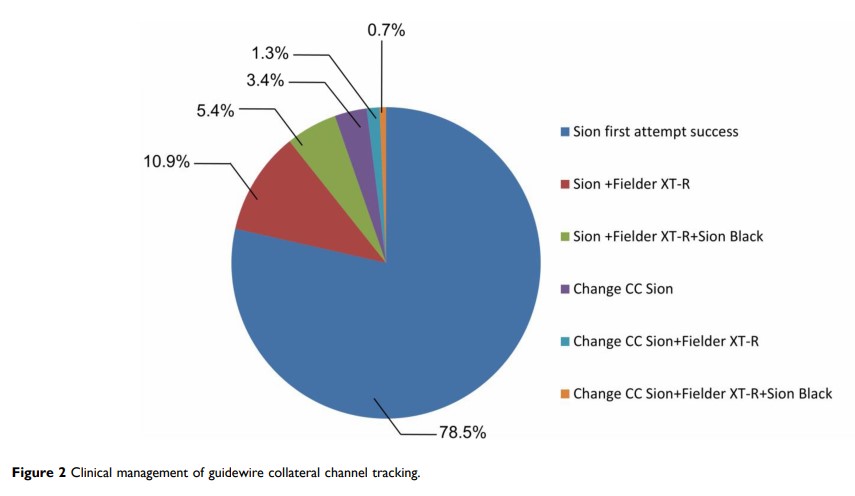
Results: The initial and final microcatheter tracking success rates were 79.2% (236/298) and 96.6% (288/298), respectively. The procedural success rate was 94.0% (280/298). The right coronary artery-to-left anterior descending artery septal ratio (48.4% vs 33.1%, p=0.037) and CC tortuosity (34.6% vs 20.8%, p=0.045) were significantly higher in the initial microcatheter CC tracking failure group than in the successful tracking group. Multivariate logistic regression analysis revealed that severe collateral tortuosity (odds ratio [OR]: 13.241, 95% confidence interval [CI]: 3.429– 27.057, p=0.038), CC entry angle of < 90° (OR:4.921, 95% CI: 1.128– 9.997, p=0.002), CC exit angle of < 90° (OR:5.037, 95% CI: 2.237– 11.182, p=0.004), use of Finecross MG as initial microcatheter (OR:1.826, 95% CI: 1.127– 3.067, p=0.035), and shunning initial retrograde application of Guidezilla (OR:0.321, 95% CI: 0.267– 0.915, p=0.024) were variables independently associated with initial microcatheter CC tracking failure in patients with CTO undergoing retrograde septal CC PCI.
Conclusion: The overall initial microcatheter CC tracking failure was 20.8%. Severecollateral tortuosity, CC entry, and exit angle of < 90°, use of Finecross MG as initial microcatheter, and shunning initial retrograde application of Guidezilla were variables independently associated with initial microcatheter CC tracking failure in patients with CTO undergoing retrograde septal PCI.
Keywords: coronary chronic total occlusion, retrograde microcatheter tracking, collateral channel, predictor