115195
论文已发表
注册即可获取德孚的最新动态
IF 收录期刊
- 3.6 Breast Cancer (Dove Med Press)
- 4.3 Clin Epidemiol
- 2.6 Cancer Manag Res
- 3.2 Infect Drug Resist
- 4.1 Clin Interv Aging
- 6.1 Drug Des Dev Ther
- 4.1 Int J Chronic Obstr
- 8.7 Int J Nanomed
- 2.5 Int J Women's Health
- 3.2 Neuropsych Dis Treat
- 2.4 OncoTargets Ther
- 2.6 Patient Prefer Adher
- 2.6 Ther Clin Risk Manag
- 3.1 J Pain Res
- 3.5 Diabet Metab Synd Ob
- 4.5 Psychol Res Behav Ma
- 3.4 Nat Sci Sleep
- 2.4 Pharmgenomics Pers Med
- 2.6 Risk Manag Healthc Policy
- 4.6 J Inflamm Res
- 2.3 Int J Gen Med
- 3.9 J Hepatocell Carcinoma
- 3.3 J Asthma Allergy
- 2.5 Clin Cosmet Investig Dermatol
- 3.0 J Multidiscip Healthc

空气污染对呼吸系统疾病医疗保健支出的影响:来自中国的证据
Authors Li L, Du T, Zhang C
Received 8 July 2020
Accepted for publication 3 September 2020
Published 24 September 2020 Volume 2020:13 Pages 1723—1738
DOI https://doi.org/10.2147/RMHP.S270587
Checked for plagiarism Yes
Review by Single anonymous peer review
Peer reviewer comments 3
Editor who approved publication: Professor Marco Carotenuto
Background: Air pollution is an important factor in health outcomes and health-care expenditure. It has become an important issue of global concern. The objective of this study was to explore the influence of air pollution on the economic burden of respiratory diseases using different levels of PM2.5.
Methods: Starting from the demand side, we took the 3,546 patients in the Respiratory and Critical Care Department of a tertiary hospital in Beijing between 2013 and 2015 as examples, combining daily air-quality data using a generalized linear regression–analysis model to explore the impact of air pollution on health-care expenditure on a microindividual level.
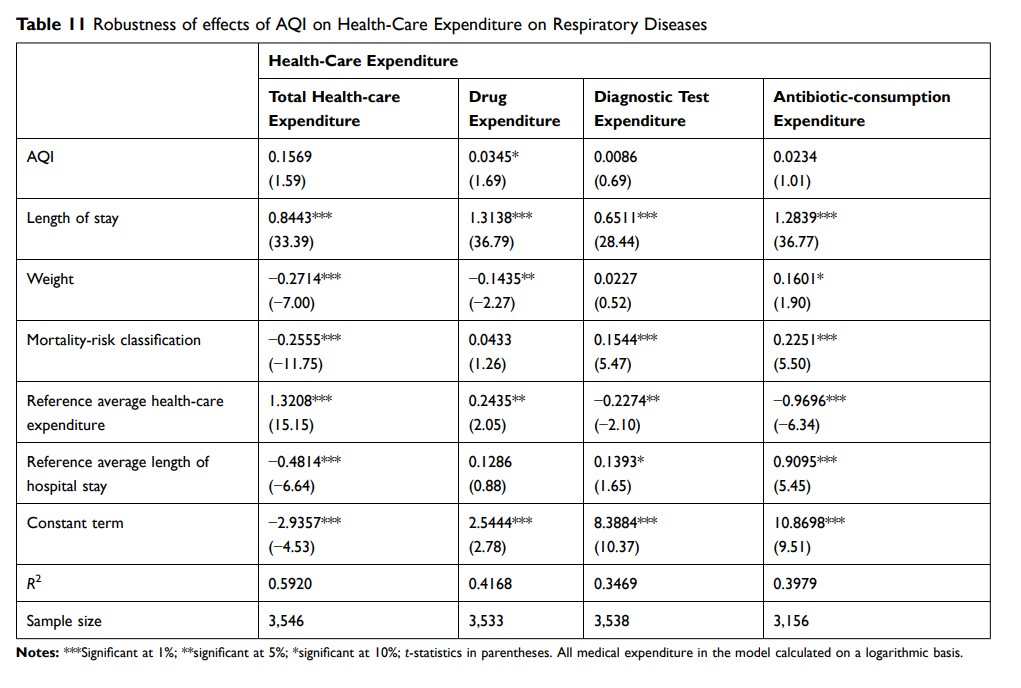
Results: We found that PM2.5 had a significant impact on health-care expenditure on respiratory diseases. It had a positive impact on total health-care expenditure, drug expenditure, and antibiotic expenditure. The impact of different levels of air pollution on the health care–expenditure burden of disease was heterogeneous. As the air-pollution index increased, health care–expenditure burden of respiratory diseases also gradually raised. The impact of PM10 and air-quality index had a positive impact on health-care expenditure for respiratory diseases. Air pollution had a significant impact on health care–expenditure burden of respiratory diseases. The effect of length of stay on various health-care expenditure was significantly positive.
Conclusion: The impact of mortality-risk classification on various health-care expenditure is significant. Therefore, policy-making must take into account both the supply side and the demand side of health-care services. Furthermore, the government should strengthen environmental governance, pay attention to the heterogeneity of the health care–expenditure burden affected by environmental pollution, improve the medical insurance system, and improve the health of residents to reduce the health care–expenditure burden.
Keywords: air pollution, PM2.5, respiratory diseases, health care–expenditure burden, individual health level