115195
论文已发表
注册即可获取德孚的最新动态
IF 收录期刊
- 3.6 Breast Cancer (Dove Med Press)
- 4.3 Clin Epidemiol
- 2.6 Cancer Manag Res
- 3.2 Infect Drug Resist
- 4.1 Clin Interv Aging
- 6.1 Drug Des Dev Ther
- 4.1 Int J Chronic Obstr
- 8.7 Int J Nanomed
- 2.5 Int J Women's Health
- 3.2 Neuropsych Dis Treat
- 2.4 OncoTargets Ther
- 2.6 Patient Prefer Adher
- 2.6 Ther Clin Risk Manag
- 3.1 J Pain Res
- 3.5 Diabet Metab Synd Ob
- 4.5 Psychol Res Behav Ma
- 3.4 Nat Sci Sleep
- 2.4 Pharmgenomics Pers Med
- 2.6 Risk Manag Healthc Policy
- 4.6 J Inflamm Res
- 2.3 Int J Gen Med
- 3.9 J Hepatocell Carcinoma
- 3.3 J Asthma Allergy
- 2.5 Clin Cosmet Investig Dermatol
- 3.0 J Multidiscip Healthc

长非编码 RNA SNHG14 通过海绵化 miR-382-5p 调节 SPIN1 表达,以促进非小细胞肺癌肿瘤进展
Authors Chen X, Song P, Yao Y, Yang Y
Received 22 February 2020
Accepted for publication 26 June 2020
Published 25 September 2020 Volume 2020:12 Pages 9113—9123
DOI https://doi.org/10.2147/CMAR.S250893
Checked for plagiarism Yes
Review by Single anonymous peer review
Peer reviewer comments 2
Editor who approved publication: Professor Rudolph Navari
Background: Non-small cell lung cancer (NSCLC) is the most common type of lung carcinoma. Long non-coding RNA (lncRNA) small nucleolar RNA host gene 14 (SNHG14 ) was identified to participate in tumor progression. However, the mechanism and functions of SNHG14 were rarely reported in NSCLC progression.
Methods: The relative gene expression was tested by qRT-PCR. Cell viability, apoptosis, migration and invasion were measured by MTT assay, flow cytometry, and transwell migration and invasion assays, respectively. The interactions between miR-382-5p and SNHG14 or SPIN1 were predicted by starBase and confirmed by the dual-luciferase reporter assay and RNA pull-down assay. The protein level of SPIN1 was evaluated by Western blot assay.
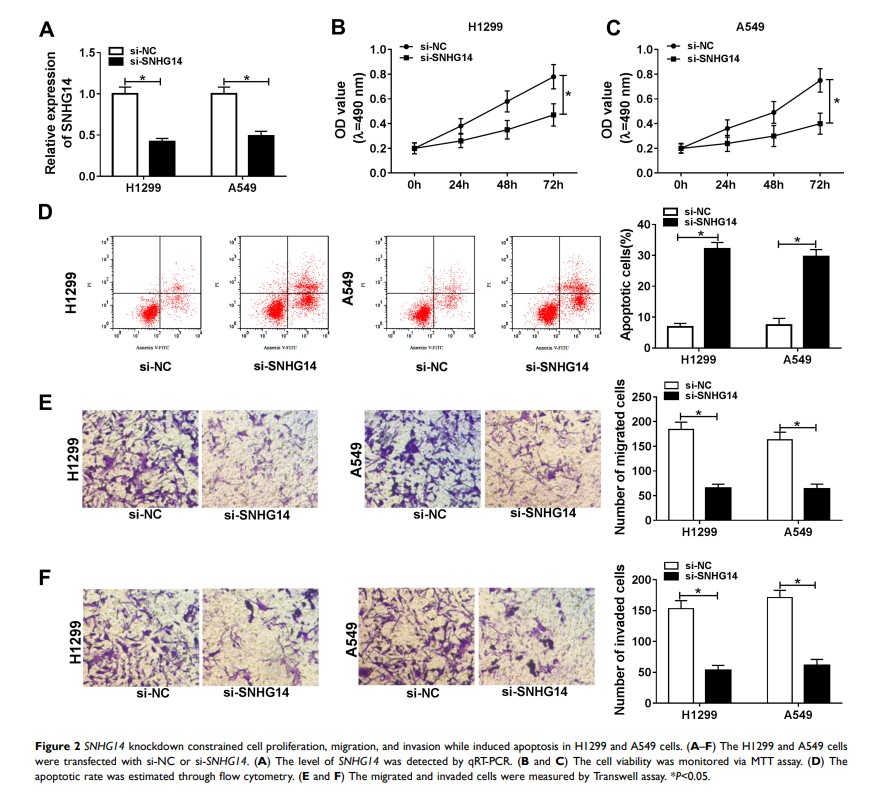
Results: The levels of SNHG14 and SPIN1 were significantly increased, while the level of miR-382-5p was apparently reduced in NSCLC tissues and cells. SNHG14 was verified to sponge miR-382-5p and SPIN1 was identified as a direct target of miR-382-5p . SNHG14 depletion repressed cell viability, migration and invasion, but induced the apoptotic rate by targeting miR-382-5p . miR-382-5p overexpression blocked cell viability, metastasis and promoted cell apoptosis by regulating SPIN1 . SNHG14 silencing down-regulated SPIN1 expression by sponging miR-382-5p .
Conclusion: SNHG14 facilitated NSCLC progression by regulating SPIN1 expression via targeting miR-382-5p .
Keywords: lncRNA SNHG14 , miR-382-5p , SPIN1 , tumor progression, NSCLC