115195
论文已发表
注册即可获取德孚的最新动态
IF 收录期刊
- 3.6 Breast Cancer (Dove Med Press)
- 4.3 Clin Epidemiol
- 2.6 Cancer Manag Res
- 3.2 Infect Drug Resist
- 4.1 Clin Interv Aging
- 6.1 Drug Des Dev Ther
- 4.1 Int J Chronic Obstr
- 8.7 Int J Nanomed
- 2.5 Int J Women's Health
- 3.2 Neuropsych Dis Treat
- 2.4 OncoTargets Ther
- 2.6 Patient Prefer Adher
- 2.6 Ther Clin Risk Manag
- 3.1 J Pain Res
- 3.5 Diabet Metab Synd Ob
- 4.5 Psychol Res Behav Ma
- 3.4 Nat Sci Sleep
- 2.4 Pharmgenomics Pers Med
- 2.6 Risk Manag Healthc Policy
- 4.6 J Inflamm Res
- 2.3 Int J Gen Med
- 3.9 J Hepatocell Carcinoma
- 3.3 J Asthma Allergy
- 2.5 Clin Cosmet Investig Dermatol
- 3.0 J Multidiscip Healthc

大学生的体育活动强度与抑郁症状:青少年健身改善策略(FITYou)项目
Authors Guo F, Tian Y, Zhong F, Wu C, Cui Y, Huang C
Received 10 June 2020
Accepted for publication 26 August 2020
Published 28 September 2020 Volume 2020:13 Pages 787—796
DOI https://doi.org/10.2147/PRBM.S267066
Checked for plagiarism Yes
Review by Single anonymous peer review
Peer reviewer comments 3
Editor who approved publication: Professor Igor Elman
Purpose: To investigate whether the physical activity at different intensities is correlated with depressive symptoms in college students.
Patient and Methods: This cross-sectional study was a part of the Fitness Improvement Tactics in Youth Project, which was conducted in 2017. A total of 2,820 college freshmen aged 15– 24 years were included in this study, of whom 699 (24.8%) were males and 2,121 (75.2%) were females. Depressive symptoms were measured using the Self-rating Depression Scale. Physical activity was assessed using the International Physical Activity Questionnaire-Short Form. Covariates included sociodemographic, lifestyle-related, and health-related factors.
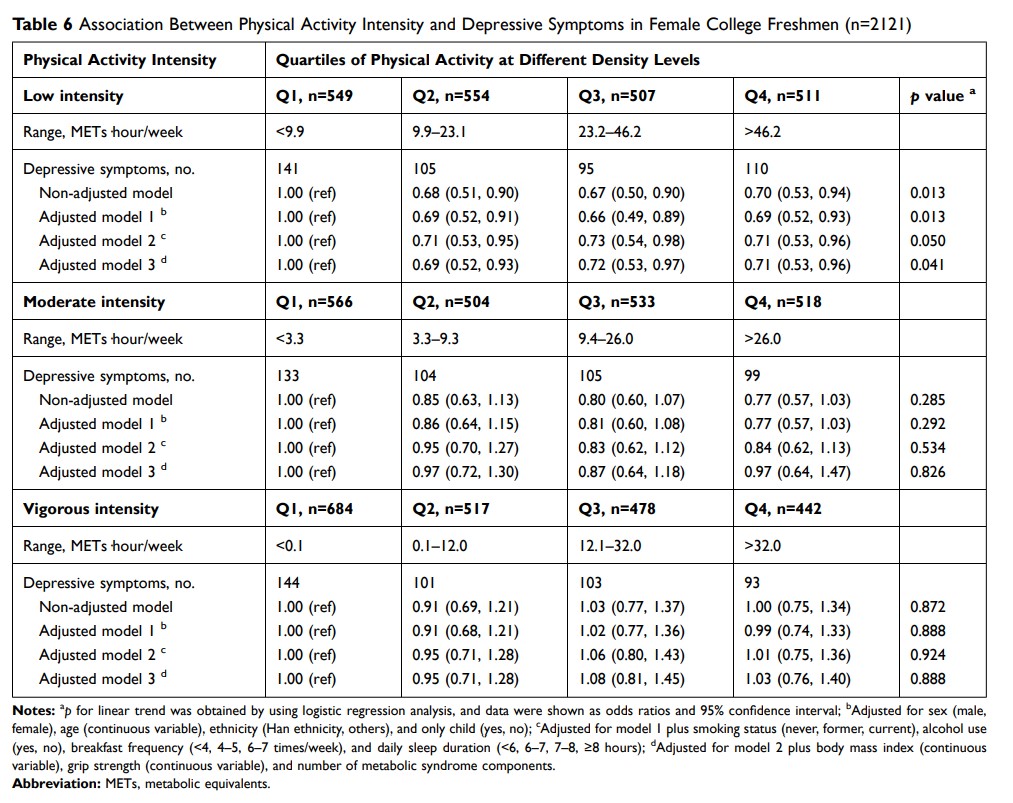
Results: A total of 560 (19.9%) college students had depressive symptoms. Total physical activity levels (METs•hour/week) were positively associated with frequency of breakfast intake (p = 0.050) but no other participant characteristics. Logistic regression analysis showed that the prevalence of depressive symptoms in the highest quartile of physical activity was lower than in the lowest quartile when adjusted for sex, age, ethnicity, only child, smoking status, alcohol use, breakfast frequency, daily sleep duration, body mass index, grip strength, and the number of metabolic syndrome components (odds ratios [95% confidence intervals (CI)]: 0.75 [0.58, 0.98], p = 0.036). Furthermore, high physical activity levels of low-intensity tended to moderately correlate to lower prevalence of depressive symptoms (odds ratios [95% CI]: Q1, 0.71 [0.55, 0.91], Q2, 0.77 [0.59, 1.01], Q3, 0.75 [0.57, 0.98], p for trend = 0.037). Associations of moderate and vigorous physical activity with depressive symptoms were not found. For secondary outcomes, sex-stratified analysis showed that similar findings were only found in females, but not males.
Conclusion: This study indicated that total physical activity and low-intensity physical activity were inversely associated with depressive symptoms in Chinese college students. All these observations showed gender differences.
Keywords: physical activity intensity, mental health, Chinese youth, cross-sectional study