115195
论文已发表
注册即可获取德孚的最新动态
IF 收录期刊
- 3.6 Breast Cancer (Dove Med Press)
- 4.3 Clin Epidemiol
- 2.6 Cancer Manag Res
- 3.2 Infect Drug Resist
- 4.1 Clin Interv Aging
- 6.1 Drug Des Dev Ther
- 4.1 Int J Chronic Obstr
- 8.7 Int J Nanomed
- 2.5 Int J Women's Health
- 3.2 Neuropsych Dis Treat
- 2.4 OncoTargets Ther
- 2.6 Patient Prefer Adher
- 2.6 Ther Clin Risk Manag
- 3.1 J Pain Res
- 3.5 Diabet Metab Synd Ob
- 4.5 Psychol Res Behav Ma
- 3.4 Nat Sci Sleep
- 2.4 Pharmgenomics Pers Med
- 2.6 Risk Manag Healthc Policy
- 4.6 J Inflamm Res
- 2.3 Int J Gen Med
- 3.9 J Hepatocell Carcinoma
- 3.3 J Asthma Allergy
- 2.5 Clin Cosmet Investig Dermatol
- 3.0 J Multidiscip Healthc

接受酪氨酸激酶抑制剂治疗的转移性肾细胞癌患者的获得性甲状腺功能减退症
Authors Wu J, Huang H
Received 1 July 2020
Accepted for publication 2 September 2020
Published 28 September 2020 Volume 2020:14 Pages 3977—3982
DOI https://doi.org/10.2147/DDDT.S270210
Checked for plagiarism Yes
Review by Single anonymous peer review
Peer reviewer comments 2
Editor who approved publication: Dr Yan Zhu
Purpose: We analyze a number of studies that describe the relationship between the onset of hypothyroidism and the prognosis of patients with metastatic renal cell carcinoma (mRCC) treated with TKIs.
Patients and Methods: Targeted therapies are currently considered as the first-line treatment for patients with mRCC. The occurrence of hypothyroidism in the treatment of mRCC with TKIs is a major side effect. A comprehensive search was performed in Pubmed, Cochrane Library, Institute for Scientific Information, and CKNI. The following keywords and descriptors were used during the search and were combined in a number of sequences in English and Chinese languages: protein kinase inhibitors (including sunitinib, pazopanib, tivozanib, cabozantinib, axitinib, sorafenib), hypothyroidism and renal cell carcinoma.
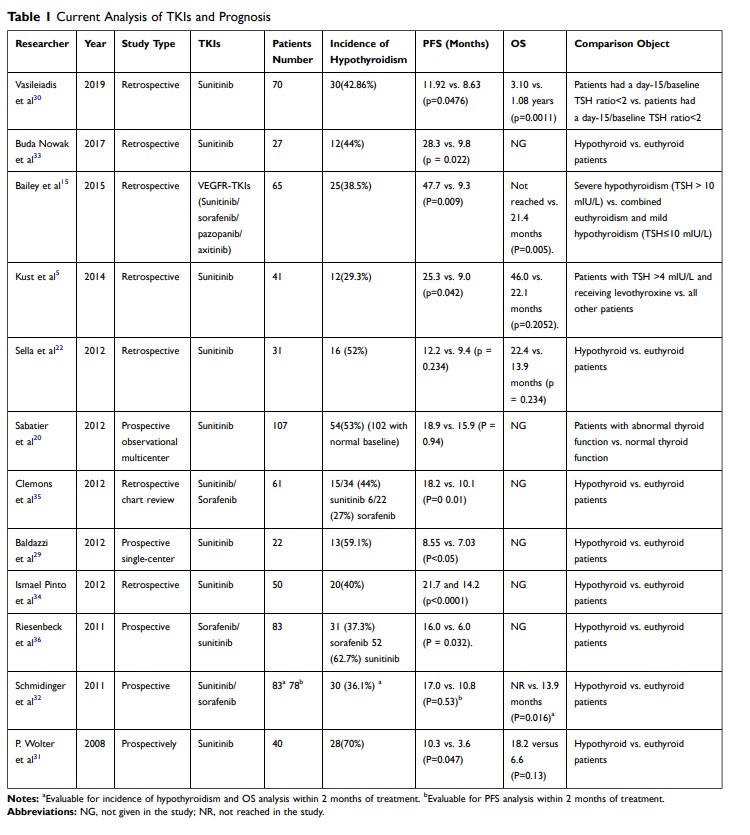
Results: Scholars have studied the clinical relationship between hypothyroidism and TKI treatment and its molecular biology mechanism. Most studies hold that hypothyroidism occurring during TKI therapy may serve as potential biomarkers of response and efficacy of treatment, but there is no consensus on this point.
Conclusion: The mechanism of hypothyroidism occurring is still unclear. Therefore, more studies are needed to clarify whether better outcomes are associated with TKI-induced hypothyroidism in mRCC patients, helping to maximize the treatment outcome of mRCC patients.
Keywords: metastatic renal cell carcinoma, mRCC, tyrosine kinase inhibitors, TKIs, hypothyroidism, progression-free survival, PFS, overall survival, OS