115195
论文已发表
注册即可获取德孚的最新动态
IF 收录期刊
- 3.6 Breast Cancer (Dove Med Press)
- 4.3 Clin Epidemiol
- 2.6 Cancer Manag Res
- 3.2 Infect Drug Resist
- 4.1 Clin Interv Aging
- 6.1 Drug Des Dev Ther
- 4.1 Int J Chronic Obstr
- 8.7 Int J Nanomed
- 2.5 Int J Women's Health
- 3.2 Neuropsych Dis Treat
- 2.4 OncoTargets Ther
- 2.6 Patient Prefer Adher
- 2.6 Ther Clin Risk Manag
- 3.1 J Pain Res
- 3.5 Diabet Metab Synd Ob
- 4.5 Psychol Res Behav Ma
- 3.4 Nat Sci Sleep
- 2.4 Pharmgenomics Pers Med
- 2.6 Risk Manag Healthc Policy
- 4.6 J Inflamm Res
- 2.3 Int J Gen Med
- 3.9 J Hepatocell Carcinoma
- 3.3 J Asthma Allergy
- 2.5 Clin Cosmet Investig Dermatol
- 3.0 J Multidiscip Healthc

预计美国、英国、俄罗斯和印度 2019 冠状病毒病(COVID-19)的患病率和死亡率
Authors Wang Y, Xu C, Yao S, Zhao Y, Li Y, Wang L, Zhao X
Received 30 May 2020
Accepted for publication 12 August 2020
Published 29 September 2020 Volume 2020:13 Pages 3335—3350
DOI https://doi.org/10.2147/IDR.S265292
Checked for plagiarism Yes
Review by Single anonymous peer review
Peer reviewer comments 4
Editor who approved publication: Professor Suresh Antony
Objective: The aim of this study is to apply the advanced error-trend-seasonal (ETS) framework to forecast the prevalence and mortality series of COVID-19 in the USA, the UK, Russia, and India, and the predictive performance of the ETS framework was compared with the most frequently used autoregressive integrated moving average (ARIMA) model.
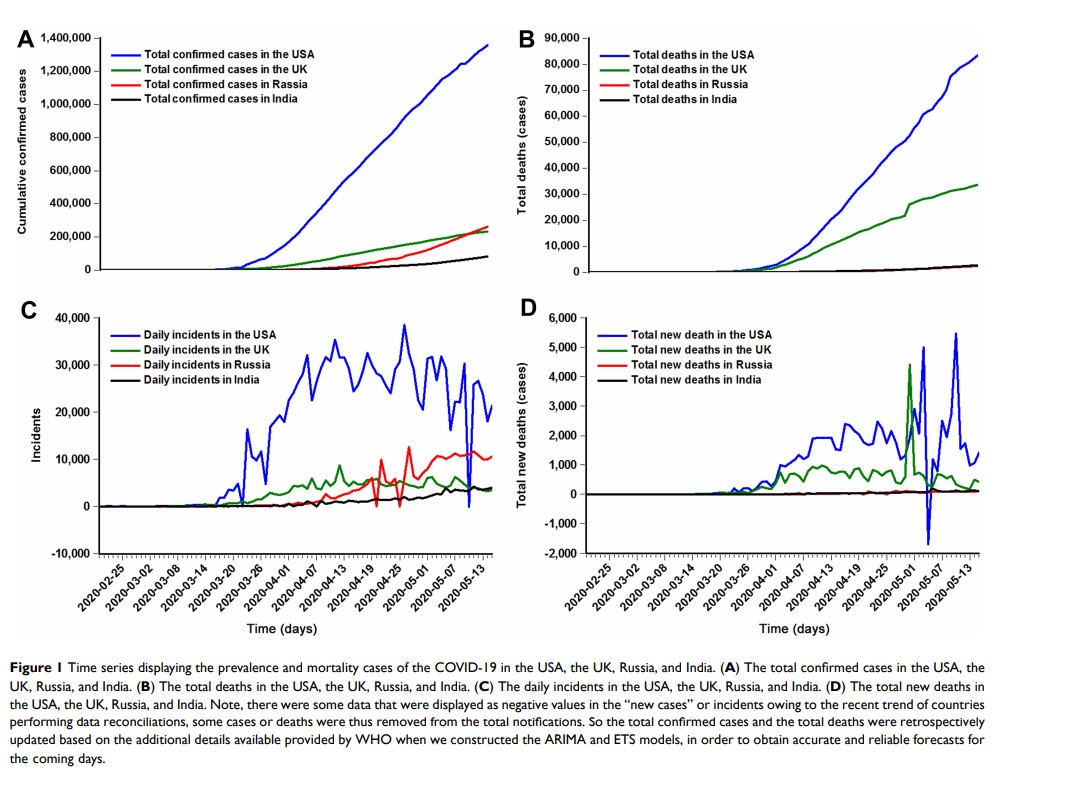
Materials and Methods: The prevalence and mortality data of COVID-19 in the USA, the UK, Russia, and India between 20 February 2020 and 15 May 2020 were extracted from the WHO website. Then, the data subsamples between 20 February 2020 and 3 May 2020 were treated as the training horizon, and the others were used as the testing horizon to construct the ARIMA models and the ETS models.
Results: Based on the model evaluation criteria, the ARIMA (0,2,1) and ETS (M,MD,N), sparse coefficient ARIMA (0,2,(1,6)) and ETS (A,AD,M), ARIMA (1,1,1) and ETS (A,MD,A), together with ARIMA (2,2,1) and ETS (A,M,A) specifications were identified as the preferred ARIMA and ETS models for the prevalence data in the USA, the UK, Russia, and India, respectively; the ARIMA (0,2,1) and ETS (M,A,M), ARIMA (0,2,1) and ETS (M,A,N), ARIMA (0,2,1) and ETS (A,A,N), coupled with ARIMA (0,2,2) and ETS (M,M,N) specifications were selected as the optimal ARIMA and ETS models for the mortality data in these four countries, respectively. Among these best-fitting models, the ETS models produced smaller forecasting error rates than the ARIMA models in all the datasets.
Conclusion: The ETS framework can be used to nowcast and forecast the long-term temporal trends of the COVID-19 prevalence and mortality in the USA, the UK, Russia, and India, and which provides a notable performance improvement over the most frequently used ARIMA model. Our findings can aid governments as a reference to prepare for and respond to the COVID-19 pandemic both in restricting the transmission of the disease and in lowering the disease-related deaths in the upcoming days.
Keywords: coronavirus disease 2019, outbreak, ARIMA model, ETS model, epidemiological indicators, nowcasting