115195
论文已发表
注册即可获取德孚的最新动态
IF 收录期刊
- 3.6 Breast Cancer (Dove Med Press)
- 4.3 Clin Epidemiol
- 2.6 Cancer Manag Res
- 3.2 Infect Drug Resist
- 4.1 Clin Interv Aging
- 6.1 Drug Des Dev Ther
- 4.1 Int J Chronic Obstr
- 8.7 Int J Nanomed
- 2.5 Int J Women's Health
- 3.2 Neuropsych Dis Treat
- 2.4 OncoTargets Ther
- 2.6 Patient Prefer Adher
- 2.6 Ther Clin Risk Manag
- 3.1 J Pain Res
- 3.5 Diabet Metab Synd Ob
- 4.5 Psychol Res Behav Ma
- 3.4 Nat Sci Sleep
- 2.4 Pharmgenomics Pers Med
- 2.6 Risk Manag Healthc Policy
- 4.6 J Inflamm Res
- 2.3 Int J Gen Med
- 3.9 J Hepatocell Carcinoma
- 3.3 J Asthma Allergy
- 2.5 Clin Cosmet Investig Dermatol
- 3.0 J Multidiscip Healthc

三甲胺 N-氧化物,一种依赖肠道菌群的代谢产物,与患有心血管疾病的老年人的虚弱有关
Authors He W, Luo Y, Liu JP, Sun N, Guo D, Cui LL, Zheng PP, Yao SM, Yang JF, Wang H
Received 10 July 2020
Accepted for publication 1 September 2020
Published 30 September 2020 Volume 2020:15 Pages 1809—1820
DOI https://doi.org/10.2147/CIA.S270887
Checked for plagiarism Yes
Review by Single anonymous peer review
Peer reviewer comments 3
Editor who approved publication: Prof. Dr. Zhi-Ying Wu
Objective: Our study aimed to explore the association between trimethylamine N-oxide and frailty in older adults with cardiovascular disease.
Patients and Methods: This cross-sectional study analyzed a total of 451 people aged 65 years or older who underwent comprehensive geriatric assessments. Frailty status was determined using a frailty index constructed with 48 variables according to the cumulative deficits model. Physical frailty and cognitive frailty were also assessed in detail. Fasting plasma TMAO was measured by mass spectrometry.
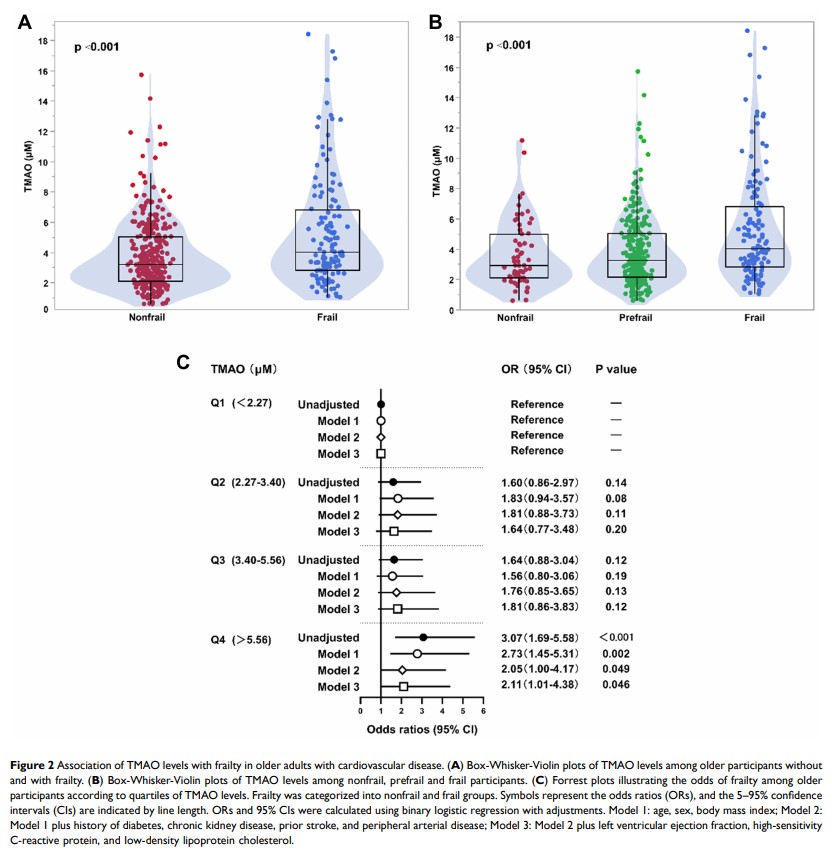
Results: The proportion of frail subjects was 29.9% (135/451). Plasma TMAO levels were significantly higher in frail patients than in nonfrail individuals (4.04 [2.84– 7.01] vs 3.21 [2.13– 5.03] μM; p< 0.001). Elevated plasma TMAO levels were independently associated with the likelihood of frailty (OR 2.12, 95% CI 1.01– 4.38, p=0.046). Dose–response analysis revealed a linear association between the TMAO concentration and the OR for frailty. A 2-unit increase in TMAO was independently correlated with physical frailty (OR 1.23, 95% CI 1.08– 1.41, p for trend 0.002) and cognitive frailty (OR 1.21, 95% CI 1.01– 1.45, p for trend 0.04).
Conclusion: Elevated circulating TMAO levels are independently associated with frailty among older adults with cardiovascular disease.
Keywords: older adults, frailty, TMAO, cardiovascular disease, physical frailty, cognitive frailty