115195
论文已发表
注册即可获取德孚的最新动态
IF 收录期刊
- 3.6 Breast Cancer (Dove Med Press)
- 4.3 Clin Epidemiol
- 2.6 Cancer Manag Res
- 3.2 Infect Drug Resist
- 4.1 Clin Interv Aging
- 6.1 Drug Des Dev Ther
- 4.1 Int J Chronic Obstr
- 8.7 Int J Nanomed
- 2.5 Int J Women's Health
- 3.2 Neuropsych Dis Treat
- 2.4 OncoTargets Ther
- 2.6 Patient Prefer Adher
- 2.6 Ther Clin Risk Manag
- 3.1 J Pain Res
- 3.5 Diabet Metab Synd Ob
- 4.5 Psychol Res Behav Ma
- 3.4 Nat Sci Sleep
- 2.4 Pharmgenomics Pers Med
- 2.6 Risk Manag Healthc Policy
- 4.6 J Inflamm Res
- 2.3 Int J Gen Med
- 3.9 J Hepatocell Carcinoma
- 3.3 J Asthma Allergy
- 2.5 Clin Cosmet Investig Dermatol
- 3.0 J Multidiscip Healthc

集成网络药理分析和药理评价,探索黄蜀葵 抑制肾纤维化的有效成分和作用机理
Authors Gu L, Hong F, Fan K, Zhao L, Zhang C, Yu B, Chai C
Received 5 June 2020
Accepted for publication 27 August 2020
Published 1 October 2020 Volume 2020:14 Pages 4053—4067
DOI https://doi.org/10.2147/DDDT.S264898
Checked for plagiarism Yes
Review by Single anonymous peer review
Peer reviewer comments 3
Editor who approved publication: Professor Jianbo Sun
Background: Renal fibrosis is a common pathological outcome of chronic kidney diseases (CKD) that is considered as a global public health issue with high morbidity and mortality. The dry corolla of Abelmoschus manihot (L.) Medik. (AMC) has been used for chronic nephritis in clinic and showed a superior effect in alleviating proteinuria in CKD patients to losartan. However, the effective components and underlying mechanism of AMC in the treatment of renal fibrosis have not been systematically clarified.
Methods: Based on drug-likeness evaluation, oral bioavailability prediction and compound contents, a systematic network pharmacology analysis was conducted to predict the active ingredients. Gene Ontology, Kyoto Encyclopedia of Genes and Genomes pathway analysis and protein–protein interaction analysis were applied to predict the potential pathway and target of AMC against renal fibrosis. The formula of component contribution index (CI) based on the algorithm was used to screen the principal active compounds of AMC in the treatment of renal fibrosis. Finally, pharmacological evaluation was conducted to validate the protective effect and primary predicted mechanism of AMC in the treatment of renal fibrosis on a 5/6 nephrectomy mice model.
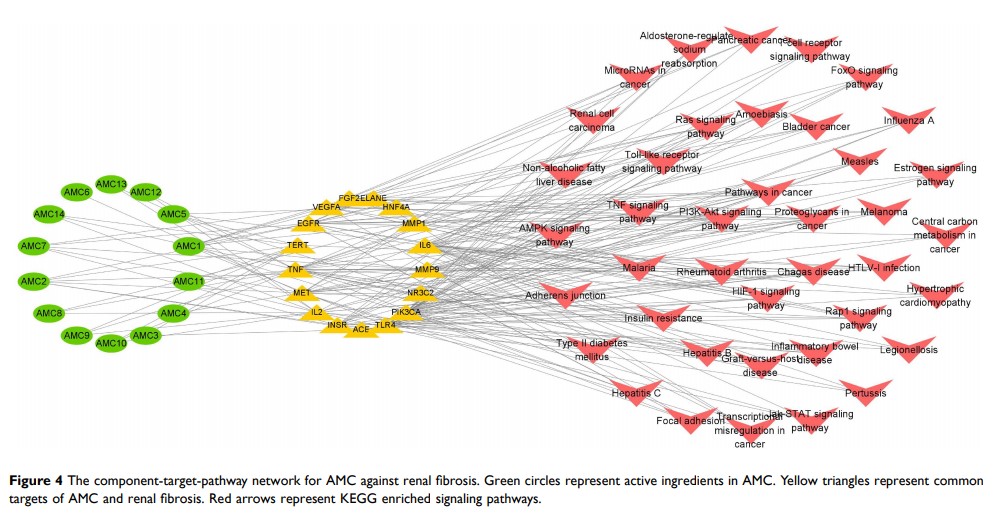
Results: Fourteen potential active components of AMC possessing favorable pharmacokinetic profiles and biological activities were selected and hit by 17 targets closely related to renal fibrosis. Quercetin, caffeic acid, 9.12-octadecadienoic acid, and myricetin are recognized as the more highly predictive components as their cumulative contribution rate reached 85.86%. The AMC administration on 5/6 nephrectomy mice showed a protective effect on kidney function and renal fibrosis. The hub genes analysis revealed that AMC plays a major role in inhibiting epithelial-to-mesenchymal transition during renal fibrosis.
Conclusion: Our results predicted active components and potential targets of AMC for the application to renal fibrosis from a holistic perspective, as well as provided valuable direction for further research of AMC and improved comprehension of renal fibrosis pathogenesis.
Keywords: Abelmoschus manihot (L.) Medik., network pharmacology, renal fibrosis, 5/6 nephrectomy, active components