115195
论文已发表
注册即可获取德孚的最新动态
IF 收录期刊
- 3.6 Breast Cancer (Dove Med Press)
- 4.3 Clin Epidemiol
- 2.6 Cancer Manag Res
- 3.2 Infect Drug Resist
- 4.1 Clin Interv Aging
- 6.1 Drug Des Dev Ther
- 4.1 Int J Chronic Obstr
- 8.7 Int J Nanomed
- 2.5 Int J Women's Health
- 3.2 Neuropsych Dis Treat
- 2.4 OncoTargets Ther
- 2.6 Patient Prefer Adher
- 2.6 Ther Clin Risk Manag
- 3.1 J Pain Res
- 3.5 Diabet Metab Synd Ob
- 4.5 Psychol Res Behav Ma
- 3.4 Nat Sci Sleep
- 2.4 Pharmgenomics Pers Med
- 2.6 Risk Manag Healthc Policy
- 4.6 J Inflamm Res
- 2.3 Int J Gen Med
- 3.9 J Hepatocell Carcinoma
- 3.3 J Asthma Allergy
- 2.5 Clin Cosmet Investig Dermatol
- 3.0 J Multidiscip Healthc

氧化苦参碱通过减弱 PKM2 介导的有氧糖酵解抑制大肠癌转移
Authors Li X, Sun J, Xu Q, Duan W, Yang L, Wu X, Lu G, Zhang L, Zheng Y
Received 15 June 2020
Accepted for publication 28 August 2020
Published 1 October 2020 Volume 2020:12 Pages 9503—9513
DOI https://doi.org/10.2147/CMAR.S267686
Checked for plagiarism Yes
Review by Single anonymous peer review
Peer reviewer comments 2
Editor who approved publication: Dr Sanjeev Srivastava
Background: Colorectal cancer (CRC), a type of highly occurred intestinal cancer at present, is prone to metastasis at the later stage of chemotherapy. Looking for the anti-metastatic agents from natural compounds attracted much concern. Here, it aims to demonstrate whether oxymatrine, an anti-cancer natural compound, has anti-metastatic activity and its potential significance in clinic.
Materials and Methods: Wound healing assay and transwell assay were for evaluating the effect of oxymatrine on cell migration and invasion in vitro. Anti-metastatic action in vivo was determined by hepatic metastasis of colorectal cancer cells in mice.
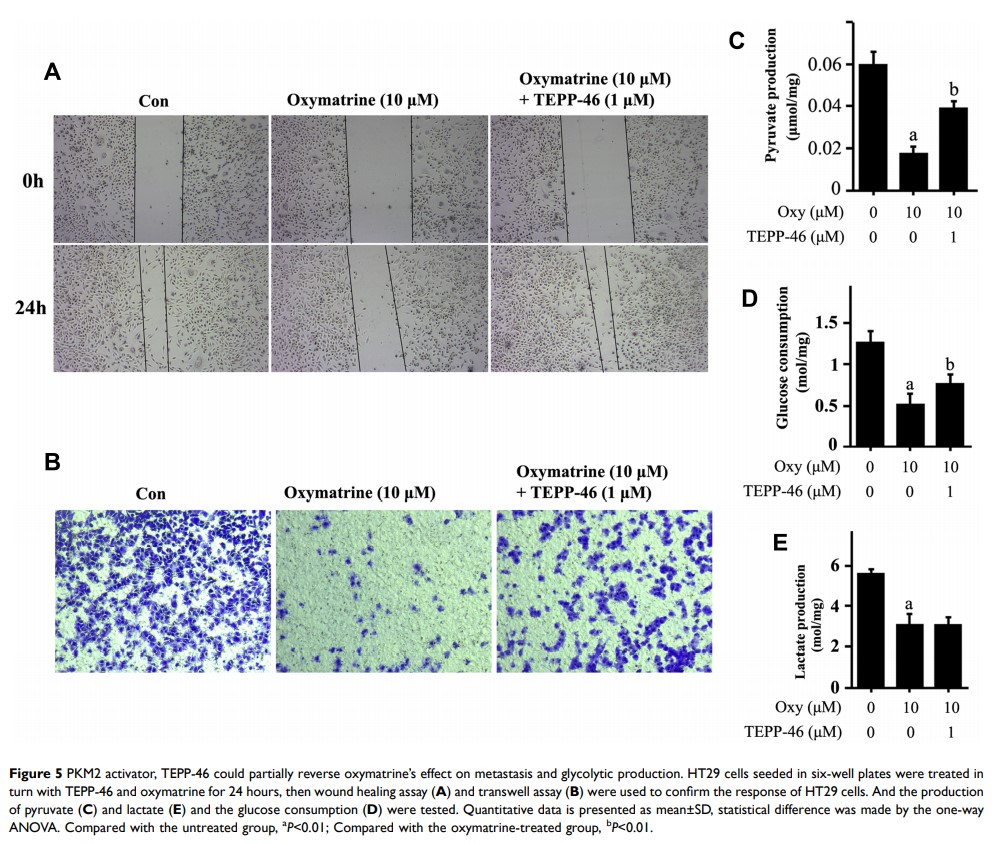
Results: Oxymatrine can significantly inhibit cancer cell migration and invasion in vitro. The production of ATP, pyruvate, and lactate was suppressed in CRC cells under the treatment of oxymatrine, as well as the glucose consumption. Meantime, extracellular acidification rates (ECR) were evidently attenuated although the oxygen consumption rates (OCR) were not affected. Both clued that oxymatrine inhibition of metastasis is possibly related to blocking aerobic glycolysis. Subsequent results indicated that pyruvate kinase M2 (PKM2) not hexokinase (HK) and phosphofructokinase (PFK) were involved in oxymatrine blocking glycolysis as the PKM2 kinase activity and expression were inhibited by oxymatrine and the PKM2 activator, TEPP-46, can reverse in part the effect of oxymatrine induced in CRC cells. Furthermore, this process was also mediated by inhibition of glucose transporter 1 (GLUT1). Finally, the in vivo metastatic model in mice showed both 20 mg/kg and 40 mg/kg oxymatrine significantly inhibit liver metastasis of CRC cells in mice, and PKM2 and GLUT1 expression in liver of the oxymatrine-treated group is declined.
Conclusion: Oxymatrine exerted anti-metastatic activity dependent on inhibition of PKM2-mediated aerobic glycolysis. It is not only an anti-cancer agent but also a potential anti-metastatic compound with clinical application significance.
Keywords: oxymatrine, colorectal cancer, aerobic glycolysis, PKM2, GLUT1