115195
论文已发表
注册即可获取德孚的最新动态
IF 收录期刊
- 3.6 Breast Cancer (Dove Med Press)
- 4.3 Clin Epidemiol
- 2.6 Cancer Manag Res
- 3.2 Infect Drug Resist
- 4.1 Clin Interv Aging
- 6.1 Drug Des Dev Ther
- 4.1 Int J Chronic Obstr
- 8.7 Int J Nanomed
- 2.5 Int J Women's Health
- 3.2 Neuropsych Dis Treat
- 2.4 OncoTargets Ther
- 2.6 Patient Prefer Adher
- 2.6 Ther Clin Risk Manag
- 3.1 J Pain Res
- 3.5 Diabet Metab Synd Ob
- 4.5 Psychol Res Behav Ma
- 3.4 Nat Sci Sleep
- 2.4 Pharmgenomics Pers Med
- 2.6 Risk Manag Healthc Policy
- 4.6 J Inflamm Res
- 2.3 Int J Gen Med
- 3.9 J Hepatocell Carcinoma
- 3.3 J Asthma Allergy
- 2.5 Clin Cosmet Investig Dermatol
- 3.0 J Multidiscip Healthc

使用下一代测序技术对中国早发性痴呆患者进行遗传分析
Authors Han LH, Xue YY, Zheng YC, Li XY, Lin RR, Wu ZY, Tao QQ
Received 13 July 2020
Accepted for publication 1 September 2020
Published 2 October 2020 Volume 2020:15 Pages 1831—1839
DOI https://doi.org/10.2147/CIA.S271222
Checked for plagiarism Yes
Review by Single anonymous peer review
Peer reviewer comments 3
Editor who approved publication: Dr Richard Walker
Objective: Early-onset dementia (EOD) is a relatively uncommon form of dementia that afflicts people before age 65. Only a few studies analyzing the genetics of EOD have been performed in the Chinese Han population. Diagnosing EOD remains a challenge due to the diverse genetic and clinical heterogeneity of these diseases. The aim of this study was to investigate the genetic spectrum and clinical features of Chinese patients with EOD.
Materials and Methods: A total of 49 EOD patients were recruited. Targeted next-generation (NGS) analyses were performed to screen for all of the known genes associated with dementia. Possible pathogenic variants were confirmed by performing Sanger sequencing. The genetic spectrum and clinical features of the EOD patients were analyzed.
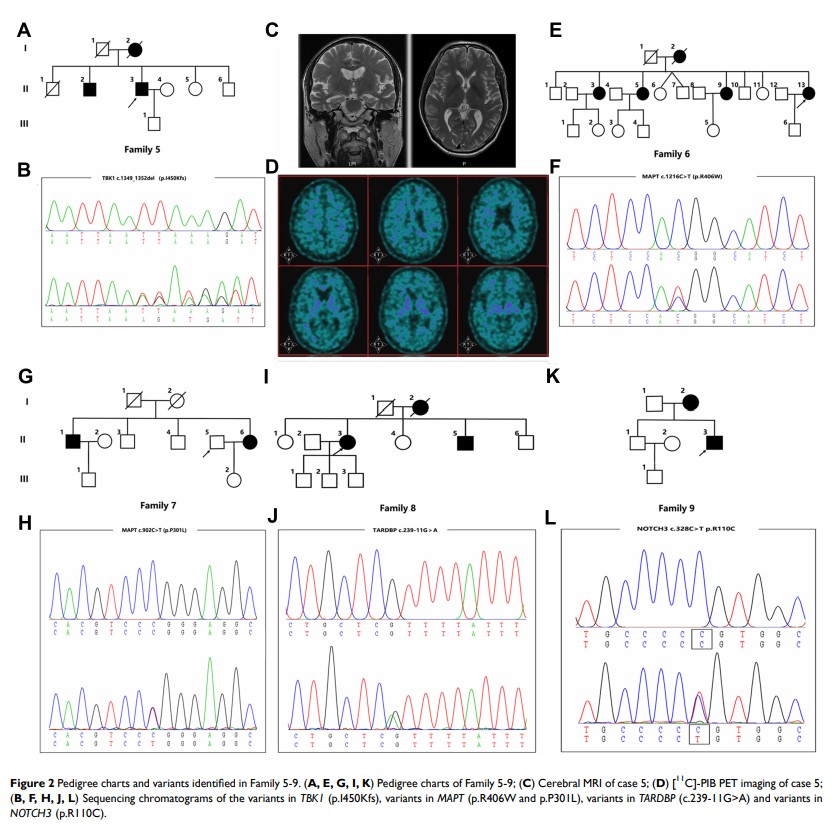
Results: Seven previously reported pathogenic variants (p.I213T and p.W165C in PSEN1 ; p.D678N in APP ; c.1349_1352del in TBK1 ; p.P301L and p.R406W in MAPT ; p.R110C in NOTCH3 ) and two novel variants of uncertain significance (p.P436L in PSEN2 ; c.239-11G>A in TARDBP ) were identified.
Conclusion: Our study demonstrated the genetic spectrum and clinical features of EOD patients, and it reveals that genetic testing of known causal genes in EOD patients can help to make a precise diagnosis.
Keywords: Chinese, genetic analysis, early-onset dementia, next-generation sequencing