115195
论文已发表
注册即可获取德孚的最新动态
IF 收录期刊
- 3.6 Breast Cancer (Dove Med Press)
- 4.3 Clin Epidemiol
- 2.6 Cancer Manag Res
- 3.2 Infect Drug Resist
- 4.1 Clin Interv Aging
- 6.1 Drug Des Dev Ther
- 4.1 Int J Chronic Obstr
- 8.7 Int J Nanomed
- 2.5 Int J Women's Health
- 3.2 Neuropsych Dis Treat
- 2.4 OncoTargets Ther
- 2.6 Patient Prefer Adher
- 2.6 Ther Clin Risk Manag
- 3.1 J Pain Res
- 3.5 Diabet Metab Synd Ob
- 4.5 Psychol Res Behav Ma
- 3.4 Nat Sci Sleep
- 2.4 Pharmgenomics Pers Med
- 2.6 Risk Manag Healthc Policy
- 4.6 J Inflamm Res
- 2.3 Int J Gen Med
- 3.9 J Hepatocell Carcinoma
- 3.3 J Asthma Allergy
- 2.5 Clin Cosmet Investig Dermatol
- 3.0 J Multidiscip Healthc

网络药理学分析和实验验证相结合揭示了辣木籽改善胰岛素抵抗作用的机理
Authors Huang Q, Liu R, Liu J, Huang Q, Liu S, Jiang Y
Received 10 June 2020
Accepted for publication 27 August 2020
Published 2 October 2020 Volume 2020:14 Pages 4069—4084
DOI https://doi.org/10.2147/DDDT.S265198
Checked for plagiarism Yes
Review by Single anonymous peer review
Peer reviewer comments 2
Editor who approved publication: Professor Jianbo Sun
Background and Purpose: Insulin resistance (IR) is one of the factors that results in metabolic syndrome, type 2 diabetes mellitus and different aspects of cardiovascular diseases. Moringa oleifera seeds (MOS), traditionally used as an antidiabetic food and traditional medicine in tropical Asia and Africa, have exhibited potential effects in improving IR. To systematically explore the pharmacological mechanism of the anti-IR effects of MOS, we adopted a network pharmacology approach at the molecular level.
Methods: By incorporating compound screening and target prediction, a feasible compound-target-pathway network pharmacology model was established to systematically predict the potential active components and mechanisms of the anti-IR effects of MOS. Biological methods were then used to verify the results of the network pharmacology analysis.
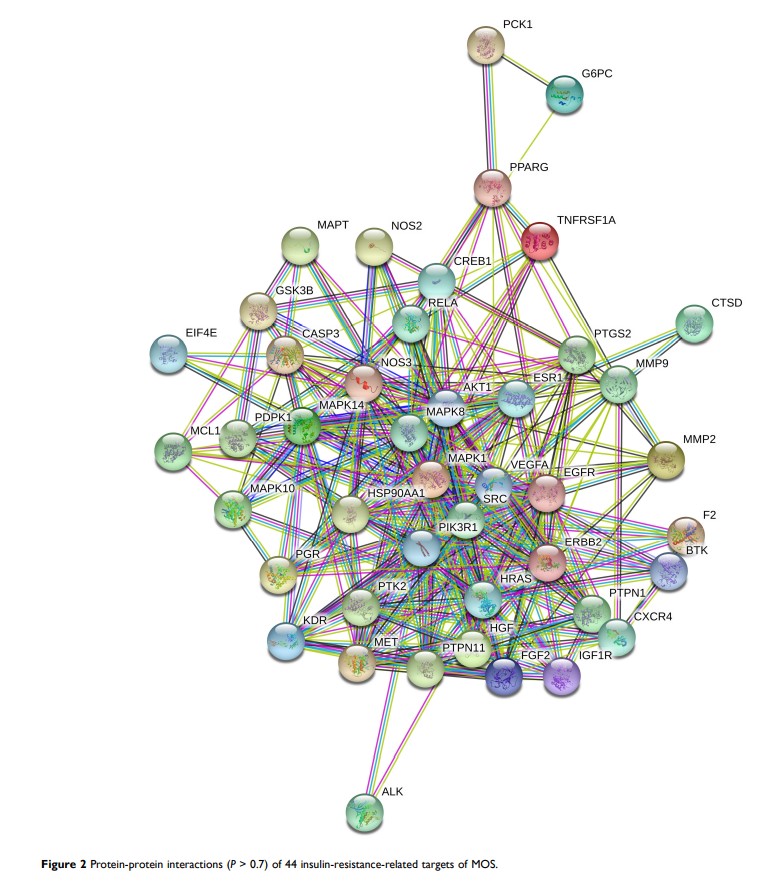
Results: Our comprehensive systematic approach successfully identified 32 bioactive compounds in MOS and 44 potential targets of these compounds related to IR, as well as 37 potential pathways related to IR. Moreover, the network pharmacology analysis revealed that glycosidic isothiocyanates and glycosidic benzylamines were the major active components that improved IR by acting on key targets, such as SRC, PTPN1, and CASP3, which were involved in inflammatory responses and insulin-related pathways. Further biological research demonstrated that the anti-IR effects of MOS were mediated by increasing glucose uptake and modulating the expression of SRC and PTPN1.
Conclusion: Our study successfully predicts the active ingredients and potential targets of MOS for improving IR and helps to illustrate mechanism of action at a systemic level. This study not only provides new insights into the chemical basis and pharmacology of MOS but also demonstrates a feasible method for discovering potential drugs from traditional medicines.
Keywords: network pharmacology, Moringa oleifera seeds, IR, active components, action mechanism