115195
论文已发表
注册即可获取德孚的最新动态
IF 收录期刊
- 3.6 Breast Cancer (Dove Med Press)
- 4.3 Clin Epidemiol
- 2.6 Cancer Manag Res
- 3.2 Infect Drug Resist
- 4.1 Clin Interv Aging
- 6.1 Drug Des Dev Ther
- 4.1 Int J Chronic Obstr
- 8.7 Int J Nanomed
- 2.5 Int J Women's Health
- 3.2 Neuropsych Dis Treat
- 2.4 OncoTargets Ther
- 2.6 Patient Prefer Adher
- 2.6 Ther Clin Risk Manag
- 3.1 J Pain Res
- 3.5 Diabet Metab Synd Ob
- 4.5 Psychol Res Behav Ma
- 3.4 Nat Sci Sleep
- 2.4 Pharmgenomics Pers Med
- 2.6 Risk Manag Healthc Policy
- 4.6 J Inflamm Res
- 2.3 Int J Gen Med
- 3.9 J Hepatocell Carcinoma
- 3.3 J Asthma Allergy
- 2.5 Clin Cosmet Investig Dermatol
- 3.0 J Multidiscip Healthc

比较 COVID-19 和腺病毒性肺炎的临床、实验室和放射学特征:回顾性研究
Authors Jiang J, Wan R, Pan P, Hu C, Zhou R, Yin Y, Zhou T, Huang H, Li Y
Received 23 May 2020
Accepted for publication 20 August 2020
Published 2 October 2020 Volume 2020:13 Pages 3401—3408
DOI https://doi.org/10.2147/IDR.S264132
Checked for plagiarism Yes
Review by Single anonymous peer review
Peer reviewer comments 2
Editor who approved publication: Professor Suresh Antony
Background: The pandemic of coronavirus disease 2019 (COVID-19) has become a global public health problem. It is important for clinical physicians to differentiate COVID-19 from other respiratory infectious diseases caused by viruses, such as human adenovirus.
Subjects and Methods: This was a retrospective observational study. We analyzed and compared the clinical manifestations, laboratory findings and radiological features of two independent cohorts of patients diagnosed with either COVID-19 (n=36) or adenovirus pneumonia (n=18).
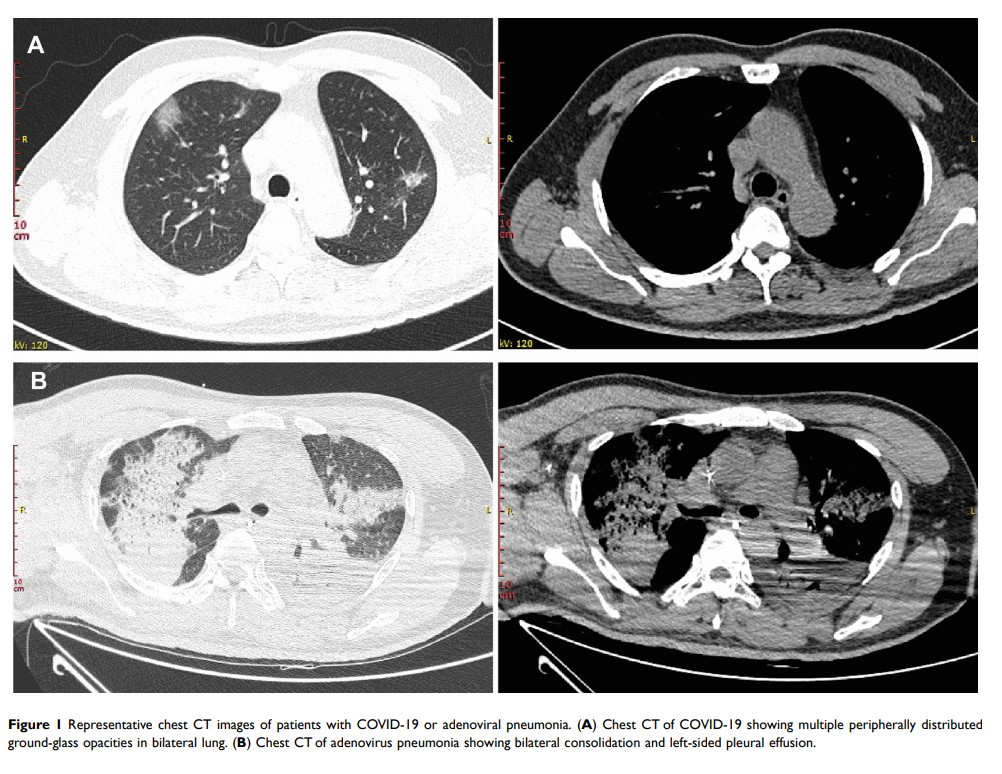
Results: COVID-19 did not show a preference in males or females, whereas 94.4% of patients with adenovirus pneumonia were males. Fever and cough were common in both COVID-19 and adenovirus pneumonia. But the median maximal body temperature of the adenovirus pneumonia cohort was significantly higher than in COVID-19 (P < 0.001). Furthermore, 77.8% of patients with adenovirus pneumonia had a productive cough versus only 13.9% of COVID-19 patients (P < 0.001). Compared with adenovirus pneumonia, constitutional symptoms were less common in COVID-19, including headache (16.7% vs 38.9%, P =0.072), sore throat (8.3% vs 27.8%, P =0.058), myalgia (8.3% vs 61.1%, P < 0.001) and diarrhea (8.3% vs 44.4%, P =0.002). Furthermore, patients with COVID-19 were less likely to develop respiratory failure (8.3% vs 83.3%, P < 0.001) and showed less prominent laboratory abnormalities, including lymphocytopenia (61.1% vs 88.9%, P =0.035), thrombocytopenia (2.8% vs 61.1%, P < 0.001), elevated procalcitonin (2.8% vs 77.8%, P < 0.001) and elevated C-reactive protein (36.1% vs 100%, P < 0.001). Besides, a higher percentage of patients with adenovirus pneumonia showed elevated transaminase, myocardial enzymes, creatinine and D-dimer compared with COVID-19 patients. On chest CT, the COVID-19 cohort was characterized by peripherally distributed ground-glass opacity and patchy shadowing, while the adenovirus pneumonia cohort frequently presented with consolidation and pleural effusion.
Conclusion: There were many differences between patients diagnosed with COVID-19 and those with adenovirus pneumonia in their clinical, laboratory and radiological characteristics. Compared with adenovirus pneumonia, COVID-19 patients tended to show a lower severity of illness.
Keywords: coronavirus disease 2019, severe acute respiratory syndrome coronavirus 2, human adenovirus, adenovirus pneumonia, differential diagnosis