115195
论文已发表
注册即可获取德孚的最新动态
IF 收录期刊
- 3.6 Breast Cancer (Dove Med Press)
- 4.3 Clin Epidemiol
- 2.6 Cancer Manag Res
- 3.2 Infect Drug Resist
- 4.1 Clin Interv Aging
- 6.1 Drug Des Dev Ther
- 4.1 Int J Chronic Obstr
- 8.7 Int J Nanomed
- 2.5 Int J Women's Health
- 3.2 Neuropsych Dis Treat
- 2.4 OncoTargets Ther
- 2.6 Patient Prefer Adher
- 2.6 Ther Clin Risk Manag
- 3.1 J Pain Res
- 3.5 Diabet Metab Synd Ob
- 4.5 Psychol Res Behav Ma
- 3.4 Nat Sci Sleep
- 2.4 Pharmgenomics Pers Med
- 2.6 Risk Manag Healthc Policy
- 4.6 J Inflamm Res
- 2.3 Int J Gen Med
- 3.9 J Hepatocell Carcinoma
- 3.3 J Asthma Allergy
- 2.5 Clin Cosmet Investig Dermatol
- 3.0 J Multidiscip Healthc

MCM10 充当潜在的预后生物标志物,并促进肝细胞癌中的细胞增殖:生物信息学分析和实验验证相结合
Received 23 June 2020
Accepted for publication 12 September 2020
Published 5 October 2020 Volume 2020:12 Pages 9609—9619
DOI https://doi.org/10.2147/CMAR.S267493
Checked for plagiarism Yes
Review by Single anonymous peer review
Peer reviewer comments 2
Editor who approved publication: Professor Rudolph Navari
Background: Hepatocellular carcinoma (HCC) is one of the most common human malignant tumors. The prognosis of HCC patients is still unsatisfying. Thus, it is of great importance to identify novel molecules and functional pathways associated with the pathophysiology of HCC. In this study, we performed the integrated bioinformatics analysis and experiment validation to identify novel biomarkers in the prognosis and progression of HCC.
Materials and Methods: Gene expression profiles were obtained from Gene Expression Omnibus database (GSE33294) for the screening of the differentially expressed genes (DEGs) between HCC tissues and matched non-tumor tissues. The DEGs were subjected to Gene Ontology (GO), Kyoto Encyclopedia of Genes and Genomes (KEGG) pathway enrichment analysis and Gene Set Enrichment Analysis (GSEA). The key genes in HCC were further subjected to overall survival analysis of HCC patients. The in vitro functional studies were performed to validate the biological functions of the key gene in HCC cell progression.
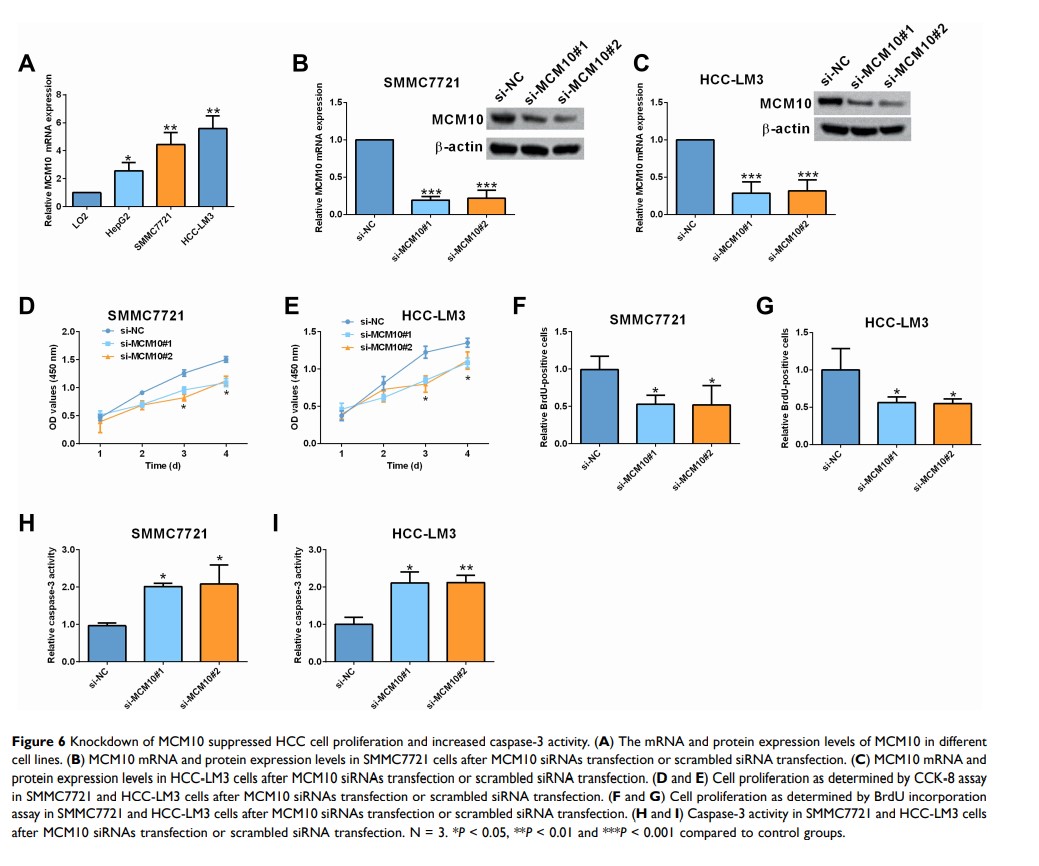
Results: A total of 2,334 DEGs were screened from GSE33294 dataset, including 1,120 up-regulated and 1,214 down-regulated genes. GO, KEGG and GSEA results showed that DEGs are significantly associated with the biological process of cell cycle, cell division and DNA replication. The Kaplan–Meier survival analysis results showed that the key genes from the minichromosome maintenance protein complex (MCM) family including MCM8, MCM10, MCM2, MCM3, MCM4, MCM6 and MCM7 were significantly correlated with the overall survival of the HCC patients. Further validation studies showed that MCM10 was significantly up-regulated in the HCC cell lines, and knockdown of MCM10 significantly suppressed cell proliferation as determined by the cell counting kit-8 and BrdU incorporation assays and increased the caspase-3 activity of HCC cells.
Conclusion: The comprehensive bioinformatics analysis identified several key genes that were associated with the prognosis of HCC patients. The validation study results indicated that MCM10 may be an important predictor for poorer prognosis of HCC patients and may act as an oncogene to promote HCC cell progression.
Keywords: hepatocellular carcinoma, GSE33294, bioinformatics, hub genes, MCM10, prognosis