115195
论文已发表
注册即可获取德孚的最新动态
IF 收录期刊
- 3.6 Breast Cancer (Dove Med Press)
- 4.3 Clin Epidemiol
- 2.6 Cancer Manag Res
- 3.2 Infect Drug Resist
- 4.1 Clin Interv Aging
- 6.1 Drug Des Dev Ther
- 4.1 Int J Chronic Obstr
- 8.7 Int J Nanomed
- 2.5 Int J Women's Health
- 3.2 Neuropsych Dis Treat
- 2.4 OncoTargets Ther
- 2.6 Patient Prefer Adher
- 2.6 Ther Clin Risk Manag
- 3.1 J Pain Res
- 3.5 Diabet Metab Synd Ob
- 4.5 Psychol Res Behav Ma
- 3.4 Nat Sci Sleep
- 2.4 Pharmgenomics Pers Med
- 2.6 Risk Manag Healthc Policy
- 4.6 J Inflamm Res
- 2.3 Int J Gen Med
- 3.9 J Hepatocell Carcinoma
- 3.3 J Asthma Allergy
- 2.5 Clin Cosmet Investig Dermatol
- 3.0 J Multidiscip Healthc

Cbl 原致癌基因 B(CBLB)c.197A>T 突变可诱导部分 I 型多发性对称性脂肪瘤病(MSL)患者的轻度代谢功能障碍
Authors Chen K, Wan X, Zhao L, Zhao S, Peng L, Yang W, Yuan J, Zhu L, Mo Z
Received 24 July 2020
Accepted for publication 11 September 2020
Published 6 October 2020 Volume 2020:13 Pages 3535—3549
DOI https://doi.org/10.2147/DMSO.S273780
Checked for plagiarism Yes
Review by Single anonymous peer review
Peer reviewer comments 2
Editor who approved publication: Professor Ming-Hui Zou
Background: Multiple symmetric lipomatosis (MSL) is a rare disease showing chronic progression of multiple, symmetrical, and non-encapsulated subcutaneous lipoma. The cause of the disease remains unknown.
Patients and Methods: This study reported and summarized 13 sporadic cases of Type I MSL patients in terms of histopathology and cellular and molecular biology and assessed the CBLB c.197A>T mutation in the IRS1-PI3K-Akt pathway.
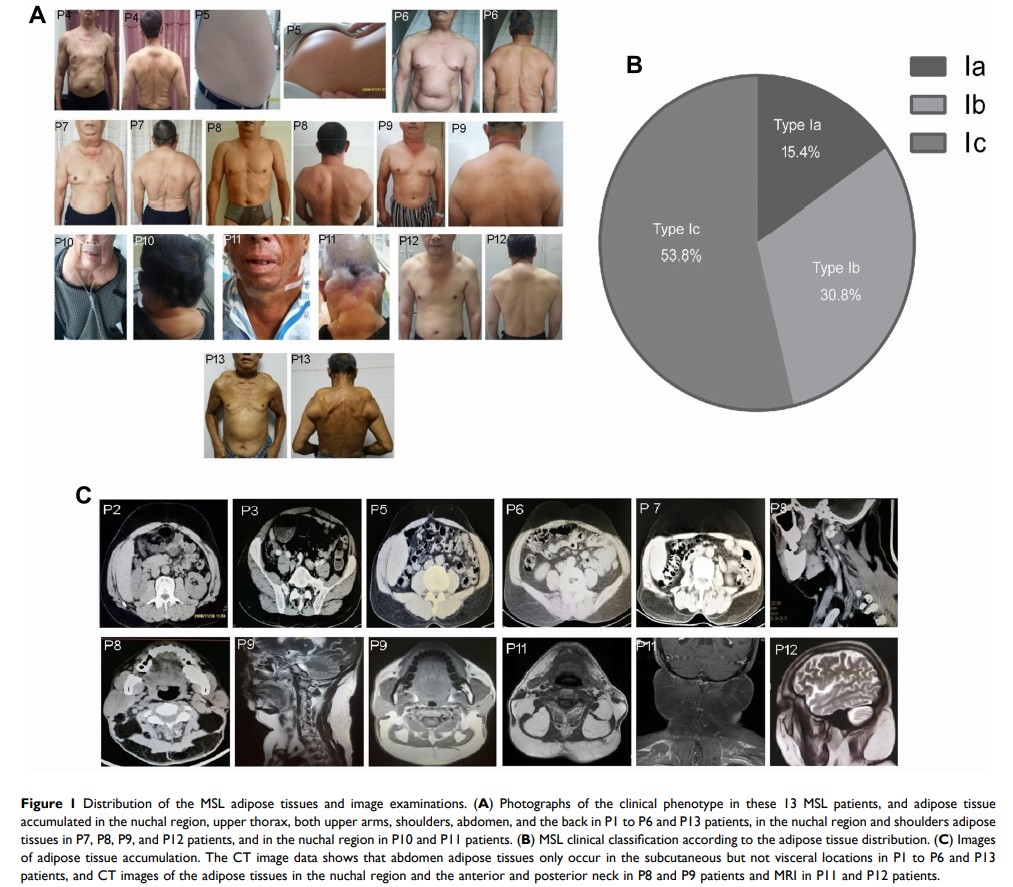
Results: The clinical data showed that these 13 Type I patients were all male with a mean age of 57.0 ± 6.6 years old and consumed alcohol heavily. The laboratory tests revealed that most of the patients had hyperuricemia, diabetes, hyperinsulinemia, or insulin resistance; however, their blood lipid levels were close to a normal range. The imaging data exhibited lipomas that only occurred subcutaneously but not viscerally, ie, Types Ia (15.4%), Ib (30.8%), and Ic (53.8%). The molecular analyses of adipocytes of isoprenaline stimulated human adipose tissue-derived mesenchymal stromal cells (hADSCs) isolated from the adipose tissue lipoma-like masses (ATLLM) demonstrated that these adipocytes did not express UCP-1. The Cbl proto-oncogene B (CBLB), an E3 ubiquitin-protein ligase, was associated with insulin resistance and obesity and was mutated (ie, CBLB c.197A>T) in four MSL patients after the whole genome and Sanger sequencing of the blood samples. Furthermore, the CBLB c.197A>T mutation induced hADSC resistance to insulin by inactivation of the IRS-1-PI3K-AKT pathway.
Conclusion: This study analyzed clinical, histopathological, and cellular and molecular biological characterizations of 13 Type I MSL patients and identified the CBLB c.197A>T heterozygous mutation that could be responsible for MSL metabolic dysfunction or even MSL development.
Keywords: multiple symmetric lipomatosis, MSL, manifestation, characterization, CBLB