115195
论文已发表
注册即可获取德孚的最新动态
IF 收录期刊
- 3.6 Breast Cancer (Dove Med Press)
- 4.3 Clin Epidemiol
- 2.6 Cancer Manag Res
- 3.2 Infect Drug Resist
- 4.1 Clin Interv Aging
- 6.1 Drug Des Dev Ther
- 4.1 Int J Chronic Obstr
- 8.7 Int J Nanomed
- 2.5 Int J Women's Health
- 3.2 Neuropsych Dis Treat
- 2.4 OncoTargets Ther
- 2.6 Patient Prefer Adher
- 2.6 Ther Clin Risk Manag
- 3.1 J Pain Res
- 3.5 Diabet Metab Synd Ob
- 4.5 Psychol Res Behav Ma
- 3.4 Nat Sci Sleep
- 2.4 Pharmgenomics Pers Med
- 2.6 Risk Manag Healthc Policy
- 4.6 J Inflamm Res
- 2.3 Int J Gen Med
- 3.9 J Hepatocell Carcinoma
- 3.3 J Asthma Allergy
- 2.5 Clin Cosmet Investig Dermatol
- 3.0 J Multidiscip Healthc

钙稳态的调节可能与糖尿病肾病大鼠的肾细胞癌易感性有关
Authors Luo Y, Lu Z, Waaga-Gasser AM, Yang H, Liu J, Wu J, Lu J, Liu X, Zhang L
Received 18 June 2020
Accepted for publication 16 August 2020
Published 7 October 2020 Volume 2020:12 Pages 9679—9689
DOI https://doi.org/10.2147/CMAR.S268402
Checked for plagiarism Yes
Review by Single anonymous peer review
Peer reviewer comments 2
Editor who approved publication: Dr Kenan Onel
Introduction: Clinical studies have indicated a relationship between diabetic nephropathy (DN) and the incidence and prevalence of renal cell carcinoma (RCC). However, the mechanism linking diabetic nephropathy and renal cell carcinoma has not yet to be identified.
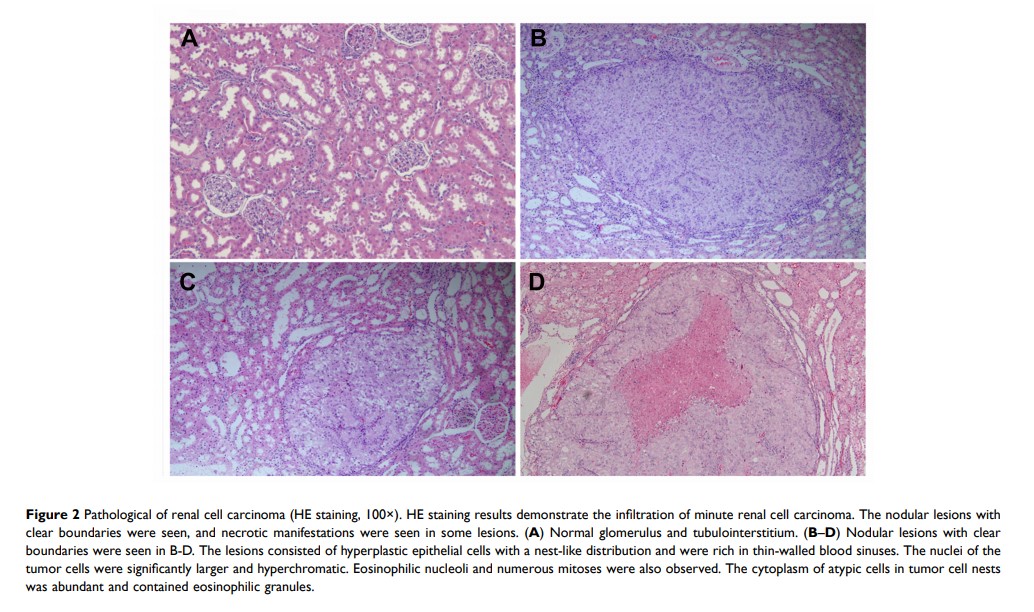
Methods: In this study, a total of 42 male Sprague Dawley (SD) rats were randomly assigned to a DN group (n=35) and a control group (n=7). All animals in the DN group were unilaterally nephrectomized and treated with streptozotocin with the development of blood glucose levels > 16.7mmol/L and dominant proteinuria and were compared to controls without such changes. Histopathologic alterations in the kidneys were examined by HE staining and Ki-67 immunohistochemistry. Differentially expressed genes were identified and validated by RNA-seq and PCR.
Results: As the results, except for two rats that failed to develop the DN model and were excluded from the analysis, 33 rats in the DN group with overt signs of DN demonstrated significantly higher food and water intake, urine production, and urine protein and urinary protein/creatinine ratio than controls. Overall, 15.2% (n=5/33) of DN animals developed RCC while none tumors were observed in the control group (n=0/7). RNA-seq analysis in these animals indicated different TRPV5 gene expression and calcium pathway expression in DN animals with developing tumors, when compared with animals with no obvious tumors. In addition, DN animals diagnosed with RCC showed increased expression of GLUT2 and c-met, when compared to controls and DN animals without tumors.
Discussion: In conclusion, the disordered calcium metabolism, especially disturbed TRPV5 mediated Ca2+ signal, may have been related to the development of RCC in DN rats. Further studies related to the detailed mechanism are still needed.
Keywords: diabetic nephropathy, renal cell carcinoma, calcium homeostasis, calcium pathway, RNA-Seq