115195
论文已发表
注册即可获取德孚的最新动态
IF 收录期刊
- 3.6 Breast Cancer (Dove Med Press)
- 4.3 Clin Epidemiol
- 2.6 Cancer Manag Res
- 3.2 Infect Drug Resist
- 4.1 Clin Interv Aging
- 6.1 Drug Des Dev Ther
- 4.1 Int J Chronic Obstr
- 8.7 Int J Nanomed
- 2.5 Int J Women's Health
- 3.2 Neuropsych Dis Treat
- 2.4 OncoTargets Ther
- 2.6 Patient Prefer Adher
- 2.6 Ther Clin Risk Manag
- 3.1 J Pain Res
- 3.5 Diabet Metab Synd Ob
- 4.5 Psychol Res Behav Ma
- 3.4 Nat Sci Sleep
- 2.4 Pharmgenomics Pers Med
- 2.6 Risk Manag Healthc Policy
- 4.6 J Inflamm Res
- 2.3 Int J Gen Med
- 3.9 J Hepatocell Carcinoma
- 3.3 J Asthma Allergy
- 2.5 Clin Cosmet Investig Dermatol
- 3.0 J Multidiscip Healthc

FoxM1 在骨肉瘤中上调和抑制 FoxM1 可以减少骨肉瘤细胞的增殖、迁移和侵袭
Authors Zhu X, Lu K, Cao L, Hu Y, Yin Y, Cai Y
Received 14 July 2020
Accepted for publication 22 September 2020
Published 9 October 2020 Volume 2020:12 Pages 9857—9867
DOI https://doi.org/10.2147/CMAR.S270825
Checked for plagiarism Yes
Review by Single anonymous peer review
Peer reviewer comments 3
Editor who approved publication: Dr Antonella D'Anneo
Background: Osteosarcoma (OS) is a highly aggressive bone malignancy that is mostly diagnosed in children and young adults. Increasing evidence indicates that the transcription factor Forkhead Box M1 (FoxM1) plays a key role in the pathogenesis of various tumors. However, the function of FoxM1 in OS has not been clearly elucidated.
Methods: In the present study, we first analyzed the expressions of FoxM1 in human OS and myositis ossificans (MO, included as a control) tissues by immunohistochemistry. To investigate the functional significance of FoxM1 in OS tumorigenesis, we examined the effects of FoxM1 downregulation in MG-63 and HOS-MNNG cells by either short hairpin RNA (shRNA)-mediated gene silencing or treatment with thiostrepton, a specific FoxM1 inhibitor.
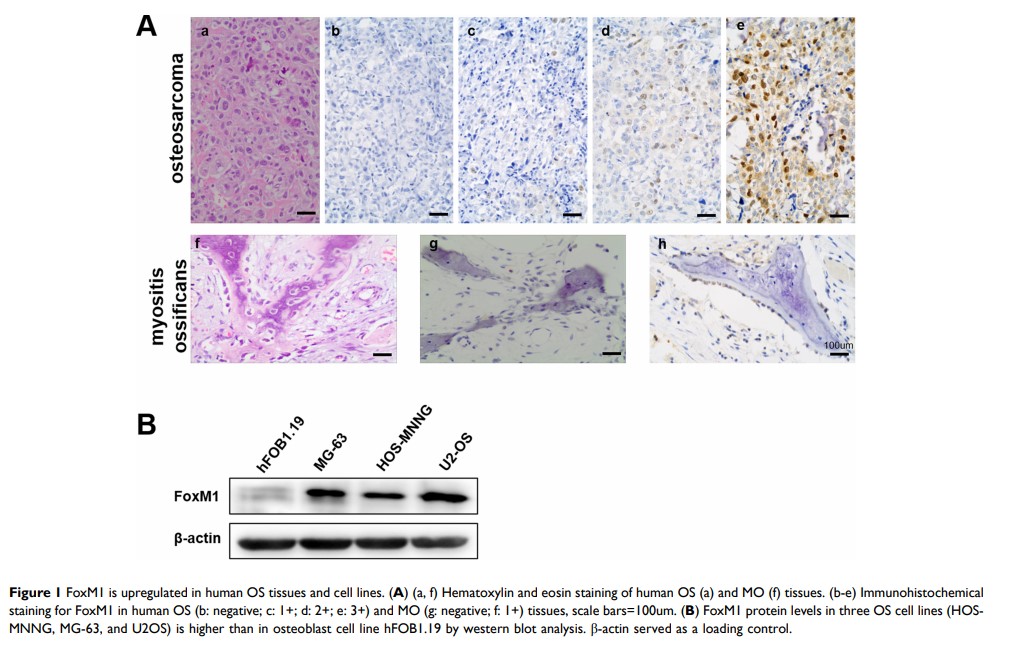
Results: FoxM1 was detected in 82.1% (55/67) of OS vs only 10% (2/20) of MO samples. High expressions of FoxM1 were also detected in three human OS cell lines (HOS-MNNG, MG-63, and U-2OS). FoxM1 downregulation significantly reduced MG-63 and HOS-MNNG cell proliferation, migration, and invasion as well as cell cycle arrest in the G2/M phase and increased apoptotic cell death.
Conclusion: The present study demonstrated the critical role of FoxM1 in the pathogenesis of OS. Therefore, FoxM1 may serve as a potential therapeutic target for the treatment of OS.
Keywords: osteosarcoma, FoxM1, thiostrepton, shRNA, tumorigenesis