115195
论文已发表
注册即可获取德孚的最新动态
IF 收录期刊
- 3.6 Breast Cancer (Dove Med Press)
- 4.3 Clin Epidemiol
- 2.6 Cancer Manag Res
- 3.2 Infect Drug Resist
- 4.1 Clin Interv Aging
- 6.1 Drug Des Dev Ther
- 4.1 Int J Chronic Obstr
- 8.7 Int J Nanomed
- 2.5 Int J Women's Health
- 3.2 Neuropsych Dis Treat
- 2.4 OncoTargets Ther
- 2.6 Patient Prefer Adher
- 2.6 Ther Clin Risk Manag
- 3.1 J Pain Res
- 3.5 Diabet Metab Synd Ob
- 4.5 Psychol Res Behav Ma
- 3.4 Nat Sci Sleep
- 2.4 Pharmgenomics Pers Med
- 2.6 Risk Manag Healthc Policy
- 4.6 J Inflamm Res
- 2.3 Int J Gen Med
- 3.9 J Hepatocell Carcinoma
- 3.3 J Asthma Allergy
- 2.5 Clin Cosmet Investig Dermatol
- 3.0 J Multidiscip Healthc

肝细胞癌妊娠区蛋白的预后意义及其与免疫浸润的关系
Received 24 June 2020
Accepted for publication 11 September 2020
Published 9 October 2020 Volume 2020:12 Pages 9883—9891
DOI https://doi.org/10.2147/CMAR.S269215
Checked for plagiarism Yes
Review by Single anonymous peer review
Peer reviewer comments 2
Editor who approved publication: Professor Harikrishna Nakshatri
Aim: Human pregnancy zone protein (PZP) is a pregnancy-related protein which is increased dramatically during pregnancy. However, the expression of PZP and its prognostic value, association with tumor-infiltrating immune cells (TIICs) in microenvironment and potential biological process in HCC were unclear.
Methods: The PZP expression, clinicopathology analysis and its influence on survival were analyzed by GEPIA and HPA. Fifty-nine HCC samples and 30 corresponding noncancerous tissues were collected and retrospectively analyzed to verify the results of bioinformatics analysis. Further, TIMER and CIBERSORT were performed to identify the significantly alerted biological process and affections of PZP expression on the immune system in patients with HCC. Finally, IHC assay of CD4+ T cells and Treg cells was performed to confirm the results of immune infiltrates analysis by TIMER and CIBERSORT.
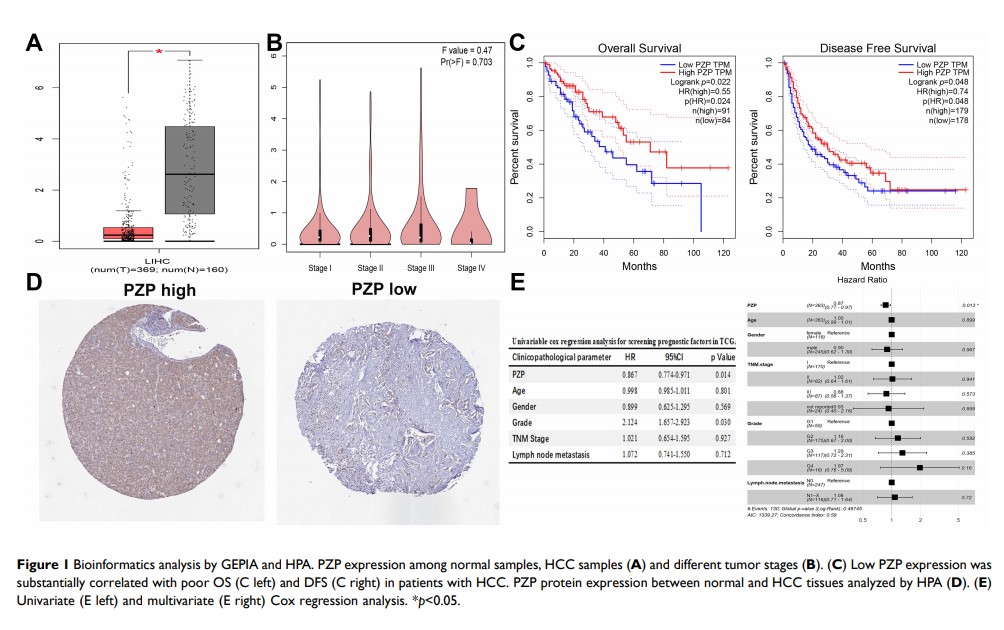
Results: PZP expression was downregulated in HCC tissues and its low level was substantially correlated with poor prognosis in patients with HCC. TIMER analysis showed that PZP expression had a positive correlation with the levels of macrophage and neutrophil. Furthermore, CIBERSORT analysis showed that resting memory CD4 T cells were increased in high PZP expression group, while the results of Tregs were the opposite. Finally, the IHC results of CD4+ T cells and Treg cells showed that only Tregs were negatively associated with PZP expression.
Conclusion: PZP was identified as a novel prognosis biomarker of HCC and might play a vital role in the regulation and recruitment of TIICs in HCC immune microenvironment.
Keywords: PZP, prognosis, TIICs